
LATAM + Africa Talent Surge
Executive Summary: The New Strategic Workforce Corridors
 For years, global hiring was narrated like a simple spreadsheet problem: “Where is talent cheaper?”
That framing is outdated—and frankly, it misses what’s happening in real companies right now.
The next wave of global hiring isn’t just moving to new regions because of cost. It’s moving because innovation is decentralizing, risk is rising, and resilience is becoming a board-level KPI. Two regions sit at the center of that shift:
Latin America and Africa.
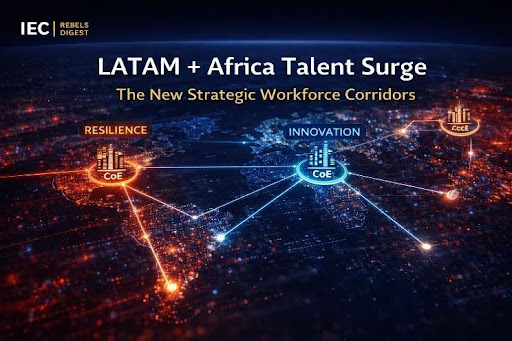
Not as “low-cost labor pools,” but as emerging strategic workforce corridors—where companies build product, ship software, operate customer support at scale, and establish regional Centers of Excellence (CoEs) that connect into global operating models.
The smart organizations aren’t asking: “Where is it cheaper?”
They’re asking: “Where can we build durable capability, faster than our competitors, with manageable risk?”
This is the LATAM + Africa talent surge—and it’s changing the global workforce map.
Why This Shift Is Happening Now
Three forces are converging:
1) The innovation map is moving
Innovation used to cluster in a few mega-hubs. Now it’s distributed.
Remote collaboration, cloud infrastructure, global open-source ecosystems, and borderless product teams have lowered the barrier for regions to become innovation producers, not just service destinations.
In the last few years, companies have started treating talent in LATAM and Africa as:
- engineering and product capability
- data, AI, and analytics capacity
- customer operations and revenue support
- compliance and documentation execution (especially in regulated industries)
This is capability building—not outsourcing.
2) Resilience has become the new growth strategy
The world is more unstable than the global expansion playbooks assumed.
Trade fragmentation, tariffs, sanctions, geopolitical conflict, and supply chain redesign have made “single-region dependence” a strategic risk.
That includes talent dependence.
Enterprises increasingly want workforce diversification across:
- time zones
- political/regulatory regimes
- infrastructure risk profiles
- talent supply conditions
- currency exposure
LATAM and Africa are being pulled into hiring strategies because they provide geographic and operational resilience, not just savings.
3) Talent crunch and specialization are driving “skill corridors”
AI, deep tech, cybersecurity, cloud, and complex B2B systems are intensifying the fight for specialized talent.
Companies are not only chasing cheaper developers. They are chasing available, scalable capability.
And in many markets, the bottleneck isn’t budget—it’s supply.
LATAM and Africa are emerging as corridors where companies can build teams faster, reduce hiring friction, and scale specialized roles through hubs and distributed models.
The Myth: “It’s Just Cost Arbitrage”
Let’s be blunt: companies still care about cost.
But cost is no longer the primary strategic driver. The smartest global workforce leaders frame LATAM and Africa around four deeper reasons:
1) Time-to-capability (speed wins)
In competitive markets, the company that builds capability first often wins.
LATAM and Africa enable faster hiring in many roles compared to saturated markets where talent is scarce and expensive.
2) Time zone strategy (operational continuity)
LATAM aligns well with North American time zones. Africa bridges Europe and global operations. Together they form a powerful operating coverage model—especially for support, DevOps, customer success, and finance ops.
3) CoE strategy (hubs, not scattered hiring)
Companies increasingly consolidate capability into regional hubs rather than hiring “a few people everywhere.”
LATAM and Africa are ideal for building CoEs:
- engineering pods
- customer operations hubs
- analytics centers
- security operations support
- implementation and technical support clusters
4) Resilience and risk diversification
The world is fragmenting. Workforce strategy is following.
Diversifying workforce corridors reduces overdependence on a single geography—especially in a world where regulatory and geopolitical shocks are no longer rare events.
LATAM: From Nearshore Talent Pool to Innovation Engine
LATAM’s evolution is striking. Many companies began with:
- customer support teams
- implementation roles
- back-office operations
Now they build:
- product engineering squads
- platform and cloud teams
- data and ML ops functions
- regional leadership and go-to-market teams
- CoEs for multi-country operations
Why LATAM works as a strategic corridor
- Time zone alignment with North America: real-time collaboration without “night shifts.”
- Growing depth in engineering and product: many markets have strong technical education pipelines and rapidly maturing ecosystems.
- Cultural proximity for US and European firms in many professional environments: strong collaboration for agile and product work.
- Nearshoring alignment: as operations shift toward regional hubs (especially US-adjacent supply chain and services), talent hiring follows.
The strategic play
The smart LATAM strategy is not “hire a few scattered engineers.” It’s:
- pick 1–2 hub countries (or cities)
- build critical mass
- scale with distributed satellites
- integrate into global HR stack and governance
- use EOR as the expansion layer first, then entity strategy where justified
Africa: From “Future Potential” to “Now Capacity”
Africa is increasingly misunderstood.
Too many narratives still treat it as an “emerging market someday” rather than a region already producing meaningful workforce scale—particularly in:
- software engineering
- customer support and operations
- fintech ecosystems
- data services and AI operations
- regional sales and partnerships
- compliance-related documentation and process work
Why Africa is rising now
- Young, expanding workforce: demographic momentum matters for long-term workforce planning.
- Rapid growth in tech ecosystems in multiple hubs: not one “Africa market,” but a network of nodes.
- European time-zone alignment for many regions: powerful for support and operations coverage.
- Innovation in constrained environments: strong problem-solving culture often produces high adaptability and resilience—valuable in fast-moving teams.
The strategic play
Africa’s opportunity is not one country. It’s a corridor strategy:
- select strong talent hubs
- build repeatable hiring infrastructure
- partner with capable EOR providers early
- implement compliance and onboarding/offboarding controls
- design for stable employee experience
- gradually transition to entities in the highest-volume markets if needed
Africa is not a “cheap labor play.” It’s a capacity and resilience play.
The CoE Shift: Why Corridors Beat Country-by-Country Hiring
Here’s the structural change many companies are making:
Instead of building a “small team in every country,” they consolidate into CoEs.
CoEs offer:
- deeper expertise concentration
- better management leverage
- standardized processes
- more consistent employee experience
- easier governance and reporting
- reduced compliance sprawl
LATAM and Africa are ideal regions to build CoEs because they allow capability scaling without the overhead of a large entity footprint everywhere.
The new global model
- Hubs (CoEs) in strategic corridor locations
- Satellites for go-to-market, client proximity, or language coverage
- Remote mesh for specialists in high-demand roles
This model drives demand for EOR as a “CoE expansion layer.”
The Infrastructure Reality: Hiring Corridors Requires More Than Talent
Here’s where many companies stumble.
They hire great people in LATAM or Africa… and then operations break.
Because corridor hiring requires infrastructure:
1) Compliance and licensing depth
This is not optional. Misclassification, local employment law, and offboarding complexity can create expensive risk.
Companies need:
- compliant employment frameworks
- country-specific onboarding and offboarding
- documented processes and escalation paths
- evidence trails for audits
- licensing coverage where required
2) Integration into the HR stack
If corridor teams sit in separate systems, governance collapses.
You need:
- HRIS/HCM integration
- finance and cost allocation alignment
- document and audit trail governance
- standardized lifecycle workflows
- reporting that shows the full global workforce picture
3) Employee experience consistency
If corridor hires feel like “second-class employees,” retention will punish you.
Successful corridor strategies invest in:
- clear benefits handling
- strong support workflows
- transparent policy access
- reliable onboarding communication
- localized compliance with unified experience
4) Remote work policies and risk controls
Hiring “anywhere” creates hidden risk:
- permanent establishment exposure
- tax and payroll triggers
- cross-border data access issues
- security and access governance problems
Corridor strategies need “approved zones,” not chaos.
The New Competitive Battlefield: Specialized Talent and Resilience Hiring
The talent surge in LATAM and Africa is accelerating because companies are chasing:
- AI and data capability
- cybersecurity capacity
- cloud and platform engineering
- implementation and customer success
- financial ops and compliance execution
This is not low-skill outsourcing. It’s core business capability.
And the companies that treat these corridors strategically—building hubs, governance, compliance infrastructure, and integration—will create a durable advantage.
What This Means for EOR Demand
This corridor shift is one of the biggest demand drivers for the EOR market.
Because companies want:
- speed without entity setup
- compliant hiring across multiple jurisdictions
- scalability for CoE buildouts
- workforce diversification without structural lock-in
- a bridge between pilot hiring and long-term entity strategy
But here’s the twist:
As corridor strategies mature, buyers stop caring about “180 countries coverage” as a headline.
They start caring about:
- which regions you’re truly strong in
- how you govern partners
- how deep your compliance execution is
- whether licensing is covered where needed
- how well you integrate into the HR stack
- how consistent CX and EX are across corridors
In other words, corridor hiring forces a more mature EOR evaluation model.
The Rebel Take: Corridors Are the New Map
LATAM and Africa are no longer “alternative hiring regions.”
They are becoming central to global workforce design.
Not because they are cheaper—but because they unlock:
- speed
- capability
- resilience
- innovation capacity
- time zone coverage
- workforce diversification
The organizations that win in the next five years won’t be those who hire globally for cost.
They’ll be those who build strategic corridors—CoEs with distributed execution—supported by real compliance infrastructure and integrated workforce governance.
That’s the talent surge.
And it’s already rewriting the global map.
Next Step: Benchmarking Global Players and Regional Champions
If you’re an EOR provider—or an enterprise buyer navigating this corridor shift—understanding who is truly strong globally and regionally matters more than ever.
That’s why the IEC Global EOR Study 2026 (IEC Dynamic Map™) will not only identify the best global players, but also highlight Regional Champions—the providers that deliver exceptional depth and execution in specific corridors and geographies.102
Want to build trust through independent validation?
If you want to learn more about IEC Audit & Certification—and how independent audits can strengthen compliance maturity, procurement confidence, and continuous improvement—reach out to: pm@theiecgroup.com
Free participation: EOR Study 2026
Provider participation is free of charge for qualified companies. If you want to ensure your offering is correctly positioned and represented in the market, contact:
pm@theiecgroup.com See you in the study. —The IEC Rebels Digest Team
Why This Matters for the IEC Global EOR Study 2026
 This is not just a market commentary. It’s the exact reason the IEC Global EOR Study 2026 is structured the way it is.
The study will assess providers across eight evaluation categories that reflect the compliance stack reality:
- Global Reach & Legal Infrastructure
- Compliance & Licensing Depth
- Tech Stack & Platform Maturity
- AI & Process Automation
- Client Experience (CX)
- Employee Experience (EX)
- Integration & API Coverage
- Innovation & Market Differentiation
And yes—there will be visibility into who ranks strongest across these categories, alongside insights into rising disruptors and the strategic direction of the market.
Because in 2026, “EOR provider” is not a uniform label. The gap between providers is widening—and the winners will be those who can prove compliance as infrastructure, not claim it as a feature.
A Final Reality Check
Global workforce management is no longer just about hiring talent abroad. It’s about building a defensible employment operating model across legal regimes—and doing it with speed, transparency, and integration.
That is a regulated product challenge.
And that’s why the EOR market is heading toward a compliance-led shakeout.
The platforms that win won’t simply help companies hire globally. They will help companies stand up to scrutiny globally.
About the IEC Rebel’s Digest
We write for the ones breaking molds, building cross-border teams, and reshaping global work. No buzzwords. Just truths, tools, and tactics for the new era of employment.
IEC Rebel’s Digest— The IEC Group can help you audit your global employment setup by identifying labor leasing risks, verifying licensing requirements, and ensuring your EOR partners meet every compliance standard—before regulators come knocking.
Last but not Least: If you’re facing challenges and wondering how others are managing similar issues, why not join The Leadership Collective Community? It’s a peer group and webcast platform designed for leaders to exchange insights and experiences.
Introducing the IEC Knowledge Network Free Membership – Your Gateway to Seamless Access!
We are thrilled to present a new service that goes beyond the ordinary download experience. In addition to offering you the ability to download the things you love, we are delighted to introduce the IEC Knowledge Network Free Membership.
The Free Membership option grants you access to our library of articles and videos, without the need for tedious registrations for each piece of content.
The publication serves as a trusted resource to support executives in their pursuit of sustainable and successful global expansion. In addition the IEC Practitioners are available to discuss your specific challenge in more detail and to give you clear advise..
Take advantage of this valuable resource to accelerate your global expansion journey

