The IEC Rebel’s Digest
Introduction to
The IEC Rebel’s Digest Global Insights
Introducing “The IEC Rebel’s Digest – Global Insights”: A bold addition to our publications, alongside IEC Executive Directions.
This monthly newsletter delivers in-depth perspectives through weekly articles. Unafraid to challenge norms, “The IEC Rebel’s Digest” provides distinctive, potentially controversial viewpoints on current affairs. It caters to those seeking opinions, not just mainstream information.
Covering diverse global expansion topics, it’s a vital resource for executives navigating international business complexities. Each issue delves deep, offering expert analysis, best practices, and actionable guidance.
With insights from IEC Practitioners, who’ve guided global success, it’s your compass for elevated expansion strategies, HR management, employer of record services, and growth maximization.
Article 131
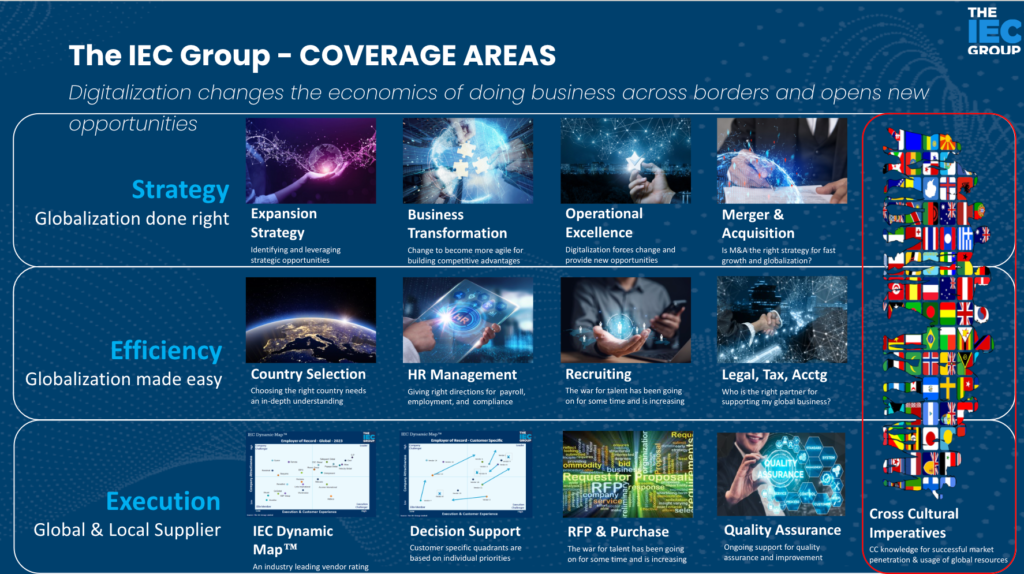
Can the Payroll Challengers Break into the Elite 25?
Deel, Rippling, Papaya Global, Remote, Multiplier and other newer payroll players entered the market from very different starting points than the traditional giants.
Their advantage is clear: cleaner architectures, faster product cycles, unified data models and fewer legacy constraints.
But payroll is not ordinary enterprise software.
Modern technology does not automatically create regulatory depth, enterprise resilience or trust at scale.
That is the challenge behind Payroll 2027: From Payroll Processing to Workforce Intelligence.
Article 129
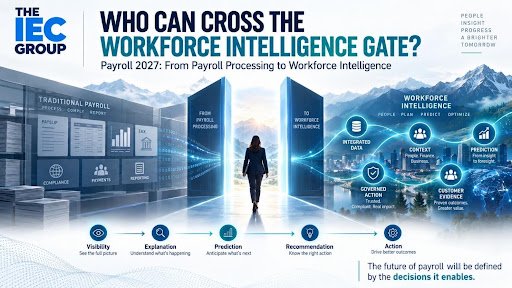
Who Can Cross the Workforce Intelligence Gate?
The next competitive question is whether payroll can become a source of enterprise intelligence.
Can a platform detect something before the payroll team sees it? Explain why it happened? Predict what comes next? Connect payroll with workforce, finance, payments and compliance data? Recommend the right action—and support governed execution?
Article 128
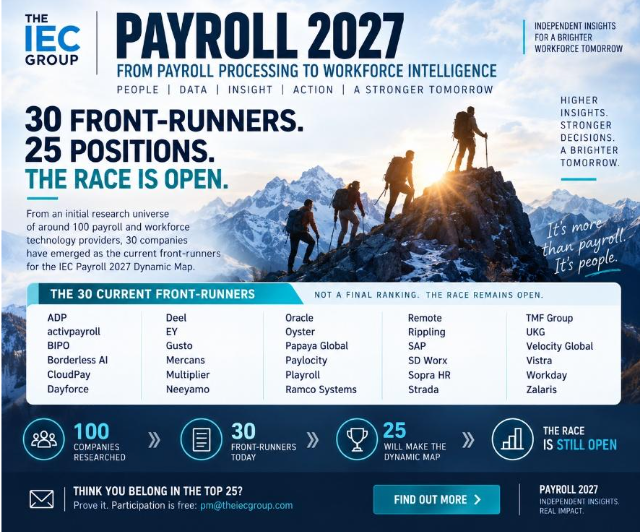
Payroll 2027: 30 Front-Runners. 25 Positions. The Race Is Open.
Last week, IEC argued that payroll leadership is being redefined: scale still matters, but scale is not intelligence.
This week, we put names behind that thesis.
From an initial research universe of around 100 payroll and workforce technology providers, 30 companies have emerged as the current front-runners for just 25 positions on the IEC Payroll 2027 Dynamic Map:
ADP, activpayroll, BIPO, Borderless AI, CloudPay, Dayforce, Deel, EY, Gusto, Mercans, Multiplier, Neeyamo, Oracle, Oyster, Papaya Global, Paylocity, Playroll, Ramco Systems, Remote, Rippling, SAP, SD Worx, Sopra HR, Strada, TMF Group, UKG, Velocity Global, Vistra, Workday and Zalaris.
But nobody has qualified yet.
Article 126
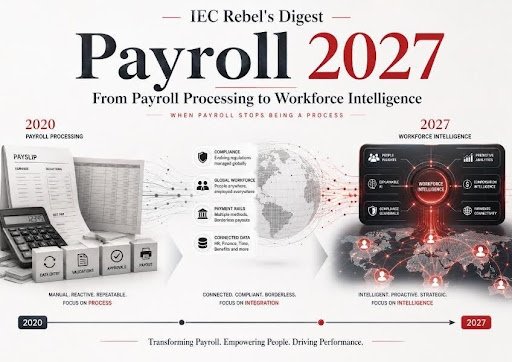
Payroll 2027: When Payroll Stops Being a Process
Payroll is no longer just about calculating salaries accurately and on time.
Since 2020, the foundations of traditional payroll have changed. Workforces have become distributed, employment models more fragmented, regulations more demanding, and payment expectations faster. Employees may work in one country, live in another, report elsewhere, and be paid through yet another entity.
The result is a fundamental shift: payroll is moving from a downstream administrative function to the center of workforce operations.
Payroll 2027 must therefore deliver more than processing. It must provide continuous visibility, explainable outcomes, compliance evidence, integrated payments, and intelligence across employees, contractors, EOR workers, jurisdictions, and systems.
Article 125
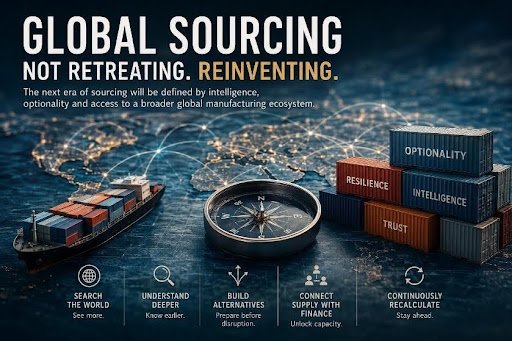
Global Sourcing Is Not Retreating — It Is Being Reinvented
For years, the debate has been framed as globalization vs. reshoring.
We believe that is the wrong debate.
Global sourcing is not disappearing. It is becoming more fragmented, more regional, more politically exposed — and far more complex to manage.
The traditional model optimized primarily for cost, scale and efficiency. The emerging model has to balance cost, capability, resilience, risk, compliance, availability and strategic dependency at the same time.
That changes sourcing fundamentally.
Article 124
The Next Strategic Battleground in Global Work
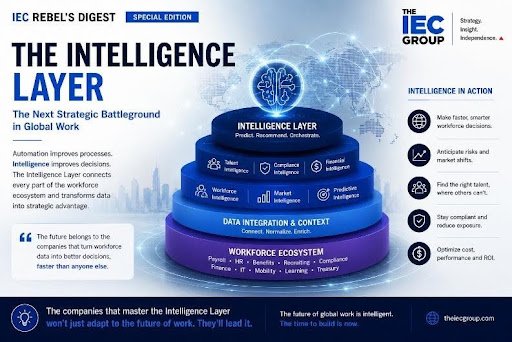
The Next Competitive Battleground Isn’t AI. It’s the Intelligence Layer.
Almost every Payroll, EOR and HR technology provider now talks about AI. Copilots, chatbots and automation have quickly become table stakes.
But after dozens of executive briefings with the world’s leading global workforce providers, one question continues to stand out:
Who is actually building intelligence—not just AI?
Automating a payroll process or generating a compliant employment contract is valuable, but it doesn’t answer the strategic questions executives face every day:
- Where should we build our next engineering hub?
- Where can we find scarce talent?
- Which markets offer the best balance of cost, compliance and growth?
- How do we anticipate workforce risks before they become business risks
Article 123
Beyond Payroll, Beyond EOR: The Race to Build the Operating System for Global Work
Global employment is entering its third major evolution. The first wave digitized payroll. The second, Employer of Record, tore down the legal and compliance walls that kept companies from hiring across borders. The third — now underway — is about convergence: payroll, EOR, payments, treasury, compliance, talent intelligence and AI collapsing into a single, intelligent operating system for the entire workforce lifecycle.
This shift isn’t speculative. It’s driven by real pressure points already facing every talent and HR leader: persistent global skill shortages, the acceleration of AI across every function, rising worker expectations, and the operational need for real-time visibility into a distributed workforce.
Article 122
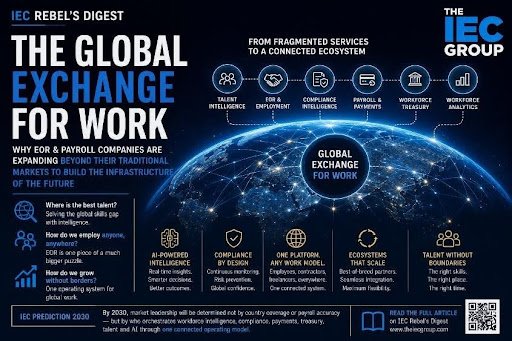
Beyond Payroll. Beyond EOR. The Global Exchange for Work
For years, we’ve viewed Payroll, Employer of Record (EOR), Compliance, Recruiting, Payments, and Workforce Management as separate markets.
We believe that’s changing—and much faster than many realize.
At a recent analyst briefing in London, Multiplier introduced an ambitious vision called the “Global Exchange for Work.” While the name itself may or may not become the industry’s future terminology, it highlights a much larger transformation that is already underway.
The real question is no longer: Who has the best payroll platform?
Or even: Who has the best EOR solution?
The question is becoming: Who will build the operating system for global work?
Article 121
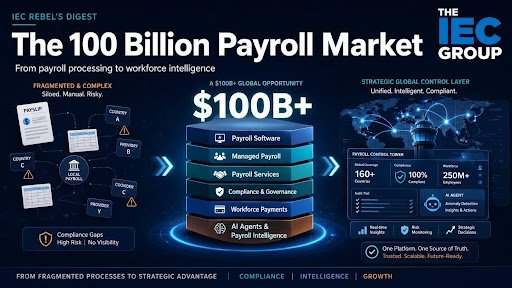
The 100 Billion Payroll Market
Payroll is no longer a back-office transaction. It is becoming one of the most important control layers for workforce cost, compliance, employee trust and AI-enabled enterprise operations.
Depending on definition, payroll is already an USD 8–10 billion software market, a USD 70 billion-plus payroll services market, and a broader USD 100 billion-plus opportunity when connected with compliance, workforce payments, HR operations, time, benefits, analytics and AI agents.
The real growth will not come from simply processing payroll faster. It will come from transforming fragmented payroll landscapes into governed payroll intelligence: global visibility, local compliance expertise, clean data, auditability, anomaly detection, AI-assisted workflows and stronger employee experience.

Article 120
From Cheap Sourcing to Trusted Sourcing: The CxO Challenge of Geopolitical Trade
Global sourcing used to be built around one dominant idea: cheaper is better.
But geopolitical turbulence is changing the rules. Tariffs, sanctions, disrupted trade routes, payment delays, FX volatility and supplier liquidity risks are turning sourcing into a board-level challenge. The question is no longer only where companies can buy at the lowest cost. The real question is where they can source reliably, pay securely, finance intelligently and remain compliant under pressure.
This shift moves global sourcing beyond procurement. It now connects the CEO’s resilience agenda, the CFO’s working-capital strategy, the COO’s continuity risk, the CPO’s supplier network, and the CIO’s data and automation roadmap.
Article 119
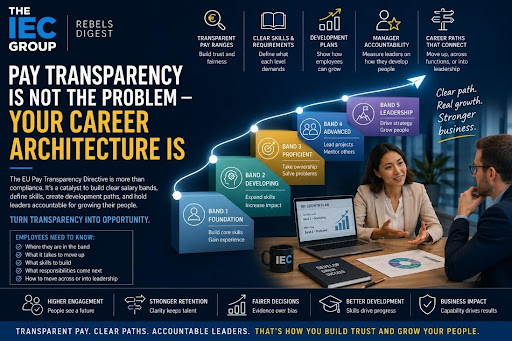
Pay Transparency Is Not the Problem — Your Career Architecture Is
Pay transparency is often seen as a compliance burden. But for HR leaders, it may be one of the biggest opportunities in years.
The EU Pay Transparency Directive will force companies to explain how pay decisions are made. But salary ranges alone will not build trust. Employees also need to understand what skills, responsibilities, performance levels, and behaviours justify movement within a band — and what it takes to move to the next one.
This is where pay transparency becomes a people-development strategy.

Article 118
Pay Transparency Is Coming: Why HR Can’t Wait Until 2026
The EU Pay Transparency Directive is not a minor HR policy update. It is a structural compliance challenge that forces companies to prove that pay decisions are fair, objective, documented, and defensible. The 7 June 2026 transposition deadline has passed, but the real work for HR organizations is only accelerating as national implementation, enforcement expectations, and employee rights become clearer country by country.
The hard work starts now: mapping which employees and applicants are in scope, reviewing job architecture, preparing salary ranges, removing pay-history questions, improving pay data, defining comparator groups, and creating processes for employee information requests and remediation.
Article 117
Pay Transparency Meets EOR: Europe’s Next Compliance Trapdoor
The EU Pay Transparency Directive is not just another HR regulation. It could fundamentally change how companies hire through Employer of Record providers in Europe.
By 7 June 2026, EU Member States must transpose the Directive into national law. The impact will be immediate: salary ranges before hiring, no pay-history questions, stronger equal-pay evidence, employee information rights, and new reporting obligations.

Latest
IEC Rebel’s Digest May 2026

Article 116
Workforce Europe: The Illusion of “One Market, One Rulebook”
Europe is often treated as one workforce market. In reality, it is a complex patchwork of national employment laws, contractor rules, payroll obligations, social security systems, collective bargaining requirements, and termination procedures.
The latest IEC Rebel’s Digest examines why workforce compliance in Europe is becoming a board-level issue — not just an HR or payroll concern. The article looks at employees, contractors, and freelancers across key markets including Germany, France, Spain, Italy, the Netherlands, and the UK.
Article 115
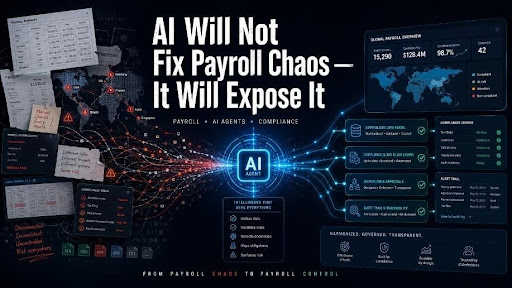
AI Will Not Fix Payroll Chaos — It Will Expose It
Payroll is no longer just a back-office process. It is becoming a strategic control layer for global workforce risk, compliance, data quality and employee trust.
Global enterprises are still struggling with fragmented payroll landscapes: multiple vendors, local systems, shadow spreadsheets, inconsistent data and country-specific compliance rules. At the same time, market expectations are changing fast. Pay transparency, AI regulation, remote work, real-time reporting and employee demand for clearer answers are pushing payroll into the spotlight.
AI and AI agents will accelerate this shift, but they will not fix broken foundations. If payroll data, processes and controls are weak, AI will simply automate the chaos.
Article 114
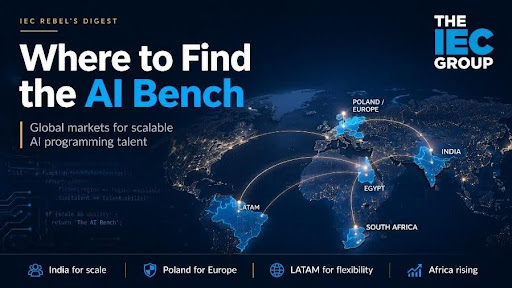
Where to Find the AI Bench
Where should companies actually look for the AI bench — the programmers, ML engineers, data engineers, and AI implementation specialists who turn strategy into execution?
That is the follow-on question to The Global Talent Hunt. And the answer is clear: there is no single “best country” for AI bench talent. The smarter strategy is to build a global portfolio of markets based on role type, cost, quality, scale, and deployability.
Article 113
The Pay Transparency Shockwave
The EU Pay Transparency Directive, due to be transposed into national law by 7 June 2026, will fundamentally change how companies manage compensation, hiring and workforce governance.
Its impact goes far beyond publishing salary ranges: employers will need to justify pay decisions through objective, gender-neutral criteria, provide applicants with pay information, stop asking for salary history, and prepare for gender pay gap reporting.
Latest
IEC Rebel’s Digest April 2026
Article 112
The EOR Study 2026 - From Hiring Hack to Global Infrastructure
The IEC Global EOR Study 2026 shows a market that is no longer a niche hiring workaround, but an increasingly important layer of global workforce infrastructure. IEC has raised its outlook for the Employer of Record market to $16.7 billion by 2030, with a 20%+ CAGR, reflecting stronger-than-expected 2025 performance, rising enterprise demand, and broader use cases beyond traditional cross-border hiring.
The regional picture is also shifting. North America remains the largest EOR deployment region at 34%, but APAC has become the strongest growth engine at 29%, followed by EMEA (21%), LATAM (11%), and Africa (5%), which is now emerging as its own distinct growth zone.
Article 111
Why valuation, acquisitions, and platform sprawl are redrawing the global employment market
The global EOR market is no longer just a hiring workaround. It is becoming a core layer of global workforce infrastructure.
What is driving the shift? Scale, valuation, and aggressive M&A. The leading players are no longer competing only on country coverage or onboarding speed.
They are expanding into payroll, compliance, contractor management, payments, IT services, and broader HR platform capabilities. In short: the market is moving from standalone EOR solutions toward integrated global workforce platforms.

Article 110
The New Global Talent Hunt
The recruiting industry has not disappeared — it has split. If a company needs an AI Architect, a senior product team, and a flexible bench of specialists, this is no longer a simple recruiting exercise. It is a global talent access challenge.
The old model of posting jobs and waiting for applicants breaks down when skills are hard to define, the best candidates are passive, and the right talent is spread across multiple countries and labor models. In this environment, no single provider solves the whole problem.
Article 109
The Last 10% of Hiring Creates 50% of the Pain
Most companies are still using one hiring machine for two completely different problems. That is the mistake.
Ordinary local hires can often be solved through a career site, job boards, referrals, and strong local recruiters. But scarce, strategic hires — AI architects, niche compliance specialists, transformation leaders, cross-border operators — do not behave like normal vacancies.
Article 107
EOR: Certified Safe, Legally Exposed
Many providers claim that certifications such as ISO 27001:2022, Cyber Essentials, and GDPR compliance prove they are fully compliant.
These standards are valuable and often necessary, but they primarily address information security, cyber hygiene, and data protection. They do not prove that an EOR can lawfully and operationally employ workers across multiple jurisdictions.

Latest
IEC Rebel’s Digest March 2026
Article 106
That Actually Moves the Needle: What the Three IEC Dynamic Map™ Studies Reveal About Talent, Workforce Operations, and Employee Experience in 2026
After years of AI hype, HR and workforce leaders are finally asking the only question that matters: where is AI producing real business value?
The three 2026 IEC Dynamic Map™ studies offer one of the clearest answers yet. Across AI in Talent Intelligence & Development, AI in Workforce Operations & Pay, and AI in Employee Experience & People Insights, the market is no longer defined by generic claims about copilots, assistants, or automation. It is being defined by where vendors are delivering meaningful workforce intelligence impact and where they are proving enterprise-grade readiness.
Article 105
Bots, Buzz & Benchmarks: AI Leaders in EX & People Insights
Employee Experience has grown up. It’s no longer a once-a-year engagement survey and a slide deck—it’s chatbots answering questions in seconds, listening engines reading the “buzz” across tools and tickets, and people analytics teams stress-testing headcount and skills like a CFO models cashflow.
In our AI in Employee Experience & People Insights – 2026 study, we looked at 20 platforms that are redefining how companies listen, learn, and act. Some embed EX into suites from Microsoft, Workday, SAP, Oracle and ServiceNow. Others specialize in continuous listening, conversational EX assistants, or deep-dive people analytics and planning.
Latest
IEC Rebel’s Digest February 2026
Article 104
From Chaos to Coverage: AI-Orchestrated Payroll & Compliance
Workforce Operations & Pay used to be back-office plumbing. Today it’s a strategic control room where labor cost, service quality, and regulatory risk collide.
Our second AI in HR & WFM study, “AI in Workforce Operations & Pay – 2026,” shows how AI is transforming three critical domains: Scheduling & Time Management, Payroll & Compliance, and Total Workforce Orchestration across employees, contractors, and EOR models.
Article 103
Beyond the Hype: 20 AI Leaders Rewiring Recruiting, Mobility & L&D
AI in Talent Intelligence & Development is where HR’s AI story gets real. Our first AI in HR & WFM Study – “AI in Talent Intelligence & Development 2026” examines how AI is already reshaping recruiting, skills intelligence, internal mobility, and L&D personalization – and which vendors are actually delivering impact, not just demos.
Article 102
LATAM + Africa Talent Surge
LATAM and Africa are no longer “low-cost hiring options.” They’re becoming strategic workforce corridors—where companies build real capability, resilience, and innovation capacity.
In our latest IEC Rebels Digest article — “LATAM + Africa Talent Surge: The New Strategic Workforce Corridors” — we explain why the next wave of global hiring is shifting from cost arbitrage to speed-to-capability and risk-smart expansion. As trade fragmentation, supply chain redesign, and ongoing talent shortages reshape operating models, companies are consolidating work into Centers of Excellence (CoEs) and scaling distributed teams faster than entity setup can keep up.
Article 101
From Local Offices to CoEs
The “open a local office in every market” playbook is breaking.
Global expansion is being rebuilt around Centers of Excellence (CoEs)—strategic hubs for engineering, finance ops, compliance, customer success, and more—supported by distributed satellite teams and a remote talent mesh. The result is a new geography of work: not countries, but nodes.

Latest
IEC Rebel’s Digest January 2026

Article 100
The Global Trade Reality Check
Global hiring used to be a straightforward globalization play: optimize cost, hire anywhere, expand fast. That world is gone.
Tariffs are back. Sanctions are structural. Export controls are tightening. And the global economy is reorganizing into fragmented globalization—trade blocs, nearshoring, data localization, and higher scrutiny on cross-border operations. The result: workforce strategy is no longer just an HR topic. It’s now tied to supply chain redesign, geopolitics, and risk management.
In our latest IEC Rebels Digest piece — “The Global Trade Reality Check: How Tariffs, Fragmentation, and Sanctions Are Reshaping Hiring” — we break down the new chain reaction:
Trade wars → supply chain redesign → Centers of Excellence (CoEs) → nearshoring → talent shifts → new entity strategy → rising EOR demand.
Article 99
AI Won’t Save You From Labor Law
AI is racing into global workforce management—onboarding automation, risk scoring, case triage, “compliance checks” at scale. And yes, it can make HR faster.
But here’s the uncomfortable truth: AI won’t save you from labor law.
If automation turns compliance into a black box, it doesn’t reduce risk—it multiplies liability.
In our next IEC Rebels Digest piece, “AI Won’t Save You From Labor Law: The New Rules for Automated Workforce Decisions,” we break down what responsible AI in EOR and global workforce operations actually requires
Article 98
APIs, Licenses, Audit Trails: What Global Workforce Compliance Really Looks Like
Global Workforce Management isn’t an ops topic anymore — it’s becoming a regulated product category.
In 2026, the winners in EOR and global employment won’t be the loudest platforms or the fastest onboarding promises. They’ll be the providers (and employers) who can prove they run a real compliance stack: legal infrastructure, licensing depth, country-specific execution, auditable controls, and integrations that keep HR data consistent across systems.
That’s the core argument in our new IEC Rebels Digest article: “The Compliance Stack — Why Global Workforce Management Is Now a Regulated Product.” It breaks down why compliance has shifted from “a module” to the operating system of global employment — and why AI and automation won’t replace compliance, but will reshape how it’s delivered (with guardrails, accountability, and evidence).
Article 97
The EOR Study 2026 Has Officially Launched!
Global employment is evolving—make sure you’re part of the narrative.
The IEC Rebels Digest EOR Study 2026 is now live, kicking off one of the most comprehensive evaluations of the global Employer of Record (EOR) market to date. This year’s edition will deliver critical insights into how the market is shifting—from compliance infrastructure to full-stack HR integration—and which providers are leading the way.
The study will evaluate participants across 8 key categories:
✅ Global Reach & Legal Infrastructure
✅ Compliance & Licensing Depth
✅ Tech Stack & Platform Maturity
✅ AI & Process Automation
✅ Client Experience (CX)
✅ Employee Experience (EX)
✅ Integration & API Coverage
✅ Innovation & Market Differentiation
We will highlight top-ranked providers in each category and uncover insights into the strategic direction of the EOR market, including the rise of disruptors, new entrants, and the role of AI and automation in global workforce management.
Latest
IEC Rebel’s Digest December 2025

Article 96
IEC Rebel’s Digest Xmas Special — 2025 Wrap + 2026 Preview (with a geopolitics reality check)
2025 was the year the market stopped applauding AI demos—and started demanding receipts. In HR, WFM, payroll, and global employment, “AI-powered” became a baseline claim, while trust infrastructure (governance, explainability, audit trails, exception handling) became the real differentiator. EOR matured fast too: buyers shifted from “speed to hire globally” toward global employment integrity—proof you can operate compliantly at scale, not just promise it.
But 2025 also delivered a second force that will dominate 2026: geopolitics is back as a board-level operating constraint. U.S. politics, tariffs, and trade friction are pushing companies to rethink supply chains, market access, partnerships, and cross-border workforce strategies. “Global” is being redesigned into controllable regions, with resilience and exit readiness built into the operating model.
Article 95
From Dashboard Theater to Decisions that Actually Move the Needle
AI in Workforce Analytics & Planning is where AI stops doing dashboard theater and starts shaping real decisions. This IEC Rebel’s Digest edition explores how AI connects HR, Finance, and Operations around one living view of capacity, skills, cost, and risk—shifting planning from annual rituals to rolling, scenario-based decisions.
We look at how leading organizations use AI to stitch together HRIS, payroll, T&A, engagement, and productivity data; forecast demand and attrition; and simulate “what if” moves before they hit people and P&L.

Article 94
Employee Experience & Virtual Assistants
AI in Employee Experience is where generative AI stops being an internal experiment and becomes the way employees experience HR, IT and work itself. In Study #3 of the IEC AI in HR & WFM Study 2026 – AI in Employee Experience & People Insights, we zoom in on the category Employee Experience & Virtual Assistants: the conversational layer that sits in Teams, Slack, mobile and portals and is supposed to be the single front door for help, answers and action.
The study looks beyond pretty chat windows. We assess how providers and customers actually perform across CMMI-style maturity levels 1–5 – from basic FAQ bots to assistants that can orchestrate end-to-end journeys, personalize responses, surface People Insights, and still stay explainable, grounded in policy, and compliant.
Article 93
You can’t “AI” your way out of a broken workforce stack.
The article introduces a 5-level AI maturity model from ad-hoc bots and siloed tools to fully orchestrated, continuously learning workforce operations with strong guardrails for compliance, ethics, and pay equity.
This piece is part of the IEC AI in HR & Workforce Management Study and feeds into our IEC Dynamic Map (Quadrant) for AI in Workforce Operations & Pay.
Article 92
Payroll is where AI either delivers—or breaks trust.
This article dives into as the most unforgiving corner of AI in Workforce Operations & Pay. We explore how AI is already transforming the full chain: scanning regulatory changes across countries, translating them into actionable rules, catching anomalies before payroll closes, reconciling messy data feeds, and generating audit-ready evidence instead of last-minute panic packs.
You’ll see where AI genuinely adds value today: pre-payroll validation, error and fraud detection, continuous controls, and copilots that explain payslips and deductions in plain language while still keeping humans firmly in charge. We also unpack the dark side: hallucinated “legal” answers, privacy and cross-border data risk, biased anomaly flags, and the dangerous illusion that “the system” is now accountable instead of the employer.
Latest
IEC Rebel’s Digest November 2025
Article 92
Payroll is where AI either delivers—or breaks trust.
This article dives into as the most unforgiving corner of AI in Workforce Operations & Pay. We explore how AI is already transforming the full chain: scanning regulatory changes across countries, translating them into actionable rules, catching anomalies before payroll closes, reconciling messy data feeds, and generating audit-ready evidence instead of last-minute panic packs.
You’ll see where AI genuinely adds value today: pre-payroll validation, error and fraud detection, continuous controls, and copilots that explain payslips and deductions in plain language while still keeping humans firmly in charge. We also unpack the dark side: hallucinated “legal” answers, privacy and cross-border data risk, biased anomaly flags, and the dangerous illusion that “the system” is now accountable instead of the employer.
Article 91
AI in Scheduling & Time Management - When Scheduling Stops Being Spreadsheet Tetris
AI is already writing job ads and summarizing performance reviews, but the real battleground is much less glamorous: who works when, where, and for how much. In most organizations, scheduling and time management are still a painful mix of Excel, gut feeling, and last-minute firefighting. That’s exactly where Study #2 of the AI in HR & WFM Global Study 2026 comes in.
This study dives into AI in Workforce Operations & Pay, with a sharp focus on the category AI in Scheduling & Time Management. We look at how AI-powered forecasting, auto-scheduling, real-time re-optimization and intelligent timekeeping can cut labor costs, stabilize operations, and improve employee wellbeing—while actually reducing compliance and payroll risk.
Article 90
AI in Learning & Development
L&D is shifting from “courses consumed” to capabilities deployed. AI now stitches together skills data, work history, performance, and business priorities to recommend the next best learning, the next best project, or the next best role.
The result: internal marketplaces that surface gigs, rotations, and roles—and instantly show the learning needed to qualify. HR stops hand-curating catalogs and starts supplying ready talent to growth initiatives. Managers fill needs faster. Employees see real paths inside the company. Finance gets hard numbers on time-to-ready and retention
Article 89
AI in Performance & Talent Intelligence
AI is rapidly transforming talent acquisition—from how we source candidates to how we screen, engage, and measure quality of hire. But let’s be clear: this is not about machines taking over recruiting.
It’s about amplifying human intelligence. The future of hiring belongs to organizations that combine AI precision with human empathy, context, and judgment.
Our latest IEC Rebel’s Digest section on AI-Driven Talent Acquisition dives deep into how leading companies are redesigning their hiring funnels around data, governance, and human-in-the-loop decision-making. We explore the tools, architectures, and measurable outcomes that are redefining speed, fairness, and candidate experience—without losing the personal touch that makes recruitment meaningful.
Latest
IEC Rebel’s Digest October 2025
Article 88
AI-Driven Talent Acquisition
AI is rapidly transforming talent acquisition—from how we source candidates to how we screen, engage, and measure quality of hire. But let’s be clear: this is not about machines taking over recruiting. It’s about amplifying human intelligence. The future of hiring belongs to organizations that combine AI precision with human empathy, context, and judgment.
Our latest IEC Rebel’s Digest section on AI-Driven Talent Acquisition dives deep into how leading companies are redesigning their hiring funnels around data, governance, and human-in-the-loop decision-making. We explore the tools, architectures, and measurable outcomes that are redefining speed, fairness, and candidate experience—without losing the personal touch that makes recruitment meaningful.
Article 87
The Great Rewire: AI in HR & Workforce Management
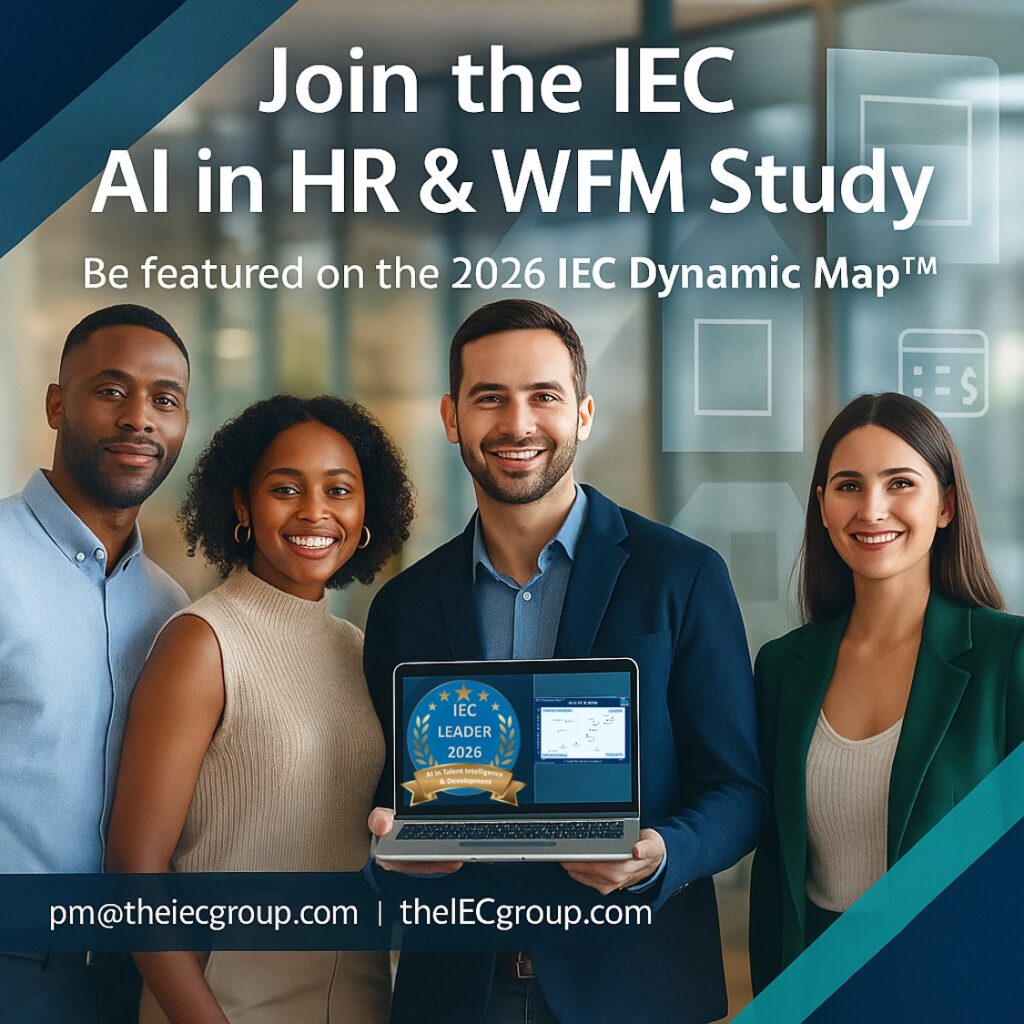
To navigate this reset, The IEC Group is launching the AI in HR & Workforce Management Global Study 2026. The program evaluates the provider market across three domains—Talent Intelligence & Development; Workforce Operations & Pay; Employee Experience & People Insights—mapped into nine sub-categories. Results will be published in our IEC Dynamic Map™ Quadrants, aligning AI Depth & Enterprise Readiness with Workforce Intelligence Impact.
Participation is free and gives executives a clear view of leaders, forerunners, and scaled innovators—grounded in real use cases, not hype.
Science Lab Building
New York, USA
Long Gate Bridge
Malmo, SE
Enix Lawyer Building
Toronto, CA
Deep Sea Bridge
Athens, GR
Car Tech Building
Denver, USA
Nctech Building
Texas, USA
Vax Tech Building
Ontario, CA
Food Lab Building
Athens, GR
Introducing the IEC Knowledge Network Free Membership - Your Gateway to Seamless Access!
We are thrilled to present a new service that goes beyond the ordinary download experience. In addition to offering you the ability to download the things you love, we are delighted to introduce the IEC Knowledge Network Free Membership.
The Free Membership option grants you unrestricted access to our library of articles and videos, without the need for tedious registrations for each piece of content.
Free level allowing limited access to most of our content.
Get access to all premium content, including full access to reports, downloads of the Executive Directions, and a dedicated expert advisor.
In case you would like to learn more about the membership book a meeting via the link below
The 25 Best EOR Companies – IEC Elite Members
Our Global EOR Study 2023























Request a free Consultation
Don’t miss out on the opportunity to expand your business globally with our help. Contact us today to learn more and take advantage of a free consultation with our experts.
Learn More From
Frequently Asked Questions
We work with businesses in a wide range of industries, including technology, healthcare, finance, and consumer goods.
The timeline for international expansion varies depending on the specific needs of each business, but we help you all the way to ensure that the process is completed as quickly and effectively as possible.
We are a vendor-agnostic research and advisory company with senior practitioners. Our team has year of experience working in international business, and our customised solutions and global network of professionals ensure that each client receives tailored support for their unique needs.