
The Next Strategic Battleground in Global Work
Opening: The Next Strategic Battleground in Global Work
During almost every analyst briefing over the past two years, one topic has appeared with increasing frequency – Artificial Intelligence.
Every provider has an AI strategy. Every provider is launching AI assistants. Every provider is adding copilots, chatbots and automation.
Yet after dozens of executive briefings with the industry’s leading Employer of Record (EOR), Payroll and Global Workforce providers, one observation continues to stand out.
Almost nobody talks about intelligence. Automation has become the conversation. Intelligence has not.
These are fundamentally different concepts.
Automating a payroll calculation is useful. Generating an employment contract in seconds is valuable. Summarizing a compliance document saves time.
But none of these capabilities answers the questions executives are increasingly asking.
- Where should we build our next engineering center?
- Which countries provide the best balance between talent availability, labor cost and regulatory complexity?
- Where are skills becoming scarce?
- Which markets present the highest compliance risk over the next five years?
- Which workforce strategy gives us the greatest competitive advantage?
These are no longer operational questions. They are strategic decisions. And strategic decisions require something different.
They require an Intelligence Layer.
Intelligence Is Not Another AI Feature
One of the biggest misconceptions emerging across the market is the assumption that Artificial Intelligence automatically creates business intelligence.
It does not.
Most AI capabilities introduced today improve productivity within existing processes.
They write emails. Review contracts. Answer employee questions. Translate documents. Generate reports.
These capabilities increase efficiency.
They rarely improve executive decision-making.
An Intelligence Layer operates at a completely different level.
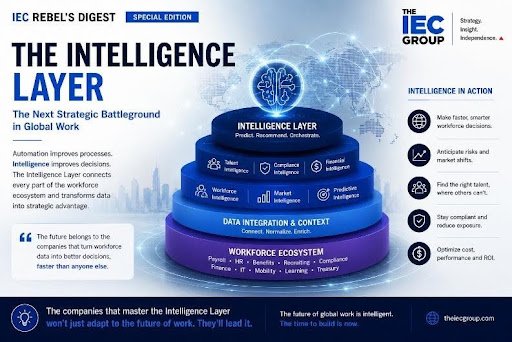
Rather than performing individual tasks faster, it continuously connects information across the entire workforce ecosystem and transforms thousands of isolated data points into strategic recommendations.
Instead of asking, “How can AI automate this process?”
the Intelligence Layer asks, “What is the best workforce decision?”
That distinction may define the next generation of market leaders.
The Missing Layer Between Data and Decisions
Every large organization already possesses enormous amounts of workforce data.
Recruitment platforms understand candidate pipelines.
Payroll systems know labor costs.
Finance tracks budgets.
Compliance teams monitor regulation.
Learning systems record skills.
Performance platforms measure productivity.
Travel systems know employee mobility.
Treasury monitors exchange rates.
The problem is not a lack of data.
The problem is that these systems rarely communicate.
Each department optimizes its own world.
Very few optimize the workforce as a whole.
The Intelligence Layer becomes the connective tissue that links these isolated functions into one continuously learning system.
Rather than replacing payroll, recruiting or compliance, it gives each of them context.
Suddenly payroll becomes more than salary calculations.
Recruiting becomes more than filling vacancies.
Compliance becomes more than avoiding fines.
Together they begin answering questions no individual system could solve independently.
A Different Kind of Workforce Platform
Historically, the workforce technology market has evolved in layers.
Payroll digitized salary administration.
Human Capital Management systems centralized employee records.
Employer of Record providers removed geographical barriers.
Compliance platforms reduced legal risk.
Artificial Intelligence is now improving the efficiency of each individual layer.
The Intelligence Layer represents something fundamentally different.
It does not replace these platforms.
It sits above them.
Its purpose is orchestration rather than execution.
Its value comes from combining information across every workforce discipline to generate recommendations instead of reports.
In many ways, it plays a similar role to what Enterprise Resource Planning (ERP) systems achieved for finance and supply chains—but focused entirely on workforce strategy.
The Six Dimensions of Workforce Intelligence
As our research has evolved, we have identified six intelligence domains that together define the emerging Intelligence Layer.
- Talent Intelligence
Understanding where scarce capabilities exist, how skills evolve, and where future shortages are likely to emerge.
- Compliance Intelligence
Monitoring regulatory change continuously while predicting future compliance exposure rather than simply reporting current status.
- Financial Intelligence
Connecting payroll, taxation, treasury, foreign exchange, benefits and employment costs into one financial view of the global workforce.
- Workforce Intelligence
Analyzing retention, engagement, productivity, mobility and organizational health across the employee lifecycle.
- Market Intelligence
Combining external labour market data, salary benchmarks, demographic trends, education output and geopolitical developments.
- Predictive Intelligence
Using AI not merely to analyze history but to recommend future workforce strategies before competitors recognize the opportunity.
Each domain provides value individually. Together they create something much more powerful than the sum of their parts.
Talent Intelligence: The Missing Piece
Perhaps the most underdeveloped component of today’s market is Talent Intelligence.
Most providers have recruitment partners.
Many operate talent marketplaces.
Some offer candidate databases.
Few provide executive-level intelligence.
There is a significant difference between helping a company recruit software engineers and advising where the next generation of AI talent will emerge, how salary inflation is likely to evolve, which universities are producing specialized expertise, and which countries offer the best combination of capability, cost, stability and scalability.
That advisory capability represents the real opportunity.
The Intelligence Layer transforms recruiting from a transactional service into strategic workforce planning.
Who Is Building the Intelligence Layer?
No provider currently delivers the complete vision. The market is still in its early stages.
Nevertheless, several organizations are building important components.
Multiplier has introduced one of the industry’s clearest strategic visions through its concept of the Global Exchange for Work, highlighting how employment, payroll, compliance, payments and workforce services may converge into a broader operating model.
Rippling possesses one of the richest enterprise data environments by integrating HR, payroll, IT, finance and identity management, creating strong foundations for advanced workforce intelligence.
Deel continues expanding rapidly across payroll, HR, immigration, compliance and financial services, creating opportunities to leverage cross-functional workforce data at scale.
Remote has focused heavily on owned infrastructure, compliance and operational consistency, providing a robust platform upon which deeper intelligence capabilities could be developed.
Papaya Global combines payroll, payments and workforce analytics, while G-P has invested significantly in AI-enabled compliance guidance and employment intelligence.
Each provider is developing different pieces of the puzzle.
None yet owns the complete Intelligence Layer. That race has only just begun.
The IEC Perspective
At The IEC Group, we believe the Intelligence Layer represents the next major evolution of the global workforce industry.
Payroll processing will remain essential.
Employer of Record services will continue enabling borderless employment.
Artificial Intelligence will automate an increasing number of operational activities.
But competitive advantage will increasingly come from helping executives answer better questions—not simply execute existing processes more efficiently.
The providers that successfully connect payroll, compliance, recruiting, finance, workforce planning and external market intelligence into one continuously learning ecosystem will create entirely new categories of value for their customers.
The future belongs not to the platforms that process the most transactions.
It belongs to those that generate the most valuable decisions.
Final Thoughts
Every technology market eventually reaches a point where operational excellence is no longer enough.
Finance moved from bookkeeping to business intelligence.
Supply chains evolved from logistics to predictive optimization.
Customer Relationship Management expanded from contact databases to revenue intelligence.
The global workforce market is approaching the same inflection point.
The next decade will not be defined by who processes payroll the fastest or operates in the most countries.
It will be defined by who builds the Intelligence Layer that helps organizations make smarter workforce decisions in an increasingly complex and borderless world.
That is where we believe the next strategic battleground has already begun.

