
How enterprises should buy payroll for 2027 rather than 2017
For the past several months, the IEC Payroll 2027 research has examined how payroll itself is changing.
We have argued that scale is not intelligence. We introduced the Workforce Intelligence Gate. We asked whether the established giants can reinvent themselves and whether challengers can scale. We examined the move from AI assistants toward increasingly autonomous payroll. And in the last Rebel’s Digest, we asked who will ultimately own the Payroll Intelligence Layer above the underlying engines.
All of this leads to a question that matters perhaps even more to enterprise buyers than it does to technology providers:
If payroll is changing this fundamentally, why are so many organizations still buying it with an RFP designed for the market of ten years ago?
Most payroll RFPs are not bad. They are simply optimized for a different era.
They ask sensible questions about country coverage, payroll calculation, statutory compliance, service levels, implementation, security, integrations, support models and price.
Every one of those questions remains necessary. But they largely answer one question:
Can this provider operate our payroll reliably?
Payroll 2027 requires enterprises to ask a second one:
Can this platform make our payroll and workforce operation materially more intelligent over the next five to ten years?
That is a very different procurement exercise.
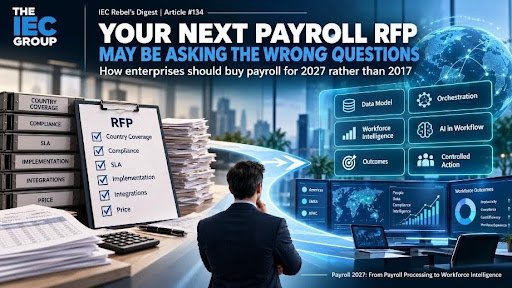
Traditional RFPs were designed to reduce operational risk
There is a good reason payroll procurement became so detailed. Payroll failure is highly visible.
Employees immediately notice when they are paid incorrectly. Tax authorities notice statutory mistakes. Finance notices funding problems. Management notices when a payroll transformation overruns or disrupts the business.
The traditional RFP therefore evolved as a risk-reduction mechanism.
- How many countries can you support?
- Which countries are native?
- Which are supported through partners?
- What is your SLA?
- How many payslips do you process?
- What interfaces do you support?
- How quickly can you implement?
- How do you manage compliance?
- What is the price per employee or payslip?
These questions remain important because the first obligation of payroll has not changed.
People must be paid accurately, compliantly and on time.
But something else has changed. Payroll technology is increasingly capable of doing much more than completing the transaction.
And an RFP that measures only transaction capability risks selecting the provider that is best equipped for yesterday’s operating model.
The RFP itself can hide innovation
There is an uncomfortable truth about large enterprise procurement processes. The more comprehensive the spreadsheet becomes, the easier it is for genuinely different providers to look identical.
- Vendor A checks “Yes.”
- Vendor B checks “Yes.”
- Vendor C checks “Yes.”
- All three have AI.
- All three have analytics.
- All three have APIs.
- All three support global payroll.
- All three offer dashboards.
- All three claim automation.
The spreadsheet creates apparent comparability. But it may actually remove the distinctions that matter.
One provider’s “AI” may be a conversational interface that explains an existing report. Another may continuously inspect payroll inputs, identify anomalies and investigate their likely causes. A third may connect payroll with time, HR and finance information, predict future labor-cost exposure and recommend action.
The RFP records three ticks in the same box. The buyer sees parity where there may be a generation of difference. This is one reason enterprise technology procurement increasingly needs to move from feature verification toward capability demonstration.
Start with the business problem, not the vendor category
The traditional sourcing exercise often begins with a statement such as: “We are looking for a global payroll provider.” But after examining the market for Payroll 2027, IEC increasingly believes that enterprises should pause before defining the solution that narrowly.
What problem are they actually trying to solve?
For one organization, the problem may genuinely be fragmented payroll execution. It may want to consolidate dozens of providers into one global service.
For another, the local payroll engines work well. The real problem is lack of global control, data standardization and visibility.
Another organization may already have consolidated payroll but struggle with manual inputs and exception management.
A fourth may be most concerned about workforce-cost intelligence, forecasting and the connection between payroll and finance.
And another may be trying to create an architecture capable of supporting AI agents and increasingly autonomous payroll operations.
These are not the same requirement. Yet a conventional “global payroll RFP” can force all of them into essentially the same procurement template.
Article 133 raised an important architectural question: which layer of payroll does the enterprise actually want a provider to own? That question should now come before vendor selection.
Buying payroll may become an architecture decision
The emerging market offers enterprises several fundamentally different models.
- One provider can potentially own the full stack from calculation through global control and intelligence.
- An HCM platform can place payroll inside a broader workforce environment.
- A newer global employment platform can combine employment, payroll, payments and compliance.
- Or an independent orchestration layer can sit above existing local payroll providers and create global standardization without replacing every engine underneath.
None of these models is automatically superior. But they create very different dependencies. And that means the buyer must understand what it is actually outsourcing.
- Is it outsourcing payroll calculation?
- Operational service?
- Data integration?
- Global governance?
- Payment execution?
- The System of Record?
- The intelligence layer?
- Or some combination of them?
A procurement process that does not distinguish these layers may end up solving the wrong problem very efficiently.
Country coverage is still important—but the question has changed
Country coverage provides a good example. For years, the number of supported countries was treated almost as a proxy for global payroll capability. It remains relevant. But “150-country coverage” tells the buyer surprisingly little on its own.
- How many countries run on the provider’s own technology?
- How many depend on partners?
- Which data moves in real time?
- Which is batch-based?
- Are outputs normalized?
- Does the global workflow operate consistently regardless of the engine underneath?
- Can intelligence identify a payroll issue across native and partner countries in the same way?
- Can the customer replace a local provider without rebuilding the global control environment?
The interesting question is therefore no longer simply: Where can you run payroll?
It is: How consistent is the experience, data and intelligence across the places where you run it?
That is a much harder question. And a far more useful one.
Enterprises should buy the data model, not just the application
Payroll implementations have traditionally concentrated heavily on interfaces.
- Can the HCM system send data into payroll?
- Can payroll send journals into finance?
- Can time systems connect?
Those interfaces remain necessary. But Workforce Intelligence changes the emphasis.
The important question becomes whether the provider can create a coherent understanding of the data moving across those interfaces.
- If overtime is represented differently in 25 countries, can the system still recognize it as the same business event?
- If organizational structures change, does payroll intelligence understand the consequences?
- Can workforce-cost information be compared consistently across entities?
- Can finance trust the consolidated result?
- Can AI reason across the data—or merely retrieve it?
This is why IEC believes the data model may become one of the most important assets an enterprise buys in its next payroll transformation.
The interface moves information. The data model creates meaning. And AI without meaning is simply faster automation of uncertainty.
Do not ask whether the provider has AI
That question is already obsolete. By 2027, almost every serious payroll technology provider will be able to answer yes. Instead, the procurement process needs to determine where intelligence actually enters the operating model.
A provider should be able to demonstrate what happens when payroll data becomes unusual. Not with PowerPoint. With the platform. Give the provider a scenario.
A population’s overtime cost has unexpectedly increased by 14 percent. Show us what happens.
- Does the technology merely display the change?
- Does it flag the variance?
- Can it identify the employees and locations responsible?
- Can it connect the change with time and attendance?
- Can it determine whether absence or staffing shortages contributed?
- Can it estimate next month’s impact?
- Can it identify a potential working-time compliance issue?
- Can it recommend what should be investigated?
- Can it prepare an action?
- Where does human approval enter?
That single demonstration may tell a buyer more about the maturity of the platform than fifty AI questions in an RFP.
The distinction between live capability and roadmap is becoming critical
AI development is moving extraordinarily quickly. That creates another procurement problem.
Technology presentations increasingly combine capabilities that are generally available, capabilities available to selected customers, preview functionality and product roadmap.
The transitions between them can be subtle. For an enterprise making a multi-year technology commitment, they are anything but subtle. A roadmap can be strategically important.
But it should not receive the same evaluation weight as functionality that customers are already using successfully in production.
IEC increasingly believes enterprise buyers should separate three questions:
- What can the platform demonstrate today?
- What are customers actually using today?
- What does the provider expect to deliver next?
The distinction protects both sides. It prevents the customer from buying tomorrow’s promise at today’s price. And it allows genuinely innovative vendors to discuss future direction without having roadmap ambition confused with current maturity.
Ask what customers have stopped doing
There is another way to assess transformation that may be more revealing than asking what new functionality the provider has added.
Ask: What work has your technology eliminated for customers?
- Do payroll teams still reconcile the same spreadsheets?
- Do they still manually investigate the same exceptions?
- Do they still wait for local providers to explain changes?
- Do finance teams still consolidate payroll costs manually?
- Do employees still open tickets to understand common pay changes?
- Do administrators still inspect entire payroll populations even though only a small percentage needs attention?
If a platform introduces advanced AI but the customer’s operating model remains essentially unchanged, the enterprise may have purchased innovation without transformation. This is particularly important as the market moves toward agentic and increasingly autonomous payroll. The value is not that an AI agent exists. The value is that unnecessary work disappears.
The next RFP should measure outcomes
Traditional payroll contracts are often rich in operational metrics.
- Accuracy.
- Timeliness.
- Incident resolution.
- Availability.
These remain fundamental. But the next generation of payroll agreements may need to incorporate another layer of outcomes.
- How much manual intervention is required?
- How many anomalies are detected before payroll finalization?
- How much faster are exceptions resolved?
- What percentage of payroll flows without human touch?
- How quickly can finance obtain reliable global workforce-cost information?
- How many employee queries are resolved automatically with sufficient confidence?
- How frequently does the technology identify compliance exposure before it becomes an incident?
These are different measures because the value proposition is different. A provider is no longer being paid only to complete payroll. It is increasingly being asked to improve how the enterprise manages payroll.
The procurement team needs different people in the room
This has organizational consequences. A traditional payroll selection can easily become dominated by payroll operations, procurement and HR technology. Workforce Intelligence expands the stakeholder group.
- Finance should have a stronger role because payroll intelligence increasingly connects with labor-cost forecasting and cash requirements.
- The CIO and enterprise architecture team should understand the data model and integration architecture.
- Security and risk teams need to understand AI governance and agent permissions.
- Compliance needs to evaluate how regulatory intelligence is created and validated.
- HR should consider how payroll connects with workforce planning and compensation.
And payroll professionals remain central because they understand where apparently elegant technology meets messy operational reality.
This is no longer simply a payroll-system selection. For large enterprises, it is increasingly a decision about the workforce operating architecture.
The cheapest payslip may become an expensive decision
Payroll sourcing has always included price pressure. That will not disappear. But the economics of payroll are changing. Imagine two providers.
Provider A charges less per payslip but requires considerable manual reconciliation, exception management and local coordination.
Provider B has a higher transaction price but automates much of that work, reduces downstream finance effort, identifies errors earlier and provides better workforce-cost intelligence.
Which one is cheaper? The traditional RFP may know the answer.
The enterprise may not. As intelligence and automation increase, buyers need to consider the total operating cost of payroll, not simply the transaction cost.
That includes internal payroll labor, integration, local coordination, reconciliation, corrections, service tickets, finance effort, compliance risk and the cost of poor information.
A more intelligent platform should eventually be able to justify itself not merely through lower payroll administration cost but through better enterprise decisions.
That is a much larger economic argument.
And ask how difficult it will be to leave
There is one final question that belongs much earlier in the procurement process than it usually appears:
What happens if we want to change providers later?
Payroll implementations create enormous switching costs.
Data structures, interfaces, workflows and local operating processes become embedded over time.
The emerging intelligence layer could either reduce that lock-in—or make it considerably stronger.
If the provider owns not only payroll execution but the normalized data, workflow, AI models, orchestration and reporting environment, leaving may become very difficult.
Enterprises should therefore understand data portability, API access, historical-data ownership and the ability to replace underlying execution providers.
This is particularly important when considering an orchestration model.
A good control layer should arguably increase enterprise flexibility rather than merely introduce another proprietary dependency.
The future payroll architecture should not only be intelligent. It should be strategically manageable.
Ten questions for the next payroll decision
If IEC were advising an enterprise beginning a major payroll procurement today, we would retain the traditional questions—but add a new set that reflects the market now emerging:
- What layer of our payroll architecture do we actually want you to own?
- What is your common payroll and workforce data model, and how does it work across different country engines?
- Show us an issue your technology can identify before our payroll team would normally see it.
- Show us how the platform explains why that issue occurred and what data it used.
- What can the platform predict today—not on the roadmap—and which customers use it in production?
- Which payroll actions can your AI currently recommend, prepare or execute, and where does human approval apply?
- How much manual payroll work have your customers actually eliminated?
- Can your intelligence layer operate across third-party payroll providers, or only your own engines?
- What measurable business outcomes have customers achieved beyond payroll accuracy and SLA performance?
- If we replace an underlying payroll provider—or eventually replace you—what data, workflows and intelligence can we retain?
A provider that answers these questions convincingly is telling the enterprise something about its future.
Not just its feature set.
The RFP should become an evidence process
Perhaps that is the most important conclusion. Payroll procurement should become less dependent on what a provider says it can do and more dependent on what the customer can observe it doing.
Fewer generic questions ⇒ More real scenarios.
Fewer feature checkboxes ⇒ More demonstrations.
Less self-scoring ⇒ More customer evidence.
Less emphasis on how many capabilities technically exist ⇒ More emphasis on whether they materially change the operating model.
This mirrors the methodology IEC is applying in Payroll 2027 itself. We are increasingly less interested in whether a vendor claims AI, automation or Workforce Intelligence. We want to understand what the system knows. What it can explain. What it can predict. What it can safely do. And what customers can prove.
Enterprise buyers should demand the same.
Buy for the operating model you want—not the one you already have
Payroll platforms tend to remain in enterprises for a long time. That means a company selecting payroll in 2027 is not buying only for 2027. It may still be operating that architecture well into the 2030s.
That makes a purely current-state RFP dangerous.
If the organization asks vendors only how they can replicate today’s payroll process, the winning provider may simply become the technology that reproduces the existing operating model most efficiently.
The more strategic question is: How should payroll operate five years from now—and which provider gives us the most credible path to get there?
That is where Workforce Intelligence becomes relevant. Not because every enterprise needs autonomous payroll tomorrow. Not because every AI capability is mature today. But because the direction of technology is clear enough that ignoring it creates its own risk.
Your next Payroll RFP may be asking the wrong questions
The traditional questions are not wrong. They are incomplete.
- Country coverage still matters.
- Accuracy still matters.
- Compliance still matters.
- Implementation still matters.
- Service still matters.
- Price still matters.
But they increasingly describe the minimum conditions for participation, not the full basis for leadership. The next generation of payroll procurement needs to examine something more fundamental:
- Can the platform create a reliable data foundation?
- Can it turn that data into context?
- Can it turn context into intelligence?
- Can it turn intelligence into controlled action?
- And can it demonstrate measurable value when it does?
That is what enterprises are really buying next. The payroll engine remains essential. But as we argued in Article 133, the strategic battle is moving toward the intelligence layer above it. For buyers, the conclusion is straightforward:
Do not write an RFP that merely identifies who can run the payroll you have today. Design a selection process that reveals who can help create the payroll operating model you will need tomorrow.
Payroll 2027: From Payroll Processing to Workforce Intelligence
The IEC Group is examining how global payroll technology, architecture, AI, orchestration and enterprise buying requirements are changing—and how those changes should influence both provider strategy and customer selection.
The study is designed for payroll providers and enterprise end-user organizations navigating the next generation of payroll transformation.
Participation in the Payroll 2027 provider research remains free of charge. pm@theiecgroup.com
The next payroll transformation may not begin with selecting a new vendor. It may begin with asking better questions.

