
From Local Offices to CoEs
Introduction: The New Geography of Work—and the Infrastructure You Need
 For decades, “international expansion” followed a familiar script: open a local office, hire a country manager, set up an entity, build a small team, repeat.
That playbook is breaking.
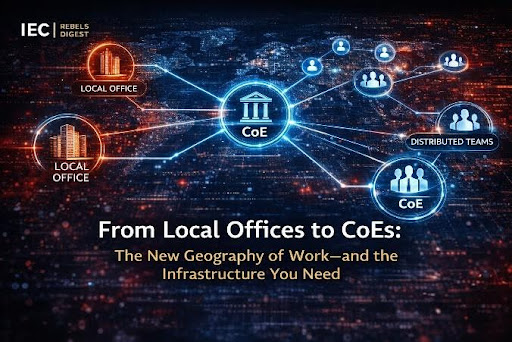
Not because companies stopped going global—but because the geography of work has changed. The center of gravity is shifting away from local offices and toward Centers of Excellence (CoEs) and distributed operating models that can scale faster than legal structures.
The modern expansion pattern looks like this:
- consolidate talent into strategic hubs (CoEs)
- serve multiple countries from those hubs
- layer distributed teams on top for market coverage
- move faster than entity setup
- keep optionality under uncertainty
- demand tighter governance, compliance, and integration
And right in the middle of this shift sits one category that used to be “HR outsourcing” and is now becoming infrastructure:
Employer of Record (EOR) — not as a workaround, but as the CoE expansion layer.
Because CoEs aren’t just a talent strategy. They are an operating model—and operating models require infrastructure.
Why Local Offices Are Losing Their Monopoly
Local offices still matter. In certain industries and markets, they’re unavoidable: regulated sectors, government contracts, complex sales cycles, on-site operations.
But the automatic instinct—“If we enter a market, we open an office”—is fading.
Three realities are driving the shift:
1) Speed beats structure
Entities, registrations, banking, compliance setup, local policies, and operational readiness can take months.
Markets move in weeks.
Companies now build teams first and formalize structures later—if at all.
2) The cost of “country sprawl” is exploding
A small local team in 12 countries sounds like growth. In reality it can become:
- fragmented HR and payroll governance
- inconsistent employee experience
- tax and permanent establishment risk
- duplicated finance and legal overhead
- poor reporting and workforce visibility
- unmanageable vendor landscapes
Local offices create a hidden tax: organizational entropy.
3) Work is no longer tied to a building
Remote work didn’t just create flexibility. It rewired expansion logic.
Today, a product manager in Berlin can manage a customer base in France and Spain while working with engineers in Lisbon and support in Cairo.
The “office” doesn’t define the work. The operating system does.
The CoE Model: Work Consolidated Into Strategic Hubs
A CoE is not “an office.” It’s a concentrated capability hub that serves a broader region or function.
Common CoEs include:
- engineering & product
- cybersecurity
- compliance & governance
- finance operations
- customer success
- procurement & supply chain
- shared services
- data and analytics
The CoE model has two advantages that local offices can’t match:
- Depth: you can build real critical mass and expertise
- Scale: one hub can serve multiple markets
That’s why companies are shifting from “local teams everywhere” to “few hubs + distributed satellites.”
The New Geography of Work: Hubs + Satellites + Remote Mesh
In practice, most organizations are moving toward a three-layer model:
Layer 1: Strategic hubs (CoEs)
Where critical capabilities concentrate.
Layer 2: Market satellites
Small presence in key markets for sales, relationships, regulatory access, or customer intimacy.
Layer 3: Remote mesh
Distributed specialists who sit wherever talent is strongest—without forcing entity creation everywhere.
This is the new geography: not countries, but nodes.
And nodes require infrastructure that works across borders.
The Real Challenge: You Can’t CoE Your Way Out of Compliance
Here’s the inconvenient truth:
CoEs reduce complexity—but they don’t eliminate compliance.
In fact, they often create new compliance challenges:
- employees working for a hub but living in another jurisdiction
- cross-border tax exposure and permanent establishment risk
- local employment law obligations triggered by remote work
- worker classification risk in contractor-heavy models
- data privacy and security requirements across geographies
- inconsistent local onboarding and termination governance
In other words, the CoE model shifts complexity from “local structure” to “cross-border execution.”
That’s where global workforce infrastructure becomes mission-critical.
Why EOR Becomes the CoE Expansion Layer
The CoE model creates pressure to move fast:
- to hire leaders early
- to build capability before competitors do
- to staff new hubs quickly
- to test markets without long-term commitments
But entities are slow.
So companies reach for the tool that matches the moment: EOR.
EOR as a CoE expansion layer means:
- hire in-country without setting up an entity
- build a satellite team while the hub ramps
- support distributed hires around a CoE
- enter markets quickly for go-to-market acceleration
- keep optionality while demand is uncertain
- reduce the burden on internal HR/legal/finance during expansion
EOR is the bridge between strategy and execution. Not a workaround. An operating model component.
CoEs Are Accelerators—EOR Is the Clutch
CoEs accelerate global capability building. EOR provides the clutch that makes acceleration controllable.
Without EOR, companies often face a bad choice:
- move fast with contractors (high misclassification risk)
- wait for entity setup (miss market timing)
EOR gives a third option:
- move fast with compliant employment
And in 2026, speed with compliance is the winning combination.
The Infrastructure You Need: The CoE Expansion Stack
To make the new geography of work sustainable, companies need a new infrastructure stack. Not “HR tools.” Infrastructure.
Here are the components that matter:
1) Legal and entity strategy framework
You need a deliberate approach:
- where do we maintain entities and why?
- where do we use EOR as a long-term model vs transitional?
- what triggers an entity build (headcount, revenue, contracts, licensing)?
- how do we avoid entity sprawl without losing control?
The best organizations treat entities as strategic assets—not automatic outcomes.
2) Compliance execution that’s auditable
Global employment isn’t “administration.” It’s regulated execution.
You need:
- country-specific contracts and policies
- onboarding and offboarding governance
- classification controls
- documentation trails
- escalation models for complex cases
- proof of licensing where required
A CoE model collapses if the compliance layer is weak.
3) Workforce data governance and reporting
CoE strategy fails if workforce visibility is fragmented.
You need:
- consistent headcount reporting across EOR, entities, contractors
- cost allocation by hub, function, and market
- standardized employee lifecycle events
- analytics to measure time-to-hire, attrition, and risk
The geography of work is new—but the CFO still needs a single view.
4) Integration into the full HR stack
This is the big one.
If your EOR provider is a standalone island, your governance will break.
Modern CoE expansion requires:
- HRIS/HCM integration (employee master data, lifecycle events)
- ATS integration (offer-to-hire workflows, approvals)
- identity and access management linkage
- finance/ERP alignment (cost centers, approvals, reporting)
- document management and audit trail storage
Integration isn’t a tech luxury. It’s risk control.
5) Employee experience designed for distributed reality
CoEs create a two-class risk:
- hub employees with strong support and clear processes
- satellite employees with fragmented support and confusion
Winning organizations standardize EX across geographies:
- consistent onboarding communication
- clear policy access
- reliable support routes
- transparent benefits handling
- localized compliance with a unified experience
The CoE model fails if satellites feel like second-class citizens.
The New Playbook: “EOR First” Doesn’t Mean “EOR Forever”
Many companies adopt an EOR-first model to move fast. That’s smart.
But the key is knowing when to transition:
When EOR should remain long-term:
- small, stable headcount markets
- uncertain markets where optionality matters
- satellite teams supporting a hub
- markets where entity setup cost is disproportionate
- early-stage growth where complexity must stay low
When you should consider entity setup:
- large headcount with stable growth
- strategic market commitment and local contracts
- regulated sectors requiring local licensing
- tax and governance reasons that demand direct control
- customer expectations in certain regions
EOR is the expansion layer—but entity strategy remains a strategic lever.
What This Means for Providers: The Next Phase of EOR
As EOR becomes embedded into CoE-driven operating models, providers will be judged on more than “country coverage.”
The new buyer criteria:
- compliance depth and licensing proof
- partner governance and auditability
- integration and API maturity
- multi-country management experience
- ability to support both hub and satellite models
- consistency of client and employee experience
- time-to-hire and operational speed
- sophistication of onboarding/offboarding handling
In other words: EOR is no longer a “service.” It’s infrastructure.
The Rebel Take: The Office Isn’t the Unit of Expansion Anymore
The old unit of expansion was the country office.
The new unit of expansion is the capability hub + its distributed workforce mesh.
This is a profound shift. It means:
- your hiring map becomes a network, not a country checklist
- your HR operating model becomes cross-border by default
- compliance becomes a continuous system, not a legal event
- integration becomes necessary to maintain control
- EOR becomes a strategic accelerator, not a stopgap
Companies that embrace this will scale faster, cleaner, and with more optionality.
Companies that cling to the office-first model will keep building expensive complexity—and call it “global growth.”
What’s Next: Measuring the CoE Expansion Layer
This is exactly why the EOR market is moving toward a new benchmark mindset: not who claims the widest coverage, but who delivers the strongest global workforce infrastructure.
That’s also why the next wave of EOR evaluation must focus on:
- legal infrastructure
- compliance depth
- automation and process maturity
- CX and EX consistency
- integration and API coverage
- innovation and market differentiation
Because the winners of the new geography of work will be those who can make hubs and distributed teams work without breaking governance.
That’s the game now.
And EOR—done right—is one of the most powerful expansion layers companies have ever had.
Want to build trust through independent validation?
If you want to learn more about IEC Audit & Certification—and how independent audits can strengthen compliance maturity, procurement confidence, and continuous improvement—reach out to: pm@theiecgroup.com
Free participation: EOR Study 2026
Provider participation is free of charge for qualified companies. If you want to ensure your offering is correctly positioned and represented in the market, contact:
pm@theiecgroup.com See you in the study. —The IEC Rebels Digest Team
Why This Matters for the IEC Global EOR Study 2026
 This is not just a market commentary. It’s the exact reason the IEC Global EOR Study 2026 is structured the way it is.
The study will assess providers across eight evaluation categories that reflect the compliance stack reality:
- Global Reach & Legal Infrastructure
- Compliance & Licensing Depth
- Tech Stack & Platform Maturity
- AI & Process Automation
- Client Experience (CX)
- Employee Experience (EX)
- Integration & API Coverage
- Innovation & Market Differentiation
And yes—there will be visibility into who ranks strongest across these categories, alongside insights into rising disruptors and the strategic direction of the market.
Because in 2026, “EOR provider” is not a uniform label. The gap between providers is widening—and the winners will be those who can prove compliance as infrastructure, not claim it as a feature.
A Final Reality Check
Global workforce management is no longer just about hiring talent abroad. It’s about building a defensible employment operating model across legal regimes—and doing it with speed, transparency, and integration.
That is a regulated product challenge.
And that’s why the EOR market is heading toward a compliance-led shakeout.
The platforms that win won’t simply help companies hire globally. They will help companies stand up to scrutiny globally.
About the IEC Rebel’s Digest
We write for the ones breaking molds, building cross-border teams, and reshaping global work. No buzzwords. Just truths, tools, and tactics for the new era of employment.
IEC Rebel’s Digest— The IEC Group can help you audit your global employment setup by identifying labor leasing risks, verifying licensing requirements, and ensuring your EOR partners meet every compliance standard—before regulators come knocking.
Last but not Least: If you’re facing challenges and wondering how others are managing similar issues, why not join The Leadership Collective Community? It’s a peer group and webcast platform designed for leaders to exchange insights and experiences.
Introducing the IEC Knowledge Network Free Membership – Your Gateway to Seamless Access!
We are thrilled to present a new service that goes beyond the ordinary download experience. In addition to offering you the ability to download the things you love, we are delighted to introduce the IEC Knowledge Network Free Membership.
The Free Membership option grants you access to our library of articles and videos, without the need for tedious registrations for each piece of content.
The publication serves as a trusted resource to support executives in their pursuit of sustainable and successful global expansion. In addition the IEC Practitioners are available to discuss your specific challenge in more detail and to give you clear advise..
Take advantage of this valuable resource to accelerate your global expansion journey

