

Why job platforms, recruiters, and headhunters are not interchangeable — and why the future belongs to the Global Orchestrator
Most companies still talk about hiring as if it were one thing.
It isn’t.
 They bundle completely different talent problems into one process, one funnel, one dashboard, one set of KPIs, and then wonder why some roles fill smoothly while others drift for months, consume leadership time, and quietly damage growth.
That is because hiring has split in two.
One side is ordinary hiring: local roles, familiar profiles, visible salary bands, active candidates, and a process that can usually be handled with a company career site, online job boards, referrals, and a decent local recruiter.
The other side is strategic talent capture: scarce skills, emerging roles, passive candidates, unclear geography, confusing titles, and a cost of failure far greater than the recruitment fee.
Most companies treat both categories with the same machinery.
That is one of the most expensive mistakes in modern talent strategy.
And it is becoming more dangerous. The World Economic Forum says employers expect 39% of key skills to change by 2030. ManpowerGroup’s 2026 Talent Shortage research found 72% of employers still struggle to fill roles, with AI skills now the hardest to find globally.
That changes the argument completely.
The old conversation was:
Should we build our own platform?
Should we use public job boards?
Should we work with recruiters?
Should we retain a headhunter?
The sharper question now is this:
Which hiring engine fits which type of talent problem?
Because for the easy hires, almost any decent machine can work.
For the critical hires, the wrong machine becomes expensive very fast.
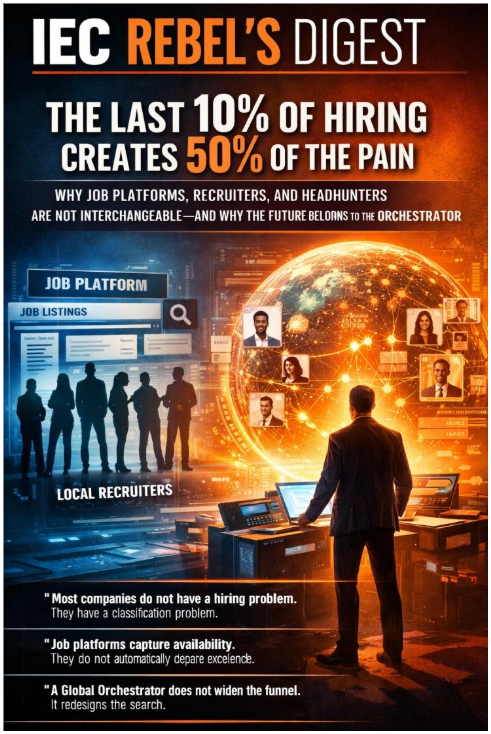
“Most companies do not have a hiring problem. They have a classification problem.”
First, separate the ordinary from the rare
Every serious hiring model should begin by sorting roles into two buckets.
Not by department.
Not by geography.
Not by who shouts loudest internally.
By hire type.
The ordinary local hire
These are roles where the market already understands the profile. There is a known labor pool, local comparability, recognizable employers, and a realistic chance that the right people will either apply directly or can be reached efficiently through normal channels.
There may already be internal contacts in place. Referral paths exist. The company knows what “good” looks like. Hiring may still take work, but it is largely a process problem.
For many companies, this is the majority of hiring. Depending on maturity, employer brand, and market, something like 70% to 90% of roles can often be filled through direct sourcing, inbound applications, referrals, and standard local recruiting support. That is not a universal statistic; it is a practical operating rule.
The scarce-skill hire
This is where things change.
The rare hire is not just harder because there are fewer candidates. It is harder because the entire hiring logic changes.
The skill set may be newly emerging. The title may be misleading. The best candidate may sit in another geography. The compensation range may not be obvious. The candidate may already be successful, employed, and not remotely in job-search mode.
This is the AI architect with real deployment experience. The regulatory product specialist who has actually built in a highly controlled environment. The country launcher with enterprise credibility and local trust. The transformation expert who has solved your exact problem once before and is not browsing job ads at midnight.
These are not volume hires. These are risk hires.
And they are precisely the roles where companies lose time, make bad compromises, or congratulate themselves for filling the seat while still missing the capability.
“The biggest strategic mistake in recruiting is treating scarce talent like a normal vacancy.”
Your own job platform: essential, but limited
Every company should have its own job platform or career site.
That is not controversial. It gives control over branding, messaging, candidate experience, data capture, and process design. It reduces dependency on third-party platforms and lets companies build a more coherent employer proposition over time.
For ordinary local hiring, that is powerful.
If the company is already credible, the role is visible, and candidates are actively searching, a good job platform can do exactly what it should do: convert interest into applications and applications into hires.
But many firms jump from “our platform is useful” to “our platform is strategy.”
It isn’t.
A company-owned job platform works best when the right candidate is already moving toward the market. That means it performs best when the hiring problem is essentially one of visibility, convenience, and conversion.
That is not the same as winning scarce talent.
Because scarce talent does not usually wake up and decide to browse your careers page for inspiration.
Public job platforms: good for reach, weak for rarity
Online job boards and digital talent platforms remain valuable for a reason: they create scale.
They produce reach, candidate flow, search visibility, and speed. For ordinary roles, especially in local or regional markets, that can be enough. Many businesses still get strong results from them because they do exactly what they were designed to do.
But there is a built-in limitation.
Job platforms mostly operate in the world of the active candidate.
Indeed defines passive candidates as people who usually already have a job and are not actively pursuing new positions, but may consider a move if the right opportunity is presented. That distinction matters because many of the best scarce-skill candidates are passive by definition.
This is where companies get confused.
They assume a platform is a map of the market.
It is not.
It is a map of the market that is currently visible, motivated, and reachable through application behavior.
That works beautifully for many roles. It fails badly when the real target candidate is employed, selective, overloaded, badly titled, difficult to keyword-match, or only interested in moving for something genuinely strategic.
The best AI architect in your target market is not necessarily active. The most credible cross-border employment expert may not have updated a profile in two years. The best regional operations leader may respond only to a trusted introduction and a carefully framed opportunity.
That is why platform economics can be deceptive. They may look cheaper on the surface. But if they systematically miss the best candidate universe, they become expensive in a more dangerous way.
“Job platforms capture availability. They do not automatically capture excellence.”
Headhunting changes the market you can access
This is the real difference between recruiting channels and headhunting.
Job platforms assume the candidate comes toward the opportunity. Headhunting assumes the opportunity must go toward the candidate.
That changes everything.
The search begins differently. The market map becomes wider. Adjacent backgrounds become more visible. Outreach matters more. Narrative matters more. Credibility matters more. The quality of the brief matters more. Timing matters more.
Headhunting is not just a premium sourcing tactic. In scarce-skill markets, it is a way of creating a candidate market that does not naturally appear on its own.
And that is why the “active versus passive” distinction is so important. Active candidates signal interest. Passive candidates often signal strategic fit. The harder and more valuable the role, the more dangerous it becomes to rely only on the visible part of the market.
This does not mean active candidates are worse. It means they are only one slice of the talent universe.
When companies forget that, they mistake application flow for talent coverage.
Why local specialist recruiters still matter
The technology industry has spent years pretending local knowledge is overrated.
It isn’t.
A strong local recruiting specialist often knows things no platform and no central talent team can see clearly: real salary expectations, reputation signals, employer pecking order, notice-period culture, commute psychology, language nuance, relocation resistance, and which companies genuinely produce strong talent versus polished CVs.
That local intelligence is not decorative. It is operationally decisive.
A good specialist recruiter in Vienna, Munich, Bangalore, São Paulo, or Warsaw can often outperform a larger brand when the role is anchored in one market and the brief is well defined. They do not just source. They interpret. They filter. They calibrate.
They know who is quietly open. They know who recently received retention money. They know which candidate is over-titled, under-scoped, or impossible to move regardless of compensation.
That is why local specialist recruiters remain highly relevant.
But relevance is not the same as sufficiency.
Because once the problem becomes cross-border, capability-led, or strategically ambiguous, local excellence alone is not enough.
The illusion of the “global recruiting company”
This is where many large recruiting firms disappoint.
A surprising number of so-called global recruiting companies are not truly global operators. They are collections of local teams, local P&Ls, local incentives, and local market habits under a single brand.
That creates predictable friction.
One office pushes its geography. Another scores candidates differently. A third optimizes for local placement economics. Searches get fragmented. Country teams become territorial. The client receives a lot of activity and not enough insight.
The firm looks global from the outside, but behaves like a federation.
That may be good enough for broad multi-country hiring volume.
It is often not good enough for scarce, strategic talent.
Because the real question is not “which local office can work on this?”
The real question is “where in the world is the best version of this hire actually hiding?”
And that question leads to a different model.
Enter the Global Orchestrator
The Global Orchestrator is not just another recruiter with more countries in the brochure.
It is a different operating system.
A true orchestrator starts with role architecture, not job posting. It asks what the company truly needs, what is non-negotiable, what can be translated from adjacent experience, and whether the organization is even searching for the right shape of person.
Then it maps the talent market globally before narrowing it locally.
Instead of defaulting to the hiring manager’s home market, it asks where the real talent density sits, where adjacent capabilities can be converted, where the role can be sold credibly, and how cost, access, quality, and speed combine.
It then uses local specialists intelligently — not as disconnected suppliers, but as calibrated instruments within a single strategy.
That means one brief. One narrative. One scorecard. One standard of evidence. One view of the role.
Most importantly, it handles the passive market professionally.
That is where the real edge sits.
Scarce talent does not respond to generic outreach. It responds to relevance, trust, timing, and a role proposition that makes sense in the context of an already successful career.
That is why the orchestrator matters most not in the first 80% of hiring, but in the final, difficult slice.
“A Global Orchestrator does not widen the funnel. It redesigns the search.”
The last 5–10% is where business risk lives
This is the part companies usually underestimate.
The value of a Global Orchestrator is not that it makes every hire slightly better. Its real value appears in the last 5% to 10% of roles that standard machinery cannot solve well: the rare, strategic, hybrid, ambiguous, or business-critical roles where the cost of delay and the cost of getting it wrong are both high.
That is where the vacancy becomes more than an HR metric.
An unfilled critical role can delay product launch, weaken architecture decisions, postpone market entry, overburden top performers, reduce execution quality, and quietly slow commercial momentum.
And a wrong hire can be worse. Because a weak strategic hire often fails slowly. The seat is filled, the dashboard turns green, and the business keeps losing time under a false sense of resolution.
SHRM notes that replacing an employee can cost 50% to 200% of annual salary, depending on role level. For a high-impact specialist or leader, that is only the visible part of the damage.
So yes, the last 5–10% of hiring may represent only a minority of total headcount.
But it often carries a majority of business risk.
Take the AI architect example
Imagine the brief: an AI architect with enterprise-scale experience, strong governance instincts, deployment credibility, and the ability to work across product, data, engineering, security, and leadership.
A job platform will produce applicants.
A local recruiter may produce some strong local talent.
A large global recruiter may activate several offices.
A Global Orchestrator does something more useful.
It asks whether this is truly one role or two. Whether the business needs frontier-model expertise or enterprise integration maturity. Which adjacent profiles translate. Which industries produce credible equivalents. Which markets contain genuine deployment talent rather than just AI branding. Which candidates are only reachable through trust-based approach rather than transactional outreach.
That process does not simply improve sourcing.
It improves the definition of the hire.
And that alone can save months.
The blunt conclusion
Companies should stop asking whether job boards, recruiters, or headhunters are best.
That is the wrong argument.
The right question is whether the role is ordinary or scarce, active-market or passive-market, local or globally optimizable, procedural or strategic.
For ordinary local hiring, your own platform, public job boards, referrals, and local specialist support may be entirely sufficient.
For market-specific hiring, a strong local recruiter may be the smartest answer.
For rare, strategic, cross-border, or high-stakes hiring, a fragmented channel mix is not a strategy.
That is where the Global Orchestrator changes the game.
Because the future of hiring is not platform versus headhunter.
It is process versus precision.
Volume versus judgment.
Visibility versus orchestration.
And for the hires that actually determine capability, growth, and competitive edge, that distinction is no longer a nice strategic idea.
It is an operating reality.
It is a financial issue.
And increasingly, it is a leadership test.
About the IEC Rebel’s Digest
We write for the ones breaking molds, building cross-border teams, and reshaping global work. No buzzwords. Just truths, tools, and tactics for the new era of employment.
IEC Rebel’s Digest— The IEC Group can help you audit your global employment setup by identifying labor leasing risks, verifying licensing requirements, and ensuring your EOR partners meet every compliance standard—before regulators come knocking.
Last but not Least: If you’re facing challenges and wondering how others are managing similar issues, why not join The Leadership Collective Community? It’s a peer group and webcast platform designed for leaders to exchange insights and experiences.
Introducing the IEC Knowledge Network Free Membership – Your Gateway to Seamless Access!
We are thrilled to present a new service that goes beyond the ordinary download experience. In addition to offering you the ability to download the things you love, we are delighted to introduce the IEC Knowledge Network Free Membership.
The Free Membership option grants you access to our library of articles and videos, without the need for tedious registrations for each piece of content.
The publication serves as a trusted resource to support executives in their pursuit of sustainable and successful global expansion. In addition the IEC Practitioners are available to discuss your specific challenge in more detail and to give you clear advise..
Take advantage of this valuable resource to accelerate your global expansion journey

