
AI in Talent Intelligence & Development – Why the First Movers Are Already Re-Wiring HR
 If you strip away the buzzwords, “AI in Talent Intelligence & Development” is about one brutally simple question:
Can you see your skills, and can you move them fast enough to win?
For years, HR tech vendors have promised this. Talent marketplaces, skills graphs, adaptive learning, AI recruiting – the slideware looked fantastic. But most HR and WFM organizations stayed stuck in pilot-land: scattered tools, siloed data, no coherent skills view, and very little measurable business impact.
Our first AI in HR & WFM Study: “AI in Talent Intelligence & Development – 2026” set out to separate hype from reality. We looked specifically at AI across recruiting, talent intelligence/skills, internal mobility, and L&D personalization – and we asked:
- Where is AI actually embedded in products (beyond marketing copy)?
- Who is generating workforce intelligence that changes decisions, not just dashboards?
- Which platforms are ready for enterprise scale – security, governance, integrations, global reach?
The outcome is the IEC Dynamic Map™ – AI in Talent Intelligence & Development 2026, with the top 20 providers placed into four leader quadrants:
- Enterprise Leaders
- Transformer Leaders
- Toolkit Leaders
- Operational Leaders
From Skills Chaos to Workforce Intelligence
Why is AI suddenly so central in this space?
Because the old talent stack is broken:
- Job descriptions are outdated the moment they’re published.
- Employees’ real skills live in emails, Git commits, project tools, and informal stretch work – not in the HRIS.
- Learning is still largely “course-catalog plus compliance,” not strategic upskilling.
- Internal mobility programs rarely scale beyond a few high-visibility roles.
AI is finally giving HR a way out of this chaos:
- Skills inference at scale – Models that infer skills from CVs, profiles, projects, and behavior instead of forcing employees to fill endless forms.
- Talent graph / intelligence – Platforms that connect skills, roles, learning content, and career paths into one navigable network.
- Personalization and matching – Recommendation engines that match people to jobs, gigs, mentors, and learning – and make those suggestions feel relevant.
- Continuous workforce insight – Analytics that show where skills are emerging, where they are at risk, and what that means for hiring and upskilling.
- Operational uplift – Recruiter copilots, automated screening, structured interviewing, content generation, and workflow orchestration.
The business benefit is clear: time-to-productivity goes down, mobility goes up, and external hiring becomes more strategic instead of reactive.
What We Measured: Two Axes That Actually Matter
The IEC Dynamic Map™ doesn’t try to capture everything; it focuses on what differentiates serious AI players from everyone else.
Vertical axis: Workforce Intelligence Impact (Low → High)
How strongly does the solution change workforce decisions? We looked at:
- Depth and quality of skills/talent intelligence
- Breadth of use cases: recruiting, mobility, L&D, workforce planning
- Evidence of business outcomes (internal fill rates, reduced time-to-hire, mobility metrics, learning engagement, etc.)
Horizontal axis: AI Depth & Enterprise Readiness (Low → High)
How robust is the AI and how ready is the platform for large, complex organizations?
- AI models, explainability, guardrails, and governance
- Integration into core HR/WFM stacks
- Security, compliance, global support, referenceability
- Ability to operationalize AI across regions, entities, and use cases
Plotting these two axes yields four leader roles – each valuable, but with different strengths and strategies.
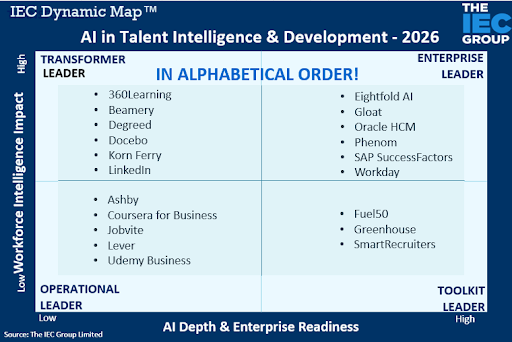
On the public map, all vendors are shown in alphabetical order inside each quadrant – not by relative position. The exact placement and detailed evaluations are only available in the full study (contact pm@theiecgroup.com).
Enterprise Leaders: AI at the Heart of the HCM Stack
Enterprise Leaders are large, global platforms where AI-driven talent intelligence is deeply embedded into the HCM backbone. They have scale, breadth, and the ability to make AI real for multi-country enterprises.
Alphabetically, this group includes:
- Eightfold AI
- Gloat
- Oracle HCM
- Phenom
- SAP SuccessFactors
- Workday
What they have in common:
- End-to-end visibility – AI is used to connect recruiting, core HR, learning, and (in many cases) workforce planning.
- Skills as a system of record – The shift from job titles to skills profiles is underway; “skills clouds,” talent graphs, and marketplaces are no longer fringe features.
- Enterprise-grade readiness – These platforms pass the hard tests: global compliance, works councils, data residency, role-based access, extensibility.
If you’re a CHRO looking to re-platform HR around skills, this is the group that can credibly become your “AI nervous system” for talent. But with great power comes great complexity: getting value requires strong governance, data stewardship, and change management.
Transformer Leaders: Changing How Talent Strategy Works
Transformer Leaders are the specialists that force everyone else to raise their game. They may not own your core HRIS, but they can radically reshape how you think about skills, learning, and careers.
Alphabetically, we identified the following as Transformer Leaders:
- 360Learning
- Beamery
- Degreed
- Docebo
- Korn Ferry
- LinkedIn (with a strong focus on LinkedIn Learning and skills signals)
Their typical superpowers:
- Talent & content graphs – Rich, constantly updated graphs that connect skills, roles, and learning content across millions of users and data points.
- Skills-driven learning – AI that surfaces micro-learning, academies, and curated paths aligned to business priorities.
- Advisory + tech – In Korn Ferry’s case, deep consulting and assessment IP amplified by AI to inform hiring, succession, and development.
Transformer Leaders are often the change catalysts: they push organizations to re-imagine talent strategy, to move from “LMS plus job board” to a skills-based, data-driven ecosystem. For many enterprises, pairing an HCM platform with one or two of these specialists is the fastest way to accelerate maturity.
Toolkit Leaders: Precision Weapons for Talent Teams
Not every organization is ready for a full-stack transformation. Sometimes what you need first is a sharp, focused weapon that solves a painful problem – and plugs nicely into your existing ecosystem.
Our Toolkit Leaders, in alphabetical order:
- Fuel50
- Greenhouse
- SmartRecruiters
These platforms excel by:
- Doing one thing exceptionally well – e.g., structured hiring with AI-assisted decision support, or highly engaging internal career pathing.
- Being integration-friendly – Open APIs, connectors to major HCM, collaboration, and analytical platforms.
- Delivering quick wins – Improved candidate experience, higher internal fill rates, better recruiter productivity – without needing a multi-year transformation.
For HR and TA leaders, Toolkit Leaders are often the first practical step into AI: visible ROI, controllable scope, and less organizational risk.
Operational Leaders: Making the Everyday Work Smarter
Finally, our Operational Leaders focus on making the “everyday engine” of recruiting and learning more intelligent and efficient. They are often easier to adopt, budget-friendly, and loved by practitioners.
Alphabetically:
- Ashby
- Coursera for Business
- Jobvite
- Lever
- Udemy Business
Their value lies in:
- Operational excellence – Strong workflows, analytics, and day-to-day usability for recruiters, hiring managers, and learners.
- AI as assistive layer – Smarter recommendations, search, screening, and content suggestions built into familiar tools.
- Accessibility – They make AI-enabled practices available to mid-market and growth companies, not just Fortune 500s.
Operational Leaders may not yet deliver the deepest talent intelligence—but they can significantly raise your baseline and prepare the organization for more advanced use cases.
The Use Cases That Actually Deliver Value
Across all quadrants, we see a clear pattern: the AI investments that stick are not “labs projects” but critical workflows where AI becomes invisible infrastructure.
Some of the most mature use cases from the study:
- AI-Driven Recruiting & Matching
- Profile enrichment and parsing that infer skills, seniority, and likely fit.
- Shortlists that combine skills, experience, and propensity-to-respond signals.
- Recruiter copilots that generate outreach, interview questions, and feedback summaries.
Benefits: Faster time-to-slate, reduced manual screening, and better candidate experience.
- Talent Intelligence & Workforce Planning
- Unified skills taxonomies and talent graphs feeding dashboards and planning models.
- Early warning on critical skill gaps, attrition risk, and location-based constraints.
- Scenario modelling: “What if we re-skill instead of hire?” at portfolio level.
Benefits: Better workforce investment decisions, more credible conversations with Finance and the business.
- Internal Mobility & Talent Marketplaces
- AI-driven matching of employees to projects, gigs, full-time roles, and mentoring.
- Transparent career paths based on people-like-you and forward-looking skill demands.
- Automated nudges to employees and managers when relevant opportunities arise.
Benefits: Higher internal fill rates, lower regretted attrition, stronger succession pipelines.
- L&D Personalization & Skills-Based Learning
- Content recommendations based on skill gaps, role changes, and business priorities.
- Generative AI for quick course creation, knowledge checks, and localized content.
- Integration of external learning with internal academies and talent programs.
Benefits: Learning that is targeted, measurable, and visibly connected to performance and career growth.
What This Means for HR & WFM Leaders
Three takeaways keep coming up in conversations with CHROs, CLOs, and Heads of Talent:
- Skills Are Becoming the New Currency
The move from static jobs to dynamic skills is no longer optional. If your systems can’t see skills, your AI can’t help you – and your workforce planning will stay reactive.
- You Need an AI Strategy and a Vendor Strategy
AI in Talent Intelligence & Development cuts across HCM, recruiting, mobility, and learning. You’ll likely need a mix of Enterprise/Transformer platforms plus a few Toolkit or Operational leaders. The challenge is to design an ecosystem, not collect toys.
- Governance and Ethics Are Differentiators
The more decisions you automate, the more you must prove fairness, explainability, and compliance. Leading vendors are investing heavily here; buyers should demand this. A clever matching engine without robust governance is a reputational risk, not a differentiator.
What This Means for Vendors
For providers on – or aspiring to – the IEC Dynamic Map™, the message is simple:
- AI depth alone is not enough. You must show how AI is embedded in workflows and tied to outcomes.
- Enterprise readiness is a hard filter. Security, audits, data residency, and integration capabilities increasingly decide RFPs.
- Clear narratives win. Buyers are overwhelmed. Vendors who can clearly articulate where they sit (Enterprise vs Transformer vs Toolkit vs Operational) and which problems they dominate will win attention and budget.
This first study is an invitation: if you are serious about AI in Talent Intelligence & Development, now is the time to step forward, open the hood, and demonstrate maturity.
Inside the Full Study
The public quadrant gives you a high-level snapshot of the market, with each of the top 20 providers listed alphabetically in their respective leader quadrants.
The full IEC study goes significantly deeper, including:
- Detailed positioning and scoring within each quadrant
- Analyst statements and maturity commentary
- Key decision criteria for providers
- Examples of AI use cases
- Core Benefits, Risk & Cautions, Recommendations
- Buyer guidance for CHROs, TA leaders, CLOs, and HRIT
- Future-of-market outlook for AI in Talent Intelligence & Development
For buying the study please contact pm@theiecgroup.com
Copyright & Usage Notice
The IEC Dynamic Map™ – AI in Talent Intelligence & Development 2026 and all related content are the exclusive intellectual property of The IEC Group Limited.
- No vendor, partner, or third party may reproduce, distribute, or modify the quadrant or any part of the study without prior written permission from The IEC Group Limited.
- Being mentioned on the public map does not grant any automatic right to use the IEC Dynamic Map™, quadrant labels, or category designations (e.g., “Enterprise Leader,” “Transformer Leader,” “Toolkit Leader,” “Operational Leader”) in marketing, sales, or investor communications.
- Any external claim of being a “Leader,” “Top Provider,” or similar status based on this study requires a valid license and explicit written approval from The IEC Group Limited.
- Unauthorized use, misrepresentation, or implied endorsement is strictly prohibited and may lead to legal action.
If you are a vendor featured in the study and would like to reference your positioning or obtain marketing usage rights, please contact pm@theiecgroup.com to discuss licensing options.
Bottom line:
AI in Talent Intelligence & Development is now the test bed for serious HR AI. The organizations and vendors who get this right will not just digitalize HR; they’ll build a living, learning workforce that can actually keep up with the business.
Everyone else will still be arguing about job descriptions while the skills market moves on without them.
pm@theiecgroup.com —The IEC Rebels Digest Team
Want to build trust through independent validation?
If you want to learn more about IEC Audit & Certification—and how independent audits can strengthen compliance maturity, procurement confidence, and continuous improvement—reach out to: pm@theiecgroup.com
Free participation: EOR Study 2026
Provider participation is free of charge for qualified companies. If you want to ensure your offering is correctly positioned and represented in the market, contact:
pm@theiecgroup.com See you in the study. —The IEC Rebels Digest Team
Why This Matters for the IEC Global EOR Study 2026
 This is not just a market commentary. It’s the exact reason the IEC Global EOR Study 2026 is structured the way it is.
The study will assess providers across eight evaluation categories that reflect the compliance stack reality:
- Global Reach & Legal Infrastructure
- Compliance & Licensing Depth
- Tech Stack & Platform Maturity
- AI & Process Automation
- Client Experience (CX)
- Employee Experience (EX)
- Integration & API Coverage
- Innovation & Market Differentiation
And yes—there will be visibility into who ranks strongest across these categories, alongside insights into rising disruptors and the strategic direction of the market.
Because in 2026, “EOR provider” is not a uniform label. The gap between providers is widening—and the winners will be those who can prove compliance as infrastructure, not claim it as a feature.
A Final Reality Check
Global workforce management is no longer just about hiring talent abroad. It’s about building a defensible employment operating model across legal regimes—and doing it with speed, transparency, and integration.
That is a regulated product challenge.
And that’s why the EOR market is heading toward a compliance-led shakeout.
The platforms that win won’t simply help companies hire globally. They will help companies stand up to scrutiny globally.
About the IEC Rebel’s Digest
We write for the ones breaking molds, building cross-border teams, and reshaping global work. No buzzwords. Just truths, tools, and tactics for the new era of employment.
IEC Rebel’s Digest— The IEC Group can help you audit your global employment setup by identifying labor leasing risks, verifying licensing requirements, and ensuring your EOR partners meet every compliance standard—before regulators come knocking.
Last but not Least: If you’re facing challenges and wondering how others are managing similar issues, why not join The Leadership Collective Community? It’s a peer group and webcast platform designed for leaders to exchange insights and experiences.
Introducing the IEC Knowledge Network Free Membership – Your Gateway to Seamless Access!
We are thrilled to present a new service that goes beyond the ordinary download experience. In addition to offering you the ability to download the things you love, we are delighted to introduce the IEC Knowledge Network Free Membership.
The Free Membership option grants you access to our library of articles and videos, without the need for tedious registrations for each piece of content.
The publication serves as a trusted resource to support executives in their pursuit of sustainable and successful global expansion. In addition the IEC Practitioners are available to discuss your specific challenge in more detail and to give you clear advise..
Take advantage of this valuable resource to accelerate your global expansion journey

