
The Boring Stuff Just Got Dangerous: AI in Workforce Operations & Pay – 2026
 Let’s be honest: scheduling, time sheets, and payroll have never been the glamorous side of HR.
Until now.
When inflation squeezes margins, regulations multiply, and labor markets swing from shortage to surplus within quarters, Workforce Operations & Pay becomes the real battlefield. If you can’t staff the right people, at the right time, at the right cost – and pay them flawlessly – your AI skills strategy doesn’t matter.
That’s why our second AI in HR & WFM Study – “AI in Workforce Operations & Pay – 2026” dives into the places where AI is already quietly rewriting the rules:
- AI in Scheduling & Time Management
- AI for Payroll & Compliance
- Total Workforce Orchestration across employees, contractors, gig workers, and EOR models (VMS/FMS, contractors, EOR)
The result is the IEC Dynamic Map™ – AI in Workforce Operations & Pay 2026, showing the top 20 providers across four leader roles: Enterprise, Transformer, Toolkit, and Operational Leaders.
On the public version of the map, all vendors are listed alphabetically within each quadrant. Their exact positions, scores, and individual assessments are only available in the full study (contact pm@theiecgroup.com).
Why Workforce Operations & Pay Is Suddenly Strategic
For years, workforce management and payroll were treated as “keep-the-lights-on” systems. Upgrade cycles were slow. Integration budgets were minimal. As long as people got paid (mostly) correctly and the schedule printed out, the C-suite was content.
That world is gone.
Today’s operations leaders are dealing with:
- Volatile demand – retail, hospitality, logistics, and healthcare can see 20–40% demand swings in weeks.
- Multi-regime compliance – local overtime rules, labor regulations, and union agreements – often changing faster than IT can keep up.
- Hybrid, gig, and extended workforce models – employees, temps, contractors, freelancers, and EOR workers all in the same schedule and cost view.
- Rising expectations from workers – transparency in pay, predictable schedules, and consideration of preferences and wellbeing.
AI is the only realistic way to juggle all these constraints in real time and still make money.
The Three Big AI Battlegrounds
- AI in Scheduling & Time Management
Think intelligent rostering, demand forecasting, and “what-if” simulations:
- Demand-aware schedules that factor in historical data, external signals (weather, events), and business constraints.
- Preference-aware shift assignment that balances fairness, cost, and legal rules.
- Real-time anomaly detection in time & attendance (buddy punching, missing punches, rule violations).
- AI for Payroll & Compliance
This is where errors become lawsuits:
- Automated classification of earnings, benefits, and deductions across countries and legal entities.
- AI-supported rules engines that adapt quickly to regulatory changes.
- Exception handling and anomaly detection that flags suspicious or non-compliant payments before payroll runs.
- Total Workforce Orchestration (VMS/FMS, contractors, EOR)
The dividing line between “internal” and “external” workforce is dissolving:
- Vendor Management Systems and Freelance Management Systems that match contingent workers to demand.
- Integrated views of cost, performance, and risk across employees, contractors, and EOR workers.
- AI that recommends the best engagement model (employee vs contractor vs EOR vs agency) for a given role, location, and timeline.
Put together, these capabilities create Workforce Intelligence: a live picture of who can work, where, at what cost, under which rules – and what happens if you change the mix.
How We Mapped the Market
As in Study #1, we evaluated vendors along two dimensions:
Vertical axis – Workforce Intelligence Impact (Low → High)
How strongly does the solution change workforce decisions and outcomes?
- Quality of forecasting, optimization, and recommendations
- Breadth of use cases across scheduling, pay, and extended workforce
- Evidence of measurable business results (coverage, cost, compliance, employee experience)
Horizontal axis – AI Depth & Enterprise Readiness (Low → High)
How robust is the AI and how ready is the platform for complex global enterprises?
- AI models, explainability, and guardrails
- Integration with HCM, payroll, ERP, and external workforce systems
- Security, compliance, scalability, references
The intersection of these axes yields four roles:
- Enterprise Leaders
- Transformer Leaders
- Toolkit Leaders
- Operational Leaders
Each role creates value in a different way.
Enterprise Leaders: Where Operations, Pay, and AI Converge
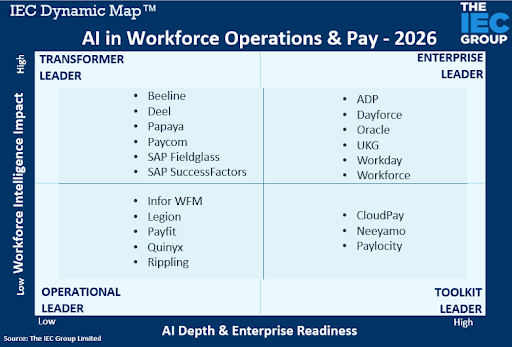 Our Enterprise Leaders are the platforms that can genuinely become the operational backbone of a large, global workforce. Alphabetically, they are:
- ADP
- Dayforce
- Oracle
- UKG
- Workday
- WorkForce Software
What they share:
- Unified time, scheduling, and pay – They connect time capture, scheduling rules, and payroll calculation end-to-end.
- Deep compliance engines – Continuous updates for country- and industry-specific regulations, often backed by local experts.
- AI embedded in core workflows – Demand-driven scheduling, time anomaly detection, predictive insights on overtime and labor cost, not just dashboards.
For large enterprises running multi-country operations, these platforms can become the command center for labor cost, compliance, and workforce agility. But, as with all big platforms, they demand serious governance and cross-functional ownership.
Transformer Leaders: Reimagining Workforce Orchestration
Our Transformer Leaders are the specialists that change how you think about workforce operations itself – often by integrating external and internal workforces or pushing AI deeper into scheduling and pay.
Alphabetically, this group includes:
- Beeline
- Deel
- Papaya Global
- Paycom
- SAP Fieldglass
- SAP SuccessFactors
Why they matter:
- Total workforce lens – VMS and EOR providers that bring contingent and cross-border workers into the same intelligence fabric as employees.
- AI-infused orchestration – Recommendations on sourcing channels, engagement models, and rate benchmarks.
- Bridging HR, Procurement, and Finance – Data and workflows that connect talent demand, spend management, and compliance in one conversation.
Transformer Leaders are often the change agents for organizations that realize “headcount” is only half the story; the other half is contractors, SOW workers, and global assignments that used to sit in disconnected systems and spreadsheets.
Toolkit Leaders: Precision Instruments for Complex Payroll
Our Toolkit Leaders are focused, highly specialized solutions that plug into broader ecosystems to solve the hardest payroll and pay-compliance problems, especially in multi-country contexts.
Alphabetically:
- CloudPay
- Neeyamo
- Paylocity
Their strengths:
- Global and cross-jurisdiction payroll – Handling complex, distributed workforces where local rules and currencies multiply risk.
- AI for anomaly detection and control – Identifying suspicious payments, configuration issues, and compliance gaps before they become headlines.
- Integration-first design – Playing nicely with HCM, finance, and time systems while adding a sophisticated pay-intelligence layer.
For organizations with relatively solid scheduling but painful payroll complexity, Toolkit Leaders often deliver the fastest ROI.
Operational Leaders: Raising the Baseline for Everyday Work
Finally, our Operational Leaders excel at making day-to-day scheduling and time operations smarter and more humane – often with a strong industry focus.
Alphabetically:
- Infor WFM
- Legion
- Payfit
- Quinyx
- Rippling
What sets them apart:
- Operational excellence – Strong coverage of scheduling, forecasting, time & attendance, and frontline-manager usability.
- AI as co-pilot – Smart demand prediction, shift recommendations, and labor-cost insights baked into everyday workflows.
- Mid-market accessibility – Often cloud-native and mobile-first, bringing advanced WFM capabilities to fast-growing organizations.
Operational Leaders may not yet reach the deepest enterprise AI maturity, but they dramatically improve the baseline and prepare organizations for more advanced orchestration.
Real Use Cases, Real Money
Across the study, a few use cases consistently produced measurable business benefits:
- Demand-Aware Scheduling
AI forecasting that ingests historical sales, bookings, seasonality, and external signals (weather, holidays, events) to automatically propose staffing levels and shift patterns.
Impact:
- Reduced over- and understaffing
- Improved service levels and conversion rates
- Lower overtime and agency reliance
- Preference- and Wellbeing-Aware Rosters
Scheduling engines that consider employee availability, skills, contractual limits, and even wellbeing constraints (e.g., limiting clopenings, honoring sleep windows).
Impact:
- Higher shift acceptance and lower absenteeism
- Better retention in frontline and shift-heavy roles
- Better compliance with local labor practices and union agreements
- Time & Attendance Anomaly Detection
AI models that flag unusual patterns: repeated missing punches, improbable locations, suspected buddy punching, or systematic rule violations.
Impact:
- Reduced leakage and fraud
- Stronger control environment for auditors and regulators
- Faster resolution of payroll disputes
- Pay Accuracy & Compliance Intelligence
Automated checks that simulate payroll runs, compare results with expected ranges, and highlight exceptions or rule misconfigurations.
Impact:
- Fewer payroll errors and re-runs
- Lower risk of wage & hour claims and penalties
- Greater trust from employees in pay transparency initiatives
- Extended Workforce Mix Optimization
Recommendations on whether to use full-time employees, contractors, agencies, or EOR arrangements based on cost, risk, and speed.
Impact:
- More strategic use of contingent labor
- Better alignment of spend with business priorities
- Reduced shadow workforce and misclassification risk
What This Means for CHROs, COOs, and CFOs
Three strategic messages emerged from this second study:
- Workforce Operations is now a board-level lever
Labor cost, compliance risk, and service quality are converging. AI-enabled WFM and payroll are no longer “back office” – they are direct contributors to margin protection and growth.
- Workforce Intelligence must span employees and non-employees
If your view stops at the HRIS boundary, you’re only seeing half the picture. The winners will integrate VMS, FMS, EOR, and payroll into one intelligence layer.
- Governance is non-negotiable
AI that touches pay, hours, and workforce allocation is highly sensitive. Explainability, auditability, and clear human-in-the-loop controls are as important as model accuracy.
What This Means for Vendors
For vendors featured on the IEC Dynamic Map™, the stakes are high:
- Prove the impact. Customers want concrete metrics: fewer payroll errors, better schedule adherence, lower labor cost per unit of output.
- Own your role in the ecosystem. Are you the operational backbone, the orchestrator, or the specialist toolkit? Clarity wins deals.
- Invest in compliance and trust. The ability to withstand regulatory scrutiny and union questions will increasingly differentiate leaders from the pack.
The full IEC study provides detailed, vendor-specific insights, including strengths, challenges, and future-readiness assessments.
Inside the Full Study
The public quadrant gives a high-level snapshot of the AI in Workforce Operations & Pay market, listing the top 20 providers alphabetically within their leader quadrants.
The full IEC report goes much deeper:
- Exact positioning and scoring within each quadrant
- Detailed analyst write-ups for each vendor
- Example customer use cases and outcomes
- Trend analysis across scheduling, pay, and total workforce orchestration
- Buyer guidance for CHROs, COOs, CFOs, and HRIT leaders
To access the full study or discuss briefings and licensing options, contact pm@theiecgroup.com.
Copyright & Usage Notice
The IEC Dynamic Map™ – AI in Workforce Operations & Pay 2026 and all related content are the exclusive intellectual property of The IEC Group Limited.
- No vendor, partner, or third party may reproduce, distribute, edit, or reuse the quadrant, the IEC Dynamic Map™ label, or any part of this study without prior written permission from The IEC Group Limited.
- Appearance on the map does not grant any automatic right to claim or market “Leader,” “Top Provider,” or similar status.
- Any external reference to quadrant positioning or leader designation (e.g., “Enterprise Leader,” “Transformer Leader,” “Toolkit Leader,” “Operational Leader”) requires a valid license and explicit written approval from The IEC Group Limited.
- Unauthorized use, misrepresentation, or implied endorsement is strictly prohibited and may result in legal action.
If you are a vendor featured in this study and would like to reference your positioning or co-create marketing assets (such as whitepapers or campaigns), please reach out to pm@theiecgroup.com to discuss licensing and collaboration opportunities.
Bottom line:
AI in Workforce Operations & Pay is no longer a back-office upgrade. It is the control room where labor cost, compliance, and experience intersect. The 20 providers on this year’s IEC Dynamic Map™ are already rewiring how work is scheduled, paid, and orchestrated.
The only real question is: Will you run your workforce with spreadsheets and hope – or with intelligence and intent?
pm@theiecgroup.com —The IEC Rebels Digest Team
Want to build trust through independent validation?
If you want to learn more about IEC Audit & Certification—and how independent audits can strengthen compliance maturity, procurement confidence, and continuous improvement—reach out to: pm@theiecgroup.com
Free participation: EOR Study 2026
Provider participation is free of charge for qualified companies. If you want to ensure your offering is correctly positioned and represented in the market, contact:
pm@theiecgroup.com See you in the study. —The IEC Rebels Digest Team
Why This Matters for the IEC Global EOR Study 2026
 This is not just a market commentary. It’s the exact reason the IEC Global EOR Study 2026 is structured the way it is.
The study will assess providers across eight evaluation categories that reflect the compliance stack reality:
- Global Reach & Legal Infrastructure
- Compliance & Licensing Depth
- Tech Stack & Platform Maturity
- AI & Process Automation
- Client Experience (CX)
- Employee Experience (EX)
- Integration & API Coverage
- Innovation & Market Differentiation
And yes—there will be visibility into who ranks strongest across these categories, alongside insights into rising disruptors and the strategic direction of the market.
Because in 2026, “EOR provider” is not a uniform label. The gap between providers is widening—and the winners will be those who can prove compliance as infrastructure, not claim it as a feature.
A Final Reality Check
Global workforce management is no longer just about hiring talent abroad. It’s about building a defensible employment operating model across legal regimes—and doing it with speed, transparency, and integration.
That is a regulated product challenge.
And that’s why the EOR market is heading toward a compliance-led shakeout.
The platforms that win won’t simply help companies hire globally. They will help companies stand up to scrutiny globally.
About the IEC Rebel’s Digest
We write for the ones breaking molds, building cross-border teams, and reshaping global work. No buzzwords. Just truths, tools, and tactics for the new era of employment.
IEC Rebel’s Digest— The IEC Group can help you audit your global employment setup by identifying labor leasing risks, verifying licensing requirements, and ensuring your EOR partners meet every compliance standard—before regulators come knocking.
Last but not Least: If you’re facing challenges and wondering how others are managing similar issues, why not join The Leadership Collective Community? It’s a peer group and webcast platform designed for leaders to exchange insights and experiences.
Introducing the IEC Knowledge Network Free Membership – Your Gateway to Seamless Access!
We are thrilled to present a new service that goes beyond the ordinary download experience. In addition to offering you the ability to download the things you love, we are delighted to introduce the IEC Knowledge Network Free Membership.
The Free Membership option grants you access to our library of articles and videos, without the need for tedious registrations for each piece of content.
The publication serves as a trusted resource to support executives in their pursuit of sustainable and successful global expansion. In addition the IEC Practitioners are available to discuss your specific challenge in more detail and to give you clear advise..
Take advantage of this valuable resource to accelerate your global expansion journey

