
That Actually Moves the Needle: What the Three IEC Dynamic Map™ Studies Reveal About Talent, Workforce Operations, and Employee Experience in 2026
After years of AI hype, HR and workforce leaders are finally asking the only question that matters: where is AI producing real business value?
The three 2026 IEC Dynamic Map™ studies offer one of the clearest answers yet. Across AI in Talent Intelligence & Development, AI in Workforce Operations & Pay, and AI in Employee Experience & People Insights, the market is no longer defined by generic claims about copilots, assistants, or automation. It is being defined by where vendors are delivering meaningful workforce intelligence impact and where they are proving enterprise-grade readiness.
That is exactly what the IEC Dynamic Map™ is designed to show.
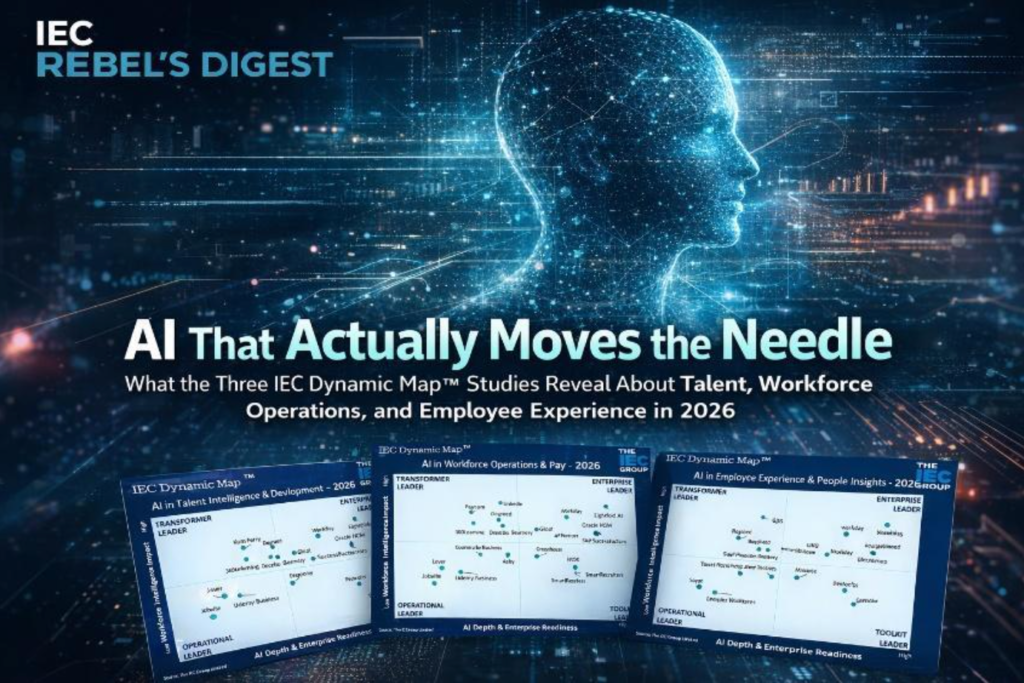 Each map plots vendors on two dimensions: AI Depth & Enterprise Readiness on the horizontal axis, and Workforce Intelligence Impact on the vertical axis. The result is four distinct leadership zones. Enterprise Leaders sit in the upper right, combining scale, maturity, and high impact. Transformer Leaders in the upper left are high-impact innovators that may be more specialized, narrower, or less enterprise-standardized. Toolkit Leaders in the lower right often bring strong capabilities and readiness, but with more limited overall workforce intelligence effect. Operational Leaders in the lower left address practical needs well, but with less strategic or transformational impact at enterprise level.
The first lesson from the three studies is simple: AI leadership in HR is not one market. It is three different battlegrounds, with different winners, different strengths, and different value stories.
1) AI in Talent Intelligence & Development: from recruiting automation to skills-based intelligence
The Talent Intelligence & Development map shows perhaps the clearest shift away from “AI for recruiting efficiency” toward AI for workforce matching, mobility, capability visibility, and learning intelligence.
In the Enterprise Leader quadrant, the map places Eightfold AI, Workday, Oracle HCM, SAP SuccessFactors, Phenom, and Gloat. This is a strong signal that enterprise buyers increasingly value not only matching engines or AI features, but also the ability to embed intelligence into broad talent processes, data models, and workforce planning environments. Eightfold AI stands out as a pure-play AI talent leader with strong enterprise credibility. Workday and Oracle HCM show how major platforms are translating scale and architecture into AI relevance. SAP SuccessFactors and Phenom reinforce the strength of suites and experience layers, while Gloat’s placement reflects the rising importance of internal mobility, talent marketplaces, and dynamic skills deployment.
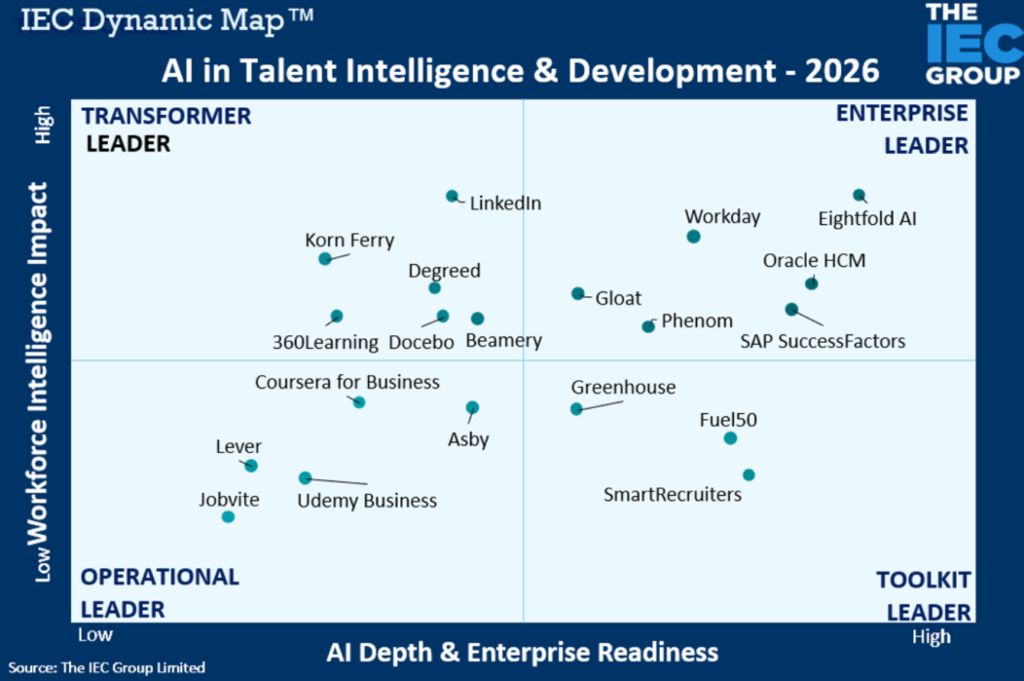 In the Transformer Leader quadrant, the map places LinkedIn, Korn Ferry, Degreed, 360Learning, Docebo, and Beamery. This is an important cluster. It suggests that some of the most influential AI contributions in talent are still coming from specialists with sharp category focus: skills intelligence, learning personalization, career pathing, recruiting intelligence, and talent discovery.
LinkedIn’s position reflects the continuing power of data scale and graph-based talent intelligence. Korn Ferry signals the enduring relevance of assessment and organizational intelligence. Degreed, 360Learning, and Docebo show that learning is no longer a content delivery problem; it is an intelligence problem. Beamery remains relevant where talent CRM, matching, and workforce planning intersect.
In the Operational Leader quadrant, the map places Lever, Jobvite, Udemy Business, Coursera for Business, and Asby. These vendors matter because they address real use cases, often with practical adoption paths, but they are not shaping the broader enterprise intelligence layer to the same degree as the upper quadrants.
In the Toolkit Leader quadrant, the map places Greenhouse, Fuel50, and SmartRecruiters. This is not a negative result. It means these vendors show credible readiness and useful functionality, but their current market position on this map suggests a more focused or narrower workforce intelligence effect relative to the top-right and top-left leaders.
The benefit story in talent is increasingly clear. The major value of AI here is not just faster screening. It is better matching, improved quality of hire, stronger internal fill rates, more targeted learning, better visibility into adjacent skills, and more intelligent workforce deployment over time. In other words, the biggest gains come when AI stops being a hiring trick and becomes a workforce capability engine.
2) AI in Workforce Operations & Pay: where AI proves ROI fastest
If talent is where AI becomes strategic, workforce operations and pay is where AI often proves itself fastest.
This map is arguably the most pragmatic of the three. It focuses on AI in scheduling and time management, payroll and compliance, and total workforce orchestration across employees, contractors, temporary labor, and EOR-linked models. Here the business case is immediate: labor costs, coverage, accuracy, compliance, and execution.
In the Enterprise Leader quadrant, the map places UKG, Workforce, Dayforce, ADP, Workday, and Oracle. This group reflects a market where enterprise buyers reward vendors that can connect forecasting, scheduling, payroll, policy, compliance, and execution at scale. UKG’s position is unsurprising given its workforce management strength. Dayforce and ADP show the power of execution-rich payroll and workforce platforms. Workday and Oracle again demonstrate cross-domain enterprise gravity. Workforce’s position signals strong relevance in operational workforce management environments.
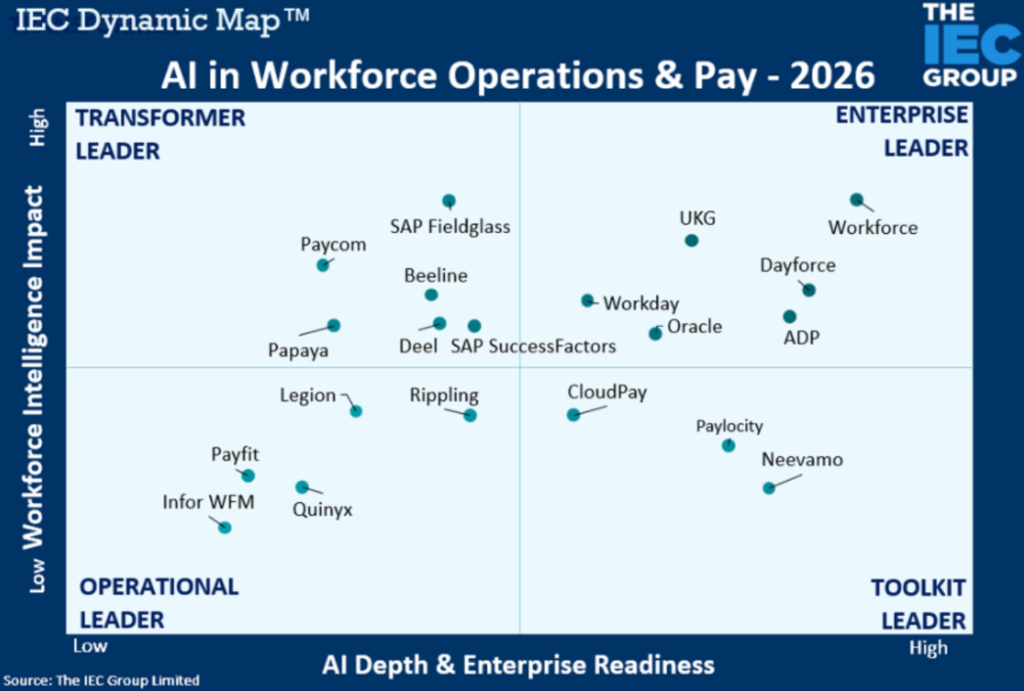 In the Transformer Leader quadrant, the map places SAP Fieldglass, Paycom, Beeline, Papaya, Deel, and SAP SuccessFactors. This is a fascinating mix. SAP Fieldglass and Beeline show the growing importance of non-employee workforce intelligence and orchestration. Deel and Papaya reflect how global work models, compliance, and cross-border workforce infrastructure are becoming AI-relevant. Paycom’s placement highlights practical automation in pay and people operations. SAP SuccessFactors appears here rather than in the upper right, which suggests breadth, but comparatively more mixed positioning in this specific operational domain.
In the Operational Leader quadrant, the map places Legion, Rippling, Payfit, Infor WFM, and Quinyx. These are serious vendors with real-world relevance, particularly in frontline labor, SMB-midmarket, and execution-heavy scenarios. Their placement suggests practical strength, but less total enterprise intelligence impact than the leaders above them.
In the Toolkit Leader quadrant, the map places CloudPay, Paylocity, and Neevamo. Again, this indicates useful capabilities and credible readiness, but a more targeted or narrower market impact on the specific dimensions of this study.
The benefits here are the most measurable of the three studies. AI in Workforce Operations & Pay can reduce overstaffing and understaffing, improve schedule quality, lower overtime leakage, reduce payroll errors, accelerate exception handling, improve compliance monitoring, and help organizations manage mixed workforce models with far more precision. This is where AI stops being a dashboard layer and starts acting like an operating system for labor execution.
For many organizations, this is also where skepticism about AI is defeated. Not with abstract future vision, but with better coverage, fewer pay issues, lower manual effort, and more predictable labor economics.
3) AI in Employee Experience & People Insights: from surveys to continuous workforce intelligence
The third map shows AI’s growing impact on a domain that used to be treated as softer, more fragmented, and harder to measure: employee experience and people insights.
That is changing quickly.
In the Enterprise Leader quadrant, the map places Microsoft Viva, Workday, Oracle, ServiceNow, Visier, and SAP SuccessFactors. This cluster shows that experience is becoming deeply connected to workflow, collaboration, analytics, and enterprise architecture. Microsoft Viva’s placement reflects the advantage of being embedded in the daily digital work environment. ServiceNow demonstrates the rise of workflow-led employee service models. Visier remains highly relevant where people analytics and decision intelligence are central. Workday, Oracle, and SAP SuccessFactors again show the scale advantage of integrated platforms.
In the Transformer Leader quadrant, the map places Perceptyx, UKG, CultureAmp, Moveworks, Qualtrics EmployeeXM, and Espressive. This is a powerful group of innovators. Perceptyx, CultureAmp, and Qualtrics EmployeeXM show how listening, sentiment, and experience intelligence are becoming AI-enhanced decision systems rather than simple survey tools. Moveworks and Espressive show the importance of conversational automation and employee support. UKG’s presence here, while also appearing as an Enterprise Leader in Workforce Operations & Pay, illustrates how a vendor can be highly impactful in one domain while playing a more innovation-driven role in another.
In the Operational Leader quadrant, the map places One Model, WorkTango, Zoho People, Anaplan Workforce, and ChartHop. These vendors contribute meaningful capabilities, often in analytics, planning, or practical employee-facing workflows, but their current position on this map suggests a lower overall workforce intelligence effect versus the upper quadrants.
In the Toolkit Leader quadrant, the map places 15Five, BambooHR, and Crunchr. This reflects focused capability and usable solutions, but a more bounded impact footprint in the broader EX and insights market.
The major benefits of AI in this domain are increasingly tangible: better self-service, reduced HR service friction, faster response times, stronger manager support, improved sentiment visibility, earlier retention risk detection, more continuous planning insight, and better alignment between experience data and operational action. The big shift is that EX is no longer about measuring feelings after the fact. It is about detecting workforce signals early enough to improve outcomes.
What the three studies say together
Taken together, the three maps reveal several market truths.
First, Workday and Oracle show the strongest cross-study consistency in the Enterprise Leader zone. That matters. It suggests that AI advantage increasingly comes from integrated data, architecture, workflow depth, and platform reach.
Second, specialists remain essential. LinkedIn, Eightfold AI, Gloat, SAP Fieldglass, Beeline, Perceptyx, CultureAmp, Qualtrics EmployeeXM, Moveworks, and others prove that category leaders can still outperform broader suites in innovation intensity and use-case depth.
Third, the real benefits of AI are operational and compounding, not theatrical. In talent, AI improves matching and capability development. In workforce operations, it improves labor execution and compliance. In employee experience, it improves service, insight, and decision quality. These are not isolated wins. Together, they strengthen the entire workforce system.
Fourth, leadership is domain-specific. A vendor’s position in one IEC Dynamic Map™ should never be generalized to another. A company may be an Enterprise Leader in one market, a Transformer Leader in another, or a Toolkit Leader in a third. That is not inconsistency. It is what a realistic market view looks like.
How to use the charts correctly
The charts should be used as strategic positioning tools, not as simplistic procurement scorecards. The right way to reference a position is by the exact study title and year, for example: positioned as an Enterprise Leader in the IEC Dynamic Map™: AI in Workforce Operations & Pay – 2026. A position should not be extended to other domains, other maps, or future years without that explicit study context.
The maps should also be reproduced in full, with the source attribution to The IEC Group Limited, and without altering relative vendor placement. Most importantly, buyers should use them to guide the next question, not to end the conversation. A Transformer Leader may be the best fit for a company seeking category depth. A Toolkit Leader may be exactly right for a narrower problem set. An Enterprise Leader may be the strongest option when governance, scale, and integration matter most.
That is the real takeaway from these three IEC studies.
The AI market in HR and workforce management is no longer about who talks the loudest. It is about who is creating measurable workforce intelligence impact, who is enterprise-ready, and who is turning AI from promise into performance. The vendors in these maps are not all winning in the same way. But the leaders are increasingly easy to spot: they are the ones making work more intelligent, more adaptive, and more executable at scale.
Inside the Full Study
The public IEC Dynamic Map™ gives a high-level overview of the AI in Employee Experience & People Insights market, with the top 20 providers displayed alphabetically inside their leader quadrants.
The full IEC report goes significantly deeper, including:
- Exact positioning and scoring for each vendor within the quadrant
- Detailed analyst commentary on capabilities, AI maturity, and roadmap
- Use-case examples and customer stories
- Architectural patterns for combining Enterprise, Transformer, Toolkit, and Operational leaders
- Practical buyer guidance for CHROs, Heads of EX, and People Analytics leaders
For access, briefings, or licensing options, please contact pm@theiecgroup.com.
Copyright & Usage Notice
The IEC Dynamic Map™ – AI in Employee Experience & People Insights 2026 and all accompanying materials are the exclusive intellectual property of The IEC Group Limited.
- No vendor, partner, or third party may reproduce, distribute, edit, or otherwise use the quadrant, the IEC Dynamic Map™ label, or any part of this study without prior written permission from The IEC Group Limited.
- Being listed on the map does not grant any automatic right to claim or market “Leader,” “Top Provider,” “Transformer Leader,” “Enterprise Leader,” “Toolkit Leader,” or “Operational Leader” status.
- Any external marketing, PR, or sales use of IEC positioning or leader designations requires a valid license and explicit written approval from The IEC Group Limited.
- Unauthorized use, misrepresentation, or implied endorsement is strictly prohibited and may result in legal action.
If you are a featured vendor and wish to reference your IEC positioning, or to co-create content such as whitepapers or campaigns, please reach out to pm@theiecgroup.com to discuss licensing and collaboration.
Bottom line:
AI-powered Employee Experience & People Insights are no longer “nice to have” analytics projects. They’re becoming the nervous system of how organizations listen, learn, and plan. The 20 leaders on this year’s map are already turning signals into decisions – and decisions into better workplaces. The question is whether you’ll still be managing EX by annual survey while they’re running the future in real time.
pm@theiecgroup.com —The IEC Rebels Digest Team
Want to build trust through independent validation?
If you want to learn more about IEC Audit & Certification—and how independent audits can strengthen compliance maturity, procurement confidence, and continuous improvement—reach out to: pm@theiecgroup.com
Free participation: EOR Study 2026
Provider participation is free of charge for qualified companies. If you want to ensure your offering is correctly positioned and represented in the market, contact:
pm@theiecgroup.com See you in the study. —The IEC Rebels Digest Team
Why This Matters for the IEC Global EOR Study 2026
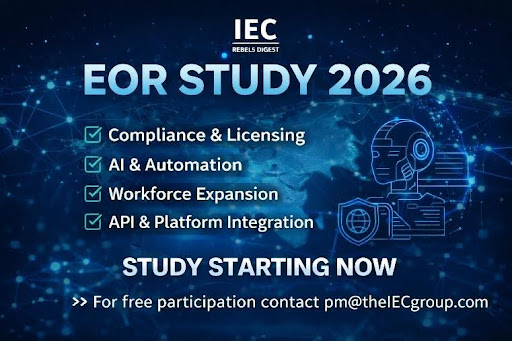 This is not just a market commentary. It’s the exact reason the IEC Global EOR Study 2026 is structured the way it is.
The study will assess providers across eight evaluation categories that reflect the compliance stack reality:
- Global Reach & Legal Infrastructure
- Compliance & Licensing Depth
- Tech Stack & Platform Maturity
- AI & Process Automation
- Client Experience (CX)
- Employee Experience (EX)
- Integration & API Coverage
- Innovation & Market Differentiation
And yes—there will be visibility into who ranks strongest across these categories, alongside insights into rising disruptors and the strategic direction of the market.
Because in 2026, “EOR provider” is not a uniform label. The gap between providers is widening—and the winners will be those who can prove compliance as infrastructure, not claim it as a feature.
A Final Reality Check
Global workforce management is no longer just about hiring talent abroad. It’s about building a defensible employment operating model across legal regimes—and doing it with speed, transparency, and integration.
That is a regulated product challenge.
And that’s why the EOR market is heading toward a compliance-led shakeout.
The platforms that win won’t simply help companies hire globally. They will help companies stand up to scrutiny globally.
About the IEC Rebel’s Digest
We write for the ones breaking molds, building cross-border teams, and reshaping global work. No buzzwords. Just truths, tools, and tactics for the new era of employment.
IEC Rebel’s Digest— The IEC Group can help you audit your global employment setup by identifying labor leasing risks, verifying licensing requirements, and ensuring your EOR partners meet every compliance standard—before regulators come knocking.
Last but not Least: If you’re facing challenges and wondering how others are managing similar issues, why not join The Leadership Collective Community? It’s a peer group and webcast platform designed for leaders to exchange insights and experiences.
Introducing the IEC Knowledge Network Free Membership – Your Gateway to Seamless Access!
We are thrilled to present a new service that goes beyond the ordinary download experience. In addition to offering you the ability to download the things you love, we are delighted to introduce the IEC Knowledge Network Free Membership.
The Free Membership option grants you access to our library of articles and videos, without the need for tedious registrations for each piece of content.
The publication serves as a trusted resource to support executives in their pursuit of sustainable and successful global expansion. In addition the IEC Practitioners are available to discuss your specific challenge in more detail and to give you clear advise..
Take advantage of this valuable resource to accelerate your global expansion journey

