
Where to find the best AI developers, where to build the army, and how not to outsource your future
 The AI talent market has already split in two, but many companies are still hiring as if nothing changed. They keep asking one lazy question: Which country is best for AI developers? That question is already obsolete. The countries producing frontier AI models, attracting the biggest AI capital, and concentrating elite technical leadership are not the same countries generating the fastest-growing developer populations for scaled execution. Stanford’s 2025 AI Index shows the U.S. still leads in notable AI models and private AI investment, while GitHub’s 2025 data shows explosive developer growth in India, Brazil, Indonesia, and other fast-rising markets. The map for AI brilliance and the map for AI manpower are no longer the same map.
That is the first thing executives need to understand: the best AI experts and the best place to build a manpower-intensive AI development team are often different labor markets. If you need people who can shape model strategy, design evaluation systems, make architecture calls, and decide when not to trust the model, you should look at the markets where frontier AI is actually being built. Stanford reports that U.S.-based institutions produced 40 notable AI models in 2024, compared with 15 from China and three from Europe, while U.S. private AI investment hit $109.1 billion, far ahead of China and the U.K. That does not mean every company should build in Silicon Valley. It means your top technical nucleus should come from markets where deep AI capability is thick rather than thin.
And that nucleus is increasingly mobile. LinkedIn’s January 2026 labor report says AI engineering talent is 8x more likely to move across borders than the average LinkedIn member. Its net migration data shows the UAE, Ireland, Germany, the U.S., and Singapore attracting AI engineering talent, while India and Israel appear as net exporters. In plain English, the strongest AI people are not just concentrated — they are moving toward ecosystems with money, infrastructure, and serious ambition. So the right answer is often not “hire locally or offshore.” It is “build a core team wherever the best AI judgment can realistically be won.”
Now flip to the other side of the market: scale. GitHub’s 2025 Octoverse data is one of the clearest indicators of where software manpower is building fast. GitHub says more than 180 million developers now build on the platform, with over 36 million joining in 2025 alone. India added more than 5.2 million developers in one year and reached 21.9 million on GitHub, making it the second-largest developer community on the platform. Brazil reached 6.89 million and Indonesia 4.37 million, while GitHub says India, Brazil, and Indonesia have each more than quadrupled their developer populations since 2020. That is not a side note. That is the future labor pool for AI implementation at scale.
This is where the market gets distorted by hype. Too many leaders think they need dozens of “AI scientists,” when what they actually need is a small number of exceptional AI leaders and a much larger number of very good engineers who can turn models into products. There is a huge difference between inventing the engine and building the fleet. Most enterprises do not need 40 frontier researchers. They need perhaps three to five people who really understand model behavior, retrieval, orchestration, evaluation, governance, and failure modes — and then a much broader execution layer for product engineering, integration, security, testing, MLOps, data pipelines, and rollout. The frontier brain and the industrial bench are different hiring problems, and they should be treated that way. This is the core strategic inference from the Stanford and GitHub data.
EUROPE: For European companies, there is another truth that is still badly underappreciated: nearshore often beats offshore for serious AI work. Not because it is fashionable, but because collaboration physics matter more in AI than in routine development. Harvard Business School highlighted research showing that each additional one-hour time-zone gap reduces synchronous communication by 11%. That matters enormously when teams are debugging agent behavior, rewriting prompts, tuning retrieval, fixing latency problems, or trying to understand why the model is “almost right” in ways that are dangerous. AI projects live on fast feedback loops. Once the clock gap becomes too wide, the team slows down exactly where it should be fastest.
That gives Europe a bigger advantage than many executives realize. EF’s 2025 English Proficiency Index ranks Austria third globally, Germany fourth, Portugal sixth, Romania eleventh, and Poland fifteenth. Those are not just language scores; they are practical collaboration indicators for cross-border product work. For DACH, Benelux, and Nordic firms, this makes countries such as Portugal, Romania, and Poland especially attractive as the backbone layer of an AI organization: not necessarily the deepest frontier research hubs, but strong places to build engineering teams with decent cost logic, high overlap, and fewer execution losses from language or time-zone friction.
India: India remains the giant scale story, and no serious AI labor strategy should ignore it. GitHub’s numbers make that obvious. But India is not a magic shortcut. It is a scale engine that rewards management maturity. Large teams in India can be outstanding for platform engineering, QA, data operations, implementation, integrations, and continuous delivery — especially when they are led by a strong architectural nucleus. The mistake is not hiring in India. The mistake is expecting India to replace technical leadership rather than amplify it. Used correctly, it is one of the best places in the world to build manpower-intensive AI development capacity.
LATAM: Brazil and the broader LATAM region deserve a similar but slightly different reading. Brazil is now the fourth-largest developer community on GitHub, and GitHub explicitly highlights LATAM markets such as Brazil, Mexico, and Colombia as regional growth engines. For U.S.-based firms, the time-zone alignment can be strategically powerful. For European firms, LATAM becomes especially attractive where customer-facing work, product execution, or multilingual support matter more than daily deep collaboration with central architecture teams. The key is not to ask whether Brazil is “cheap.” The key is to ask whether Brazil is right for the layer of the organization you are trying to build.
MEA: Africa and the Gulf are the next chapter, not just a footnote. GitHub’s forward-looking view points to strong momentum in Egypt, Nigeria, Kenya, and Morocco, while LinkedIn’s migration data and Stanford’s global AI vibrancy work both show that the UAE has become a meaningful AI node rather than merely a rich buyer of imported technology. So two things can be true at once: parts of Africa are becoming increasingly relevant for future developer scale, and the UAE is becoming increasingly relevant for attracting senior AI talent, regional leadership, and ambitious AI infrastructure plays. Executives who still treat both as peripheral are reading last decade’s map.
So where do you actually find these people? Not by posting a generic “Senior AI Engineer” role and waiting for unicorns to appear. GitHub should be one of the first hunting grounds because it now hosts more than 180 million developers, and GitHub’s own documentation shows how repositories surface approachable contribution paths through labels such as good first issue. That matters because strong developers leave traces: pull requests, issues, review comments, documentation, testing discipline, and technical judgment in public discussion. Kaggle remains useful for applied machine learning and data science because it maintains live rankings of top data scientists. None of these sources is perfect on its own, but together they show far more than a buzzword-heavy résumé.
JUDGMENT: And here is the part too many talent teams still underestimate: in the AI era, judgment is becoming more valuable than raw coding speed. Stack Overflow’s 2025 survey says 84% of respondents are using or planning to use AI tools in development, yet more developers distrust AI output accuracy (46%) than trust it (33%). The same survey says 66% are frustrated by AI solutions that are “almost right,” and Stack Overflow notes that developers turn to human-verified knowledge when AI becomes unreliable. That is the whole hiring story in one paragraph. The best AI developers are not the ones who blindly use the tools. They are the ones who know when the tools are lying.
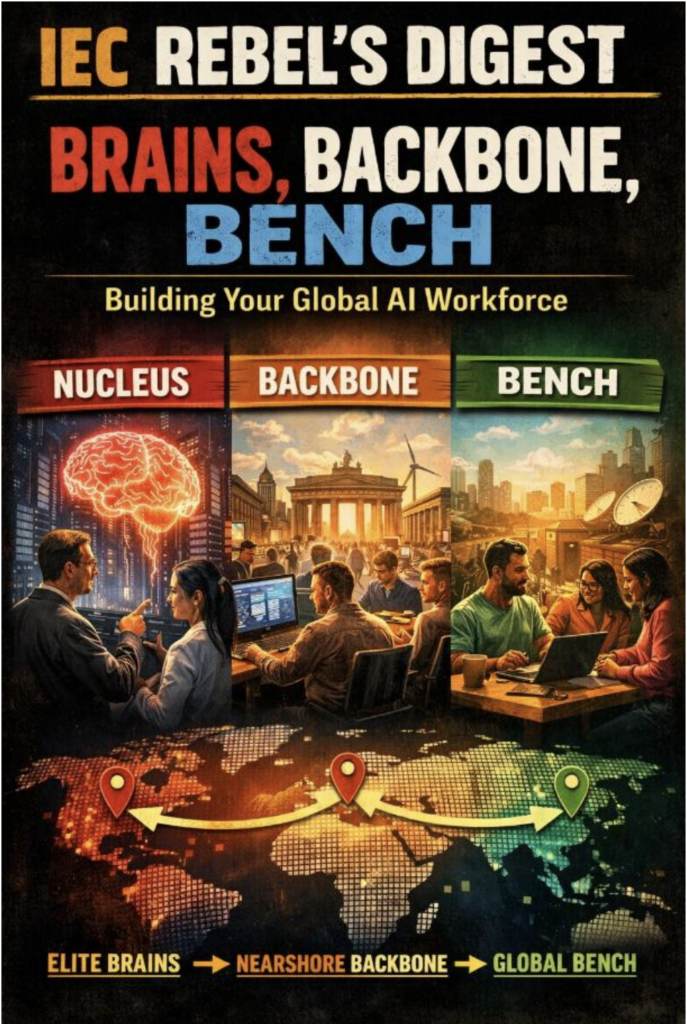
THREE-LAYER-MODEL: So how should companies approach this in 2026? With a three-layer model. Build a nucleus in high-caliber AI markets: your Head of AI, principal architect, evaluation lead, and perhaps one or two very strong product engineers. Build a backbone in collaboration-friendly nearshore markets that support real product velocity. Then build a bench in high-scale talent markets for implementation, testing, data work, support engineering, and rollout. Do not flatten all three into one outsourcing contract and call it strategy. That is not a talent model. That is abdication. The companies that separate brains from bench, while keeping architecture and decision rights close to the business, will move faster and protect more value. This is an inference from the labor-market data, but it is a strong one.
CONCLUSION: The real Rebel’s Digest conclusion is simple. Stop looking for one perfect country. It does not exist. The best experts are still concentrated in a handful of elite AI ecosystems led by the U.S., followed by China, the U.K., and a rising set of secondary hubs. The best markets for manpower-intensive AI execution are increasingly India, Brazil, Indonesia, and selected African growth markets, while Europe retains a strong nearshore edge through countries such as Portugal, Romania, and Poland. The winners will not be the companies that “outsource AI.” They will be the ones that design an AI workforce architecture: a small concentration of brilliance, a disciplined engineering backbone, and a scalable global bench. That is how you build for AI without outsourcing your future.
Rebel takeaway: In AI hiring, geography is no longer one decision. It is three: where you place the brain, where you build the backbone, and where you scale the bench.
Want to build trust through independent validation?
If you want to learn more about IEC Audit & Certification—and how independent audits can strengthen compliance maturity, procurement confidence, and continuous improvement—reach out to: pm@theiecgroup.com
Free participation: EOR Study 2026
Provider participation is free of charge for qualified companies. If you want to ensure your offering is correctly positioned and represented in the market, contact:
pm@theiecgroup.com See you in the study. —The IEC Rebels Digest Team
Why This Matters for the IEC Global EOR Study 2026
 This is not just a market commentary. It’s the exact reason the IEC Global EOR Study 2026 is structured the way it is.
The study will assess providers across eight evaluation categories that reflect the compliance stack reality:
- Global Reach & Legal Infrastructure
- Compliance & Licensing Depth
- Tech Stack & Platform Maturity
- AI & Process Automation
- Client Experience (CX)
- Employee Experience (EX)
- Integration & API Coverage
- Innovation & Market Differentiation
And yes—there will be visibility into who ranks strongest across these categories, alongside insights into rising disruptors and the strategic direction of the market.
Because in 2026, “EOR provider” is not a uniform label. The gap between providers is widening—and the winners will be those who can prove compliance as infrastructure, not claim it as a feature.
A Final Reality Check
Global workforce management is no longer just about hiring talent abroad. It’s about building a defensible employment operating model across legal regimes—and doing it with speed, transparency, and integration.
That is a regulated product challenge.
And that’s why the EOR market is heading toward a compliance-led shakeout.
The platforms that win won’t simply help companies hire globally. They will help companies stand up to scrutiny globally.
About the IEC Rebel’s Digest
We write for the ones breaking molds, building cross-border teams, and reshaping global work. No buzzwords. Just truths, tools, and tactics for the new era of employment.
IEC Rebel’s Digest— The IEC Group can help you audit your global employment setup by identifying labor leasing risks, verifying licensing requirements, and ensuring your EOR partners meet every compliance standard—before regulators come knocking.
Last but not Least: If you’re facing challenges and wondering how others are managing similar issues, why not join The Leadership Collective Community? It’s a peer group and webcast platform designed for leaders to exchange insights and experiences.
Introducing the IEC Knowledge Network Free Membership – Your Gateway to Seamless Access!
We are thrilled to present a new service that goes beyond the ordinary download experience. In addition to offering you the ability to download the things you love, we are delighted to introduce the IEC Knowledge Network Free Membership.
The Free Membership option grants you access to our library of articles and videos, without the need for tedious registrations for each piece of content.
The publication serves as a trusted resource to support executives in their pursuit of sustainable and successful global expansion. In addition the IEC Practitioners are available to discuss your specific challenge in more detail and to give you clear advise..
Take advantage of this valuable resource to accelerate your global expansion journey

