
What the IEC Global EOR Study 2026 really tells us about growth, regional shifts, and the next phase of global workforce infrastructure
For a long time, the Employer of Record market was underestimated.
Too many people still see EOR as a tactical workaround — a useful mechanism for hiring one engineer in Poland, one SDR in Mexico, or one support lead in the Philippines without setting up a local legal entity. That reading is now outdated. The newly announced IEC Global EOR Study 2026 makes that very clear. The category is no longer behaving like a narrow HR services niche. It is evolving into a broader layer of global workforce infrastructure.
And once a category moves from “helpful workaround” to “strategic infrastructure,” the rules change.
At that point, country count is no longer enough. Speed is no longer enough. Nice UX is no longer enough. The real competitive question becomes: who can combine compliant hiring, payroll, contractor support, platform maturity, customer experience, and global execution into something enterprises can actually trust at scale?
That is the real story behind the IEC Global EOR Study 2026. And that is why this year’s results deserve more than a quick press release skim.
A Bigger Market Than Many Expected
The first major signal from the 2026 study is simple: the market is stronger than many assumed.
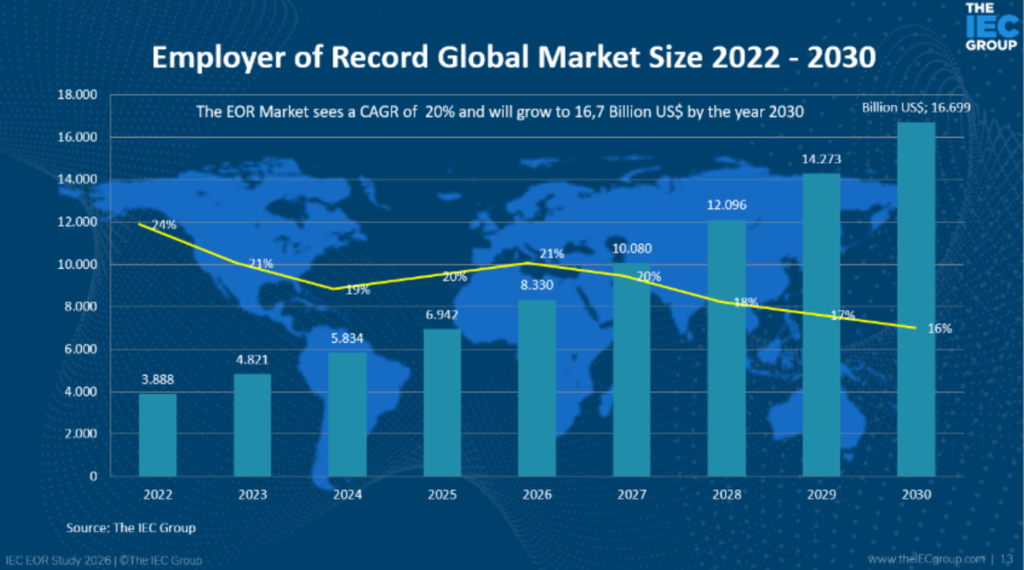 IEC has now revised its global market outlook upward and expects the EOR category to reach $16.7 billion by 2030, supported by a 20%+ CAGR outlook. That is a meaningful jump from the prior expectation of around $12 billion, and IEC directly links that stronger forecast to better-than-expected 2025 revenue performance, broader enterprise demand, wider use cases, and ongoing platform consolidation across the sector.
This matters because it tells us something fundamental about the maturity of the market.
If EOR were still mostly a temporary post-pandemic phenomenon or a narrow startup convenience layer, we would not be seeing this kind of upward revision. Instead, what the data suggests is that the market has proved more durable, more relevant, and more expandable than many observers expected. Even in an environment shaped by macroeconomic caution and tighter purchasing scrutiny, organizations are still investing in compliant global hiring models.
That is not just resilience. That is structural demand.
Why the Market Outlook Was Raised
IEC’s press release points to several reasons behind the stronger forecast, and each of them reveals something about how the category is changing.
The first driver is stronger enterprise demand for compliant global hiring models. That is significant because it moves the discussion beyond early-stage remote-first companies. Larger and more established organizations are increasingly using EOR not as a workaround, but as part of a structured workforce expansion strategy.
The second driver is broader use cases beyond classic EOR deployments. This is perhaps the most important strategic shift of all. EOR is no longer just about entering a new country quickly. It is becoming more closely tied to payroll, compliance orchestration, contractor management, and wider workforce planning.
The third and fourth drivers — the growing importance of payroll and contractor infrastructure, plus platform consolidation across fragmented HR and payroll stacks — point in the same direction. Buyers increasingly want fewer disconnected solutions. They want integrated infrastructure that can support international employment at scale.
Put simply, the EOR market is growing because it is becoming more useful to more serious buyers in more strategic contexts.
The Regional Map Is Changing Fast
The second big story in the 2026 results is regional balance.
According to the study, North America remains the largest single region for EOR deployment at 34%, but that lead is no longer the whole story. APAC has climbed to 29%, EMEA stands at 21%, LATAM at 11%, and Africa now appears as its own distinct 5% growth slice.
That distribution matters because it signals that the market is becoming more globally balanced.
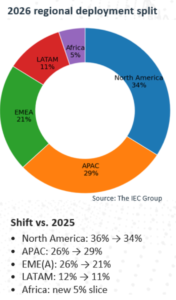 North America still leads in scale and adoption, but the category is no longer defined only by North American demand. The study identifies APAC as the strongest growth engine, driven by large digital talent pools and rising demand for compliant cross-border hiring. That is a major strategic signal. APAC is no longer just a region to source talent from. It is now central to the future growth logic of the sector.
EMEA remains a major region, and its importance is not hard to understand. Europe is one of the most compliance-intensive and operationally demanding environments in the world. That makes it a real proving ground for vendors claiming payroll depth, labor law sophistication, and execution quality.
LATAM continues to benefit from nearshore demand and time-zone alignment, particularly for companies expanding from North America. And Africa’s emergence as its own visible market slice is one of the more interesting developments in the study. IEC clearly frames Africa not as an extension of another region, but as a distinct growth zone for digital, support, and tech roles. That is a notable shift in how the market is being understood.
The short version: this is no longer a one-region market with some international tailwinds. It is a more distributed global category with multiple growth centers.
The Competitive Landscape Is Getting More Strategic
One of the strongest parts of the IEC press release is its treatment of the vendor landscape.
The market is no longer just a list of providers offering roughly the same promise. The study highlights meaningful differences across compliance depth, operating model, customer experience, platform maturity, and broader workforce capability. That is exactly what a maturing market should look like.
And those differences matter more now because buyers are starting to evaluate EOR vendors not just as service providers, but as strategic operating partners.
G-P Remains the Benchmark EOR-Focused Player
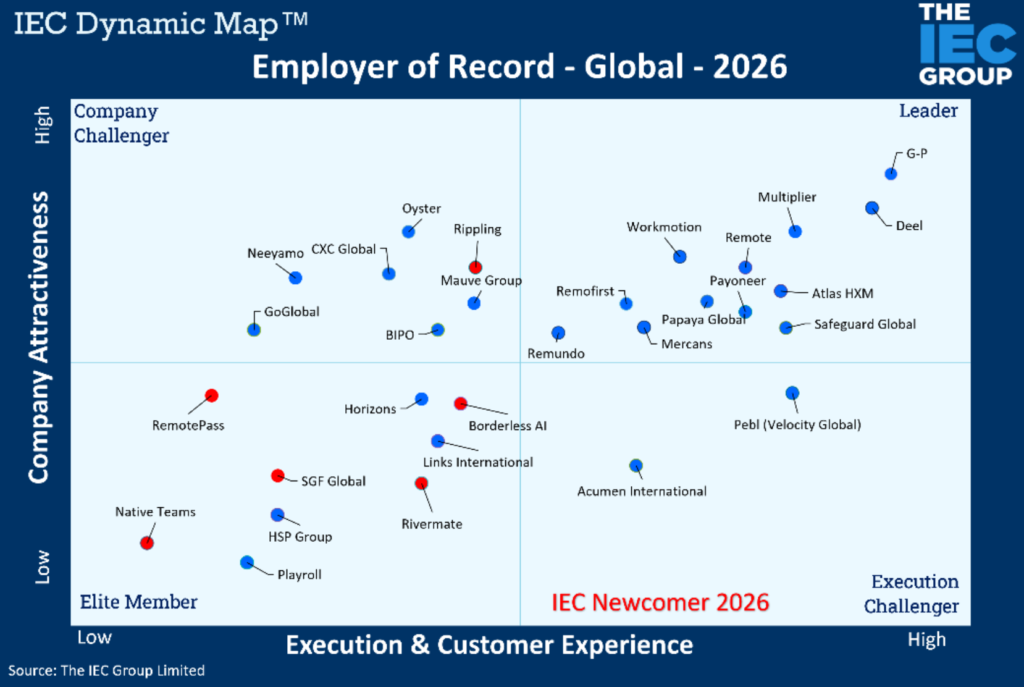 IEC again positions G-P as the benchmark for a fully EOR-focused model, emphasizing its strong market credibility, clear employer-of-record identity, and continuing relevance as one of the best-known specialists in the category.
That matters for two reasons.
First, it shows that dedicated EOR specialization still has real value. In a market where many players are broadening into larger workforce or HR platform stories, buyers still want a reference point for what a focused, mature EOR proposition looks like.
Second, it gives the market a baseline. Even in a fast-changing category, there is still value in knowing who represents the pure-play benchmark.
Multiplier Shows That Momentum Can Be Earned
IEC calls out Multiplier for one of the strongest improvements in the 2026 assessment. That is an important signal because it shows that this market is still fluid. Positions are not fixed. Vendors can strengthen their standing through execution, sharper positioning, and stronger market momentum.
That kind of movement is healthy for the category. It suggests the market is still dynamic enough for progress to matter.
WorkMotion Turns Compliance Into a Real Differentiator
WorkMotion stands out in the study as the only vendor in the peer group specifically recognized for compliance certification, giving it a particularly strong trust and compliance message, especially in the European market.
That is more than a marketing point.
As the EOR category matures, buyers increasingly want proof, not just claims. Compliance has always been central to the category, but in the past it was often treated as a baseline promise. Now it is becoming a visible differentiator. In a market where customers are more cautious and where auditability matters more, independently recognized compliance depth can become a very powerful strategic asset.
RemoFirst Pushes a Different Growth Formula
IEC describes RemoFirst as a provider drawing attention through a combination of high growth, low-cost positioning, and a partner-led delivery model. That is a very different route to market than the full-stack or specialist models, but it is clearly working for a specific buyer segment.
That matters because affordability still counts. Not every buyer is looking for the broadest platform or the deepest enterprise-grade architecture. Some want speed, broad coverage, and cost efficiency. RemoFirst’s visibility in the study suggests there is still strong market space for that proposition.
Deel Shows the Power of Scale and Product Breadth
IEC describes Deel as one of the market’s most visible and commercially powerful players, driven by broad HR product expansion beyond core EOR, strong growth momentum, and a company valuation that underscores its scale and ambition.
That positioning reflects one of the key tensions in the market right now: is EOR best delivered as a focused specialty, or as part of a broader global workforce and HR platform?
Deel is one of the clearest examples of the second approach. Its relevance is not just about size. It is about what size enables: more product breadth, more commercial visibility, and a much wider story than classic EOR alone.
EOR Is Moving Beyond a Point Solution
This is arguably the single most important conclusion in the 2026 study.
IEC states clearly that EOR is no longer viewed simply as a tactical solution for isolated foreign hires. Instead, it is increasingly intersecting with global payroll, HR technology, contractor management, compliance orchestration, mobility support, and international workforce planning.
That is a big statement, and it should be read carefully.
Because once EOR is connected to all of those adjacent layers, it stops being a niche buying decision. It becomes part of how organizations design and run a global workforce. The buyer conversation changes. Instead of only asking whether a provider can hire in a given country, customers start asking whether the provider can support mixed workforce models, integrate into payroll architecture, satisfy compliance teams, and scale with long-term international growth.
That is what infrastructure looks like.
And it also explains why the market is becoming more strategically differentiated. Some players are building toward broader platform relevance. Some are reinforcing specialization. Some are monetizing trust. Some are winning on cost. Some are trying to do several of those things at once.
What Buyers Should Take Away
There are four clear takeaways from the 2026 results.
- First, the market is bigger and stronger than many expected. The upward revision to $16.7 billion by 2030 shows that EOR is not fading into a niche service layer. It is expanding.
- Second, the market is becoming more globally balanced. North America still leads, but APAC’s rise, LATAM’s continued relevance, EMEA’s enduring importance, and Africa’s emergence all point to a more distributed demand picture.
- Third, vendor differentiation is deepening. G-P remains the benchmark focused player. Multiplier is gaining momentum. WorkMotion has a distinctive compliance message. RemoFirst is pushing a high-growth, low-cost model. Deel continues to demonstrate the power of platform breadth and commercial scale.
- And fourth, EOR is becoming part of global workforce infrastructure, not just a transactional hiring solution. That is the strategic shift that matters most.
The Old Lens No Longer Works
The 2026 study lands at exactly the right time.
The market is no longer simple. It is no longer just about fast hiring in foreign markets. It is no longer a side category sitting somewhere between HR outsourcing and payroll convenience. It is becoming more central to how global employment is structured.
That means the old evaluation lens no longer works.
The better question now is not just who can hire internationally. It is who can do it with the right mix of compliance, execution, platform depth, regional strength, and customer trust.
That is why the IEC Global EOR Study 2026 feels more significant than a normal market update. It does not just tell us that the market is growing. It tells us that the category is maturing, broadening, and becoming strategically more important.
Full Study Information
For more information on the full IEC Global EOR Study 2026, including vendor benchmarking, market outlook, regional deployment trends, and strategic analysis, the full study can be purchased by contacting pm@theIECgroup.com
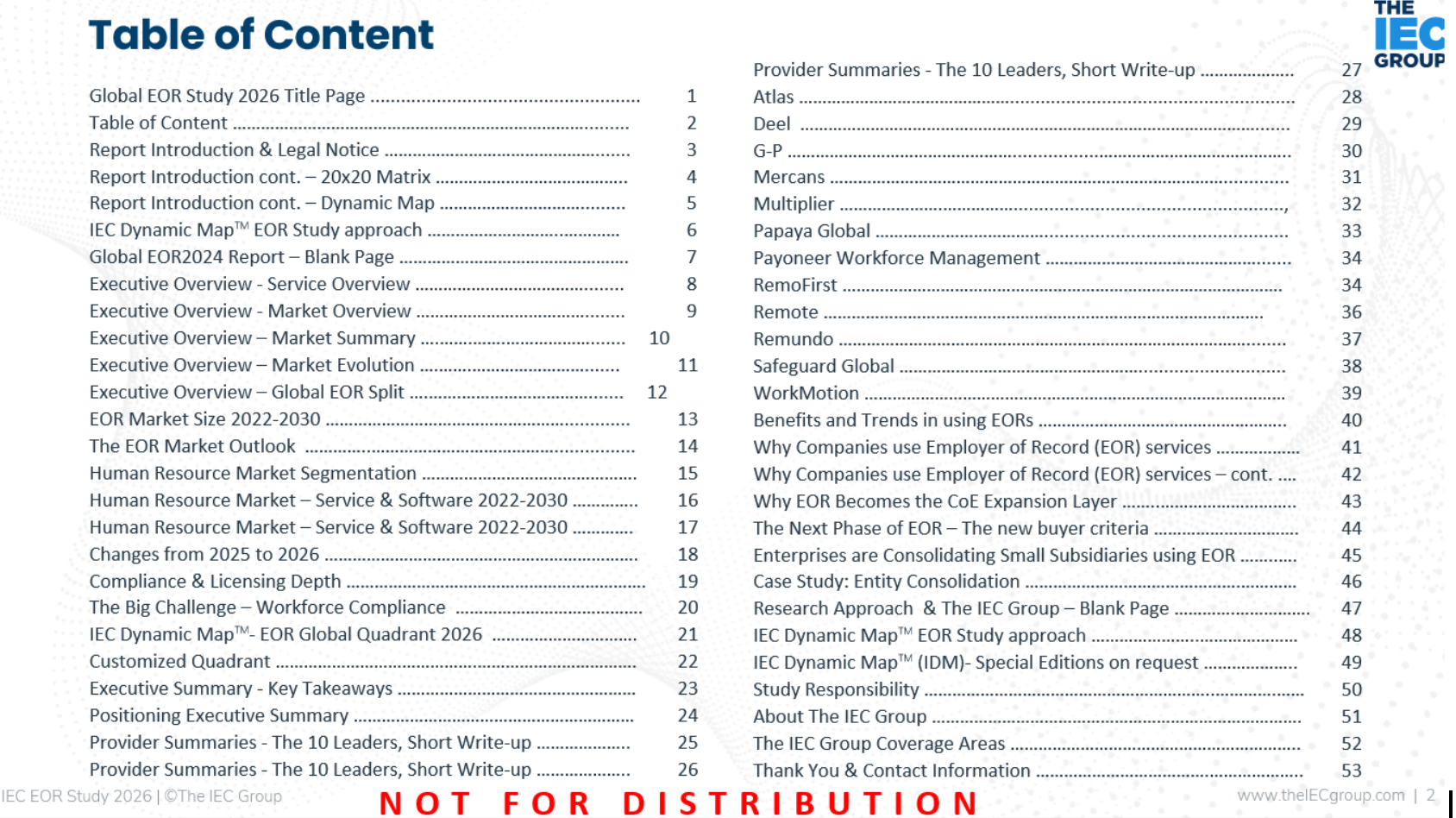
IEC study findings, assessments, and vendor positioning may not be reused, excerpted, adapted, or referenced for marketing, sales, or promotional purposes without prior written permission from The IEC Group.
About the IEC Group
The IEC Group is the leading fully integrated research, advisory and consulting company for mid-sized and large organizations, maximizing the business value of their international expansion initiatives through innovative, neutral and independent expert advice and membership approach.
The IEC Group offers a membership subscription service, consulting services, market surveys, vendor rating, conferences, round tables, web casts and publications related to international expansion, human resource issues, as well as technology trends. Our Membership includes unlimited access to our global expansion experts as well as strategy consulting and sourcing support.
For more information please contact our The IEC Group office or send us an Email to pm@theIECgroup.com
Last but not Least: If you’re facing challenges and wondering how others are managing similar issues, why not join The Leadership Collective Community? It’s a peer group and webcast platform designed for leaders to exchange insights and experiences.
Introducing the IEC Knowledge Network Free Membership – Your Gateway to Seamless Access!
We are thrilled to present a new service that goes beyond the ordinary download experience. In addition to offering you the ability to download the things you love, we are delighted to introduce the IEC Knowledge Network Free Membership.
The Free Membership option grants you access to our library of articles and videos, without the need for tedious registrations for each piece of content.
The publication serves as a trusted resource to support executives in their pursuit of sustainable and successful global expansion. In addition the IEC Practitioners are available to discuss your specific challenge in more detail and to give you clear advise..
Take advantage of this valuable resource to accelerate your global expansion journey

