
Why valuation, acquisitions, and platform sprawl are redrawing the global employment market
The EOR Market
 If you still think Employer of Record is a niche workaround for hiring one engineer in Poland, one SDR in Mexico, or one support manager in the Philippines, you are looking at the market through an old lens.
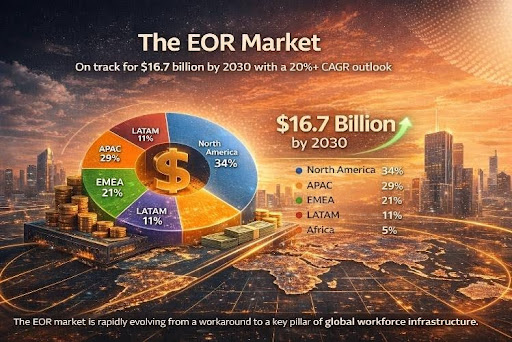
According to the upcoming IEC Global EOR Study 2026, the category is now on track for $16.7 billion by 2030 with a 20%+ CAGR outlook. The regional deployment picture is also shifting fast: North America remains largest at 34%, but APAC has climbed to 29%, followed by EMEA at 21%, LATAM at 11%, and Africa emerging as its own 5% growth slice. That is not a side story anymore. That is a new market shape.
And that shape matters, because once a category moves from “useful workaround” to “strategic infrastructure,” the competitive rules change. Suddenly, country count is not enough. Nice UX is not enough. Even speed is not enough. What matters now is who has capital, who has compliance depth, who has payroll engines, who owns critical pieces of the stack, and who can widen the offer from EOR into something much bigger: global workforce infrastructure.
That is the real 2026 story.
This week is not about the IEC Dynamic Map. That comes next. This week is about the money, the motion, and the strategic land grab underway behind the scenes.
And Editor’s note: Because the IEC Global EOR Study 2026 will be announced on April 28, IEC Rebel’s Digest lands on Tuesday next week instead of its usual Monday slot.
EOR is no longer selling only employment. It is selling trust at scale.
The first thing buyers need to understand is that EOR is moving out of the “HR services” box. The leaders do not want to be seen as vendors that merely hire abroad on your behalf. They want to be the platform you use to hire, onboard, pay, manage, equip, classify, move, and increasingly advise a global workforce.
That strategic broadening is visible everywhere.
G-P still matters because it remains one of the clearest benchmarks for a full EOR-focused model. While others have stretched into adjacent layers, G-P continues to anchor its identity around compliant global employment, with coverage in 180+ countries and a message built around execution, payroll accuracy, and global employment expertise. In a market getting noisier by the quarter, that clarity still carries weight.
That is important, because the market has not stopped needing a benchmark pure-play. In fact, as buyers grow more skeptical about marketing claims, the presence of a specialist reference point becomes even more valuable. You need one player that reminds the market what “serious EOR” looks like before you start debating who has the flashiest add-ons.
But the other big truth is this: the category is no longer being won by purity alone.
Valuation is not just vanity. It is strategic ammunition.
In the old SaaS world, valuation often functioned as a headline. In the EOR world of 2026, valuation is increasingly an operating weapon.
It buys entity build-out. It buys payroll infrastructure. It buys legal depth. It buys product breadth. It buys AI teams. It buys time. And, maybe most importantly, it buys the right to play offense while smaller rivals are still trying to fund compliance market by market.
That is why Deel and Rippling matter so much to the category conversation, even though they represent different models.
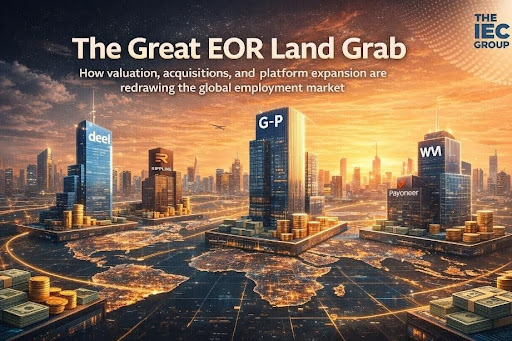 Deel announced a $300 million Series E in October 2025 at a $17.3 billion valuation. It also says it now serves 40,000+ companies, and has expanded its owned infrastructure and entities to 100+ countries. That combination of scale, infrastructure, and fresh capital is precisely why Deel keeps bending the category toward a broader HR and workforce platform story rather than staying boxed into a narrow EOR narrative.
And Deel has not been subtle about how it is using that capital. Its acquisition program has targeted exactly the layers that turn EOR into a larger operating system: PaySpace for deeper payroll infrastructure, Atlantic Money for payments rails in Europe, Hofy for global device and IT management, and Assemble for compensation management. Deel has also tied the PaySpace integration to a more unified payroll engine and real-time payroll processing across 50+ markets. That is not random shopping. That is a deliberate attempt to move from EOR vendor to cross-border workforce stack.
In plain English: Deel’s broad HR product expansion is not a side quest. It is the growth model.
Rippling proves the next battle is platform gravity.
If Deel represents the “EOR expanding outward” story, Rippling represents the reverse: the broader workforce platform that keeps pulling EOR into its gravitational field.
Rippling raised $450 million in Series G at a $16.8 billion valuation in 2025. The company says it now offers more than two dozen products across HR, IT, and spend, and that the new funding will support expansion into new markets, stronger products, and new capabilities. In April 2025, it also said its Employer of Record services were live in 80 countries.
That matters because Rippling changes the buyer conversation. It makes EOR part of a much bigger workflow. For some customers, especially more systems-minded or operations-heavy organizations, the appeal is not just “hire globally.” It is “run HR, payroll, IT, access, spend, and international employment in one system.”
That is a different value proposition from classic EOR. It is also a warning shot to the whole market. If EOR becomes just one module inside a broader workforce management system, then pure-play providers have to defend why they deserve a seat at the table on their own.
The Payoneer move tells you where the category is going next.
One of the most important structural developments in the market did not come from a traditional HR vendor at all. It came from fintech.
Payoneer acquired Skuad in 2024 for $61 million in cash, then rebranded it into Payoneer Workforce Management as part of a wider push into global workforce operations. In January 2026, Payoneer doubled down again by acquiring Irish EOR platform Boundless, saying the move would deepen its workforce management capabilities in Europe. In its 2025 full-year results, Payoneer said it had crossed $1 billion in annual revenue, and disclosed that the Boundless acquisition cost $13 million, with an additional earn-out of up to $4 million.
This is bigger than one deal.
It shows how the borders between payroll, payments, contractor payouts, AP, and EOR are collapsing. A company that already understands cross-border money movement can look at workforce management and say: why stop at paying companies and marketplaces? Why not own more of the labor transaction itself?
That is why the Boundless acquisition matters beyond its price tag. It was not a trophy deal. It was a precision move: faster European depth, stronger compliant coverage, and a better footprint for the workforce business Payoneer had already entered through Skuad. The signal is clear. EOR is no longer only attracting HR tech competition. It is attracting fintech, payments infrastructure, and broader global operations players too.
Compliance just became a marketable asset.
For years, EOR vendors talked about compliance as a baseline promise. In 2026, that is no longer enough. Buyers want proof.
That is why WorkMotion stands out. WorkMotion describes itself as the world’s first compliance-certified EOR, tied to the IEC Gold Certification process and an audit framework built on more than 1,000 control points across areas such as licensing, payroll, labor law, data protection, and benefits. WorkMotion also now markets itself as the only global EOR with IEC compliance certification.
This is strategically important for the whole market. Why? Because once compliance becomes independently validated rather than merely advertised, it changes the buying criteria. It shifts the conversation away from glossy country maps and toward operational proof. And that is bad news for vendors who have relied on broad claims without much third-party scrutiny.
In other words: compliance is becoming brandable.
Not every winner will be built on giant valuations.
The other mistake people make is assuming the market will end with only the biggest balance sheets standing.
It will not.
Multiplier is a good example of why. The company’s last widely publicized funding announcement was a $60 million Series B that valued it at $400 million, and today it markets EOR coverage in 150+ countries. That number is tiny compared with the eye-watering valuations of Deel or Rippling, but it does not make Multiplier strategically irrelevant. Quite the opposite: in the IEC 2026 read of the market, Multiplier is one of the names showing meaningful momentum and stronger execution.
The point is not that Multiplier has the biggest paper valuation. The point is that execution, focus, and product maturity can close a lot of strategic distance.
The same applies to RemoFirst, though in a different way. RemoFirst has built a proposition around low cost, flat pricing, and broad coverage, advertising EOR in 185+ countries starting at $199 per employee per month, while openly leaning into partnerships and reseller relationships as part of its operating model. That is not the same strategic story as G-P, Deel, or Rippling. But it is a real one, and in a tighter budget environment it has obvious market pull.
That is why the 2026 market is so interesting. It is not converging on one archetype. It is splitting into several viable ones.
You have the benchmark pure-play.
You have the high-valuation platform consolidator.
You have the broad workforce operating system.
You have the fintech entrant buying its way into labor infrastructure.
You have the compliance-first challenger.
And you have the low-cost growth player using a partner model to win on affordability and speed.
That is not a mature category. That is an active strategic battlefield.
So what is capital really buying?
If you strip away the brand language, capital in the EOR market is buying four things.
First, it is buying faster market entry. Acquiring an established regional player is often faster than building every capability country by country.
Second, it is buying adjacent product depth. Payroll engines, contractor management, compensation tools, payments infrastructure, IT provisioning, and AI are all becoming part of the same commercial conversation.
Third, it is buying enterprise credibility. Big customers do not only buy features. They buy assurance that the vendor can survive, invest, localize, and absorb regulatory complexity over time.
Fourth, it is buying strategic optionality. Once a company sits at the center of hiring, payroll, money movement, and workforce data, it can keep expanding into neighboring markets.
That is why acquisitions in this sector matter so much more than they used to. They are not just about revenue synergies. They are about changing category definition.
The buyer takeaway: stop asking who is “big.” Start asking what they are becoming.
That is the real lesson from the 2026 market.
The question is no longer simply who has the largest country map, who can onboard fastest, or who has the loudest LinkedIn campaign. The better question is: what kind of company is this vendor becoming?
Is it becoming a deeper EOR specialist?
Is it becoming a global payroll engine?
Is it becoming a workforce operating system?
Is it becoming a fintech-powered labor infrastructure layer?
Is it becoming a compliance-led trust brand?
Because those futures are not the same. And buyers who confuse them will choose the wrong partner for the wrong reason.
The EOR market is not just growing. It is reorganizing itself.
G-P still matters as the benchmark for the full EOR-focused model. Deel is using capital and acquisitions to widen the platform and justify a premium valuation. Rippling is proving that EOR can be absorbed into a much larger workforce system. Payoneer Workforce Management is showing how fintech can use acquisitions like Skuad and Boundless to enter and deepen the category. WorkMotion is making independently validated compliance part of the commercial pitch. Multiplier is showing stronger momentum. RemoFirst is proving that low-cost, partner-led growth still has a place.
That is the market before the map.
And that is why 2026 feels different.
The land grab is already underway.
About the IEC Rebel’s Digest
We write for the ones breaking molds, building cross-border teams, and reshaping global work. No buzzwords. Just truths, tools, and tactics for the new era of employment.
IEC Rebel’s Digest— The IEC Group can help you audit your global employment setup by identifying labor leasing risks, verifying licensing requirements, and ensuring your EOR partners meet every compliance standard—before regulators come knocking.
Last but not Least: If you’re facing challenges and wondering how others are managing similar issues, why not join The Leadership Collective Community? It’s a peer group and webcast platform designed for leaders to exchange insights and experiences.
Introducing the IEC Knowledge Network Free Membership – Your Gateway to Seamless Access!
We are thrilled to present a new service that goes beyond the ordinary download experience. In addition to offering you the ability to download the things you love, we are delighted to introduce the IEC Knowledge Network Free Membership.
The Free Membership option grants you access to our library of articles and videos, without the need for tedious registrations for each piece of content.
The publication serves as a trusted resource to support executives in their pursuit of sustainable and successful global expansion. In addition the IEC Practitioners are available to discuss your specific challenge in more detail and to give you clear advise..
Take advantage of this valuable resource to accelerate your global expansion journey

