
If you need an AI Architect, a senior product team, and a specialist bench across borders, who should you actually use?
The thesis
 Most recruiting firms still sell a comforting illusion: that hiring is mainly a sourcing problem.
It is not.
If you need an AI Architect with genuinely relevant experience, a senior product layer that can turn AI capability into a commercial product, and a flexible bench of specialists to accelerate delivery, you do not have a normal recruiting brief.
You have a global talent access problem. The skill set is scarce, the titles are inconsistent, the best people are often passive, and the right team is unlikely to be located in one market or employed under one model. That challenge is getting harder, not easier: the World Economic Forum says employers expect 39% of workers’ core skills to change by 2030, with AI and big data among the fastest-growing skill areas. Meanwhile, ManpowerGroup’s 2026 survey says 72% of employers still struggle to fill roles and that AI capabilities have now overtaken engineering and traditional IT skills as the hardest to find in its survey.
That shift has split the recruiting market into distinct models. Classic executive search still matters. AI-native talent platforms matter. Global hiring infrastructure matters. Embedded recruiting partners matter. But they do not solve the same problem. The most useful way to analyze this market is not to ask which firm is “best.” It is to ask which model solves which layer of a complex global hiring problem. That is where most buyers still get it wrong.
Why the old recruiting model breaks down
The old recruiting playbook assumed four things: the role was reasonably well defined, the talent pool was geographically concentrated, the best candidates would at least show up in the funnel, and the hiring model would be obvious once the candidate was found.
All four assumptions are now weak.
The role itself is often unstable. “AI Architect” can mean platform architect, enterprise transformation lead, applied AI leader, model operations strategist, or a commercially minded technical executive. The “senior product team” might require B2B SaaS product leadership, AI governance awareness, pricing fluency, or GTM experience. The “bench” might need to include prompt engineers, ML engineers, data product operators, AI governance specialists, and vertical experts on a burst basis rather than as permanent hires. In other words, the hardest part is often not sourcing. It is defining the right mix of capabilities.
The geography is unstable too. If you search only one country, you will often miss the real market. Oyster’s 2025 Global Hiring Trends & Impact Report shows how globally dispersed hiring has become: 43% of new hires made through Oyster in 2024 were in Europe, and the company also reported a 46% increase in new contractor engagements and a 10x rise in consulting hires from 2023 to 2024. That is a strong signal that buyers are increasingly solving capability gaps through a mix of permanent, contractor, and consulting talent across borders.
And the funnel itself is changing. TestGorilla says 85% of employers are using skills-based hiring in 2025, while resume use has dropped to 67%. That tells you two things. First, employers increasingly distrust old proxies. Second, finding the right person now requires stronger interpretation of skills, adjacent experience, and real capability — not just keyword filtering or application volume.
So the old model — post, screen, shortlist, fill — is too blunt for a global AI build. The buyer now needs something more strategic.
The market has split into four useful categories
- Executive search for the anchor hire
If the mission is to land one rare, senior, trust-heavy hire, classic executive search is still relevant. This is where firms like Heidrick & Struggles and Korn Ferry still have a strong case.
Heidrick explicitly positions itself around executive search and leadership advisory, and it has a visible practice around AI, data, and analytics leadership. Its broader services also include on-demand talent and leadership advisory, which matters because it signals a move beyond old-school retained search into a more flexible talent model. Korn Ferry, meanwhile, is very open about the growing role of AI in talent acquisition while also flagging the risks around algorithmic bias, weak ROI, and loss of human touch. In other words, the legacy search houses are not ignoring the shift. They are trying to modernize around it.
This model is strongest when the AI Architect is the mission-critical hire: the person who will shape architecture, leadership, vendor choices, standards, and credibility. Search firms are still good at confidential market mapping, passive outreach, leadership assessment, and persuading candidates who were never going to answer a job post.
But this is also where the limits show. Executive search can land the spear tip. It is less naturally designed to build the whole distributed formation around it. It can solve the anchor hire. It is not always the best operating model for the broader global product-and-bench build.
- Embedded global recruiting and orchestration for the full team build
This is the most interesting category, and for many complex cross-border mandates it is the most relevant one. This is where Launch Global and Talentful sit.
Launch Global’s positioning is unusually aligned with what sophisticated buyers now need. On its site, it describes itself as supporting global growth through a trusted international partner network, coordinated through a single point of contact, with local expertise delivered without forcing the client to manage multiple providers. It also describes an embedded partner model, explicitly says it works alongside business leaders to reduce friction, and references both its subscription model and long-term support logic. That is not transactional recruitment language. That is strategic talent-partner language.
Talentful represents a similar but more recruiting-centric version of that model. It positions itself as a scalable embedded global RPO and recruiting partner, claims 20,000+ hires enabled, delivery across 80 countries, and experience embedded within 300+ tech organizations. It also emphasizes AI-driven sourcing, real-time hiring intelligence, global coverage across the US, EMEA, LATAM, and APAC, and — crucially for buyers — predictable, subscription-based pricing.
This category matters because it is the closest match to the real problem. If the brief is fuzzy, the geography is unclear, the labor model is fluid, and the client needs advice rather than just candidate flow, embedded global partners are far better positioned than pure search firms or pure software platforms. They can act like an extended internal recruiting function: redefining the brief, advising where to search, deciding which roles should be permanent versus flexible, and managing complexity behind one face to the client.
That is a big deal. For difficult global hiring problems, consulting potential plus recruiting delivery plus one accountable relationship is worth more than a “better database.”
- Global hiring platforms for execution
Then there is the execution layer. Deel Talent is a good example of how this market is evolving. Deel says clients can get ready-to-hire candidates through AI matching or trusted recruiters, then employ them anywhere through the same platform. More broadly, Deel Hire positions itself around finding and hiring anyone, anywhere, without being limited by location, entities, or employment model, while connecting sourcing, tracking, onboarding, and compliant hiring in one flow.
This matters because global hiring often breaks after sourcing. Candidate found, then the operating mess begins: vendor agreements, local employment, onboarding, compliance, handoffs. Deel’s proposition is that the gap between “found the person” and “hired the person” should be collapsed into one environment.
That makes this category very useful — but only for the right layer of the problem. A platform can make execution cleaner. It is not always the best adviser when the brief itself is still ambiguous. So for a global AI team build, I would see this model as the execution backbone, not necessarily the strategic front-end brain.
- AI-native talent intelligence for discovery
The fourth category is the AI-heavy camp. SeekOut is the clearest example in the current set. It positions itself as an agentic AI recruiting platform that helps teams source and engage passive candidates, qualify inbound applicants, rediscover talent in the ATS, and search across huge profile sets with context-aware AI. It also says its AI can evaluate and engage more candidates than traditional methods and that human recruiters remain part of the loop.
This model is valuable when the title is misleading, the skill adjacency matters, and the obvious candidate pool is too small. In a market where many relevant candidates will not self-identify under your chosen title, AI-native discovery tools can widen the funnel far better than manual Boolean searches or ordinary job boards.
But the AI believers should not be romanticized. Better matching is not the same as better hiring. Korn Ferry’s own analysis highlights that many talent teams are now wrestling with algorithmic bias, ROI concerns, and loss of human touch as AI use rises. And under the EU AI Act, AI systems used for recruitment, job-ad targeting, application filtering, and candidate evaluation fall into the law’s high-risk employment category. That means AI is not a free pass. In hiring, explainability, accountability, and governance still matter.
So AI-native tools are best understood as discovery engines, not complete hiring answers.
Who should you use for what?
Here is the practical buyer’s guide.
Use executive search when you need the one rare, senior anchor hire and getting it wrong will be costly. That is where firms like Heidrick or Korn Ferry still have real value.
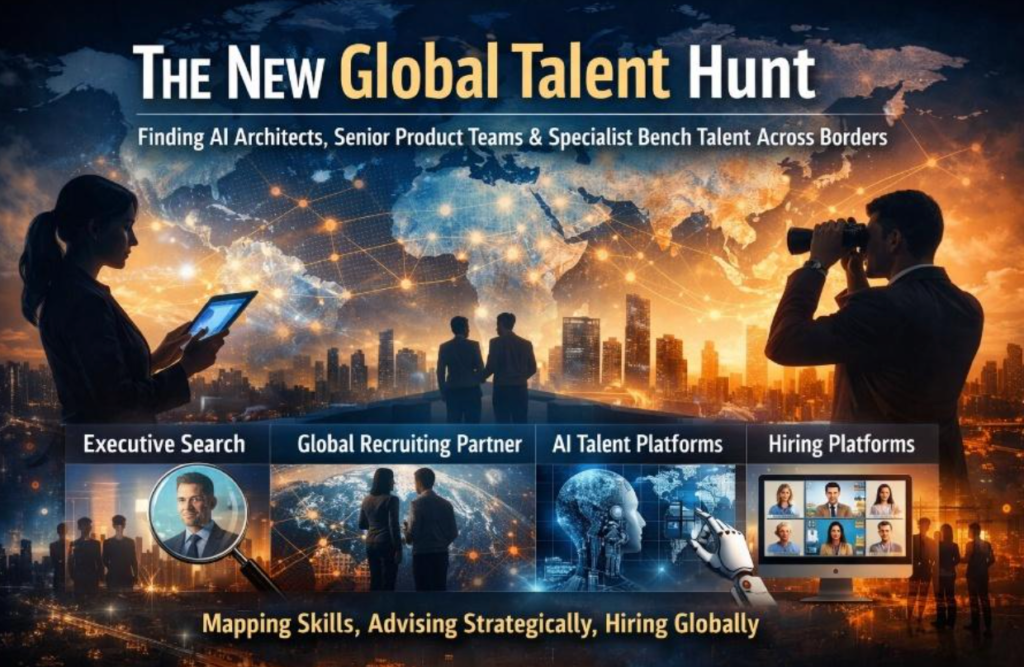
Use embedded global recruiting / orchestration when you need to build the broader system: define the brief, map geographies, decide the labor mix, and manage the whole search like an extended internal recruiting expert. This is where Launch Global and Talentful are the most relevant examples.
Use a global hiring platform when you already know the profiles you want and need to hire them across borders without creating operational chaos. That is where Deel fits best.
Use AI-native talent intelligence when your recruiters or partners need help widening the search, finding passive candidates, and spotting adjacent skill matches the market would otherwise miss. That is where SeekOut fits.
And use on-demand talent when the bench matters as much as the org chart. Heidrick’s on-demand talent business explicitly positions itself around access to independent talent and interim leaders with deep expertise. For a specialist AI bench, that flexibility can be far more valuable than trying to force every capability into a permanent headcount plan.
My recommendation for the exact mandate
If the brief is:
- one AI Architect with specific experience,
- one senior product team,
- and one bench of specialists,
- spread across multiple possible markets,
then I would not pick one provider and hope for magic.
I would use an embedded global partner as the lead relationship, because this is the category most likely to combine recruiting capability, consulting muscle, and one accountable interface over time. For a difficult, not fully defined global brief, that is the highest-value model. Launch Global is especially relevant here because its public positioning is explicitly built around embedded partnership, global-local execution, single-point accountability, and subscription-style engagement. Talentful is a strong comparison name because it offers embedded recruiting at global scale with subscription pricing and strong technical hiring credentials.
Then I would layer in executive search for the one hardest strategic hire if needed, Deel for cross-border execution, and AI-native discovery to widen the search beyond obvious titles. That is not overcomplication. That is simply acknowledging that the modern global hiring problem has multiple layers.
Bottom line
The old recruiting industry has not disappeared. It has split.
Executive search wins the rarest leadership hires.
Embedded global partners win the broader cross-border build.
Hiring platforms win execution.
AI-native tools win discovery.
On-demand talent wins the bench.
But in the most complex cases — where skills are hard to define, the right location is unclear, the hiring model is fluid, and the client needs more than candidate flow — the real winner is often the provider that combines recruiting capability with consulting potential.
That is the model to watch: a partner that does not just fill roles, but helps design the hiring strategy, advises on where to search globally, defines the right mix of permanent and flexible talent, and offers the client a single accountable interface over time. In the best version of this model, the relationship looks less like external recruiting and more like an extended internal talent function — sometimes delivered through subscription or embedded agreements rather than one-off mandates. Launch Global and Talentful are relevant because they explicitly lean into that long-term, embedded logic.
That is the real shift in global hiring.
The future does not belong to the loudest AI believers, the biggest databases, or the firms still pretending geography defines talent. It belongs to the players that can map globally, advise strategically, hunt proactively, hire compliantly, and stay accountable through one relationship. That is no longer just recruiting. That is talent access.
About the IEC Rebel’s Digest
We write for the ones breaking molds, building cross-border teams, and reshaping global work. No buzzwords. Just truths, tools, and tactics for the new era of employment.
IEC Rebel’s Digest— The IEC Group can help you audit your global employment setup by identifying labor leasing risks, verifying licensing requirements, and ensuring your EOR partners meet every compliance standard—before regulators come knocking.
Last but not Least: If you’re facing challenges and wondering how others are managing similar issues, why not join The Leadership Collective Community? It’s a peer group and webcast platform designed for leaders to exchange insights and experiences.
Introducing the IEC Knowledge Network Free Membership – Your Gateway to Seamless Access!
We are thrilled to present a new service that goes beyond the ordinary download experience. In addition to offering you the ability to download the things you love, we are delighted to introduce the IEC Knowledge Network Free Membership.
The Free Membership option grants you access to our library of articles and videos, without the need for tedious registrations for each piece of content.
The publication serves as a trusted resource to support executives in their pursuit of sustainable and successful global expansion. In addition the IEC Practitioners are available to discuss your specific challenge in more detail and to give you clear advise..
Take advantage of this valuable resource to accelerate your global expansion journey

