
From Cheap Sourcing to Trusted Sourcing: The CxO Challenge of Geopolitical Trade
Introduction: In a world of unstable trade routes and rising geopolitical pressure, sourcing decisions can no longer be made on price alone.
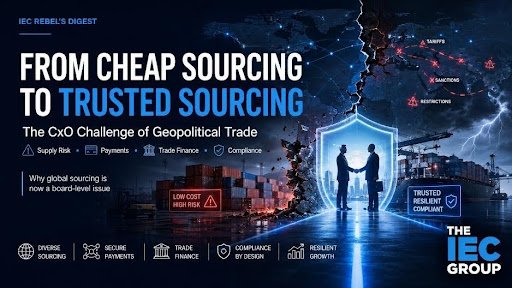 For decades, global sourcing had one dominant religion: cheaper is better.
Find the lower-cost supplier. Push the price. Extend payment terms. Shift production to the next attractive region. Build the spreadsheet, run the tender, celebrate the savings, and tell the board that procurement delivered value.
That world is not gone. Cost still matters. Margin still matters. Competitive sourcing still matters.
But the rules of the game have changed.
The next sourcing crisis will not only be about whether a supplier can produce the part. It will be about whether the company can trust the supplier, pay the supplier, finance the transaction, clear the goods, manage the documentation, avoid sanctions exposure, absorb FX volatility, and still explain the decision to auditors, banks, customers and regulators.
Welcome to the new reality of geopolitical trade.
Cheap sourcing is no longer enough. The new boardroom question is trusted sourcing.
The old sourcing model was built for a world that no longer exists
The classic global sourcing model was designed for a relatively stable form of globalization. Trade routes were assumed to be open. Payment rails were assumed to work. Banks were assumed to process transactions. Political risk was usually a footnote, not the main scenario. Supplier location was a cost variable, not a strategic exposure.
Procurement optimized for price. Supply chain optimized for efficiency. Treasury optimized for cash. Compliance checked the boxes. IT connected the systems, often years later.
Each function did its job.
And that was exactly the problem.
Because geopolitical trade does not respect organizational charts.
A tariff does not care whether the cost impact sits in procurement or finance. A blocked payment does not care whether the supplier was perfectly sourced. A sanctions issue does not care whether the business needs the shipment urgently. A disrupted shipping route does not wait for the next steering committee.
The old model treated sourcing, supplier risk, payments, trade finance, logistics and compliance as separate workflows. The new environment turns them into one connected operating risk.
That is why CxOs should stop asking only:
“Where can we source this cheaper?”
They should start asking:
“Where can we source this reliably, pay securely, finance intelligently and remain compliant under pressure?”
That is a very different question.
Geopolitics has moved from the news page to the purchase order
For many executives, geopolitics used to be a topic for government affairs, strategy retreats or macroeconomic outlook slides. Interesting, important, but often abstract.
Not anymore.
Geopolitics now shows up in delivery dates, payment delays, insurance premiums, supplier onboarding, customs documentation, sanctions screening, export controls, energy prices, working capital, and customer commitments.
It appears when a shipment is stuck because the route is no longer safe.
It appears when a supplier asks for advance payment because its local bank cannot provide liquidity.
It appears when a buyer wants to diversify away from one country but discovers that the alternative supplier network is more fragmented, less transparent and financially weaker.
It appears when the cheapest supplier suddenly becomes the riskiest supplier.
The uncomfortable truth is that many companies still run global sourcing as if the world were predictable. They have beautiful procurement policies, but poor real-time visibility. They have supplier databases, but weak supplier trust intelligence. They have payment processes, but little understanding of payment execution risk. They have trade finance options, but only after the problem becomes urgent. They have compliance processes, but often too late in the workflow.
That is not resilience. That is administrative hope.
And hope is not a sourcing strategy.
Supplier diversification is not a strategy if finance cannot follow
“China+1”, nearshoring, friendshoring, regionalization and supplier diversification have become boardroom vocabulary. The logic is clear: reduce dependency, increase optionality, create fallback routes, and avoid single-country concentration.
Good.
But diversification is not free. It creates complexity.
Every new sourcing country introduces different banking relationships, currency exposure, documentation requirements, tax rules, payment behavior, customs processes, supplier maturity levels and local risk factors. A second supplier may reduce production risk but increase financial execution risk. A regional supplier may improve delivery security but require new payment terms. A smaller supplier may be flexible but may not survive extended payment cycles.
CxOs need to understand this: supplier diversification without payment and finance orchestration can simply move the bottleneck from production to settlement.
The company may find a supplier.
But can it onboard the supplier quickly?
Can it validate ownership, reputation and financial health?
Can it pay in the required currency?
Can it offer early payment, supply chain finance or alternative trade finance if the supplier needs liquidity?
Can it monitor sanctions and counterparty risk?
Can it handle documents, customs and compliance without creating a manual nightmare?
Can it do all of this fast enough to matter?
This is where the old procurement playbook breaks. It assumes that supplier selection is the main event. In geopolitical trade, supplier selection is only the opening move.
The real game is execution confidence.
Cross-border payments are now part of supply-chain resilience
For too long, payments were treated as the boring end of the process. Procurement selected the supplier. Operations received the goods. Finance paid the invoice. End of story.
That view is dangerously outdated.
In a volatile trade environment, payment is not a back-office transaction. It is a strategic capability.
If a supplier does not trust that it will be paid, it may not prioritize the order. If a payment is delayed by banking friction, compliance checks or currency issues, production may stop. If a supplier lacks access to affordable finance, it may not be able to buy raw materials. If payment terms are too aggressive, the buyer may accidentally weaken the very supplier it depends on.
The future of sourcing is not only about who can supply.
It is about who can be paid, financed and trusted.
This has direct implications for CFOs and treasury leaders. Working capital optimization can no longer be an internal cash game only. Extending payment terms may look good on the balance sheet, but it may damage supplier resilience. Early payment may look expensive, but it may protect supply continuity. Trade finance may look like a banking product, but it may become a sourcing weapon.
The CFO and CPO need to stop behaving like neighbors and start behaving like co-owners of the same risk.
Procurement owns supplier choice.
Finance owns payment and liquidity.
Compliance owns permission.
Operations owns continuity.
But the business owns the outcome.
And the outcome increasingly depends on whether these functions can act as one system.
The next generation of sourcing will require a trust layer
Companies have invested heavily in procurement suites, ERP systems, supplier portals, risk databases, spend analytics, contract tools and payment platforms. Yet many still lack one thing:
A real-time trust layer.
Not a static vendor master.
Not an annual supplier questionnaire.
Not a PDF compliance certificate stored somewhere in a portal.
A trust layer means the company can evaluate, in context, whether a sourcing decision is viable. It connects supplier identity, financial health, geopolitical exposure, payment feasibility, compliance status, logistics risk, documentation requirements and working-capital implications.
This is not traditional supplier management. It is not just procurement analytics. It is not only trade finance. It is not generic AI sprinkled across workflows.
It is decision infrastructure for geopolitical trade.
In the old model, the question was:
“Is this supplier approved?”
In the new model, the question becomes:
“Is this supplier the right trusted option for this transaction, at this moment, under these risk, payment, finance and compliance conditions?”
That is the shift.
The future will belong to companies that can move from static supplier approval to dynamic sourcing confidence.
AI will not fix broken trade processes — but it can expose them
Every technology vendor now has an AI story. Some of it is useful. Some of it is theatre. Some of it is a chatbot looking for a problem.
In global sourcing and trade execution, AI will not magically remove geopolitical risk. It will not make sanctions disappear. It will not reopen shipping routes. It will not turn a financially weak supplier into a resilient partner.
But AI can do something very powerful: it can connect signals faster than humans can.
It can identify alternative suppliers. It can classify trade documents. It can detect risk patterns. It can compare payment options. It can flag counterparty concerns. It can simulate landed cost scenarios. It can match sourcing decisions with financing options. It can recommend when a transaction requires human review. It can help companies move from reactive firefighting to proactive decision support.
The key is not “AI for procurement”.
That is too narrow.
The key is AI-enabled orchestration across procurement, treasury, trade finance, compliance and supply-chain execution.
CxOs should be very careful here. The winning model is not autonomous chaos. No serious enterprise should allow black-box AI to make uncontrolled sourcing, payment or compliance decisions. The winning model is guided autonomy: AI handles complexity, but humans define guardrails, exceptions, approvals and accountability.
In other words: AI should not replace trade judgment. It should upgrade it.
The CxO problem: nobody owns the full picture
Here is the Rebel’s Digest uncomfortable question:
Who owns trusted sourcing?
The CPO? Partly.
The CFO? Partly.
The COO? Partly.
The Chief Risk Officer? Partly.
The CIO? Technically, but not operationally.
The CEO? Ultimately, but not daily.
And that is the problem.
Trusted sourcing cuts across functions, but most companies still govern it in fragments. Procurement measures savings. Finance measures cash. Operations measures availability. Compliance measures violations. IT measures system performance. Risk measures exposure.
But geopolitical trade risk does not arrive in tidy departmental packages.
It arrives as a business interruption.
That means the operating model must change. Companies need cross-functional governance for strategic sourcing corridors, critical supplier dependencies, payment risk, financing needs, compliance exposure and geopolitical scenarios.
This does not mean creating another committee that produces beautiful slides and zero decisions. It means creating a practical control tower for trade execution: clear data, clear accountability, clear escalation, clear decisions.
The board does not need another dashboard showing that risk exists.
The board needs confidence that the company can act when risk becomes operational.
From cost savings to resilience-adjusted value
Procurement has spent years proving its value through savings. That will not disappear. But in geopolitical trade, savings alone is an incomplete metric.
The cheapest supplier may create the highest risk. The lowest unit cost may lead to the highest landed cost. The best payment terms may weaken supplier liquidity. The fastest route may be the least resilient. The most attractive market may carry the most unpredictable regulatory exposure.
CxOs need a new sourcing metric: resilience-adjusted value.
This means evaluating sourcing decisions through a broader lens:
Total landed cost, not just unit price.
Payment reliability, not just invoice processing.
Supplier financial health, not just supplier approval.
Compliance readiness, not just contract signature.
Geopolitical exposure, not just country cost.
Financing optionality, not just working-capital extraction.
Recovery speed, not just procurement cycle time.
In a stable world, procurement could win by negotiating harder.
In an unstable world, procurement wins by designing optionality.
That requires different data, different workflows, different incentives and different executive conversations.
The five maturity levels of trusted sourcing
Most companies are somewhere on a maturity curve. The question is whether they know where.
Level 1: Reactive Firefighting
Sourcing teams respond when something breaks. Alternative suppliers are found manually. Payments are handled case by case. Compliance becomes urgent only when a transaction is blocked. The organization survives through heroic effort.
Level 2: Fragmented Control
Procurement, finance and compliance each have their own tools and processes. Supplier risk is monitored, but not fully connected to payment and sourcing decisions. Dashboards exist, but action is still manual.
Level 3: Integrated Sourcing Governance
Critical categories, countries and suppliers are mapped. Procurement and finance collaborate on supplier payment terms and liquidity. Compliance checks move earlier in the workflow. Scenario planning becomes part of sourcing strategy.
Level 4: Data-Driven Trade Orchestration
Supplier selection, payment feasibility, financing options, logistics exposure and compliance risk are evaluated together. AI supports decision-making, flags exceptions and recommends alternatives. The company can act faster because the data is connected.
Level 5: Trusted Sourcing Network
The company operates sourcing, payments, financing, compliance and risk as one intelligent network. It can shift suppliers, payment terms, finance structures and logistics routes dynamically. Resilience is not a presentation. It is an operating capability.
The gap between Level 1 and Level 5 is not technology alone. It is leadership maturity.
The Rebel’s Playbook for CxOs
So what should executives do now?
First, stop treating global sourcing as a procurement-only topic. If it affects supply continuity, payment execution, liquidity, risk and compliance, it belongs on the CxO agenda.
Second, identify the company’s critical sourcing corridors. Which countries, categories, suppliers and payment routes create the highest dependency? Where would disruption create immediate financial or operational pain?
Third, connect procurement and treasury. Supplier payment terms should not be optimized in isolation. Working capital strategy must be balanced against supplier resilience and continuity risk.
Fourth, move compliance earlier. Sanctions, export controls, documentation, ownership checks and counterparty risk should be part of sourcing design, not a late-stage transaction blocker.
Fifth, build a trusted sourcing data layer. Supplier data, payment data, risk data, finance data and logistics data need to speak to each other. Without this, AI will only accelerate confusion.
Sixth, use AI where it matters: signal detection, supplier matching, document intelligence, scenario analysis, exception handling and decision support. Do not buy AI theatre. Buy decision advantage.
Finally, redefine success. The future is not “savings versus resilience”. The future is savings through resilience.
The Bottom Line
The era of cheap sourcing is not over. But the era of cheap sourcing as the dominant strategy is over.
Geopolitical trade has changed the rules. The companies that win will not simply find cheaper suppliers. They will build trusted sourcing capabilities that combine procurement, payments, trade finance, compliance and risk intelligence into one operating model.
This is the new CxO challenge.
Not just: Can we buy it cheaper?
But: Can we source it, trust it, pay for it, finance it, move it and defend the decision when the world changes?
That is the future of global trade.
And it will not be managed by spreadsheets, annual supplier reviews and disconnected workflows.
Cheap sourcing was the old advantage.
Trusted sourcing is the new one.
About the IEC Rebel’s Digest
We write for the ones breaking molds, building cross-border teams, and reshaping global work. No buzzwords. Just truths, tools, and tactics for the new era of employment.
IEC Rebel’s Digest— The IEC Group can help you audit your global employment setup by identifying labor leasing risks, verifying licensing requirements, and ensuring your EOR partners meet every compliance standard—before regulators come knocking.
Last but not Least: If you’re facing challenges and wondering how others are managing similar issues, why not join The Leadership Collective Community? It’s a peer group and webcast platform designed for leaders to exchange insights and experiences.
Introducing the IEC Knowledge Network Free Membership – Your Gateway to Seamless Access!
We are thrilled to present a new service that goes beyond the ordinary download experience. In addition to offering you the ability to download the things you love, we are delighted to introduce the IEC Knowledge Network Free Membership.
The Free Membership option grants you access to our library of articles and videos, without the need for tedious registrations for each piece of content.
The publication serves as a trusted resource to support executives in their pursuit of sustainable and successful global expansion. In addition the IEC Practitioners are available to discuss your specific challenge in more detail and to give you clear advise..
Take advantage of this valuable resource to accelerate your global expansion journey

