
The 100 Billion Payroll Market
Introduction: Why Payroll Is Becoming the New Control Layer for Workforce, Compliance and AI
Payroll used to be boring.
That was its charm.
Nobody wanted a payroll revolution. Nobody wanted drama. Nobody wanted disruption. The ideal payroll function was invisible: people got paid, taxes were filed, deductions were made, regulators stayed quiet and employees did not call HR in panic.
That world is disappearing.
Payroll is now sitting at the intersection of global workforce strategy, compliance risk, employee trust, finance visibility, AI automation and cross-border employment complexity. It is no longer just a transaction engine. It is becoming one of the most important control layers in the enterprise.
And that is why the payroll market is much larger than most executives think.
Depending on how narrowly or broadly it is defined, payroll is already an USD 8–10 billion software category, a USD 70 billion-plus payroll services market, and a broader USD 100 billion-plus opportunity when payroll is connected with compliance, workforce payments, HR operations, time, benefits, analytics and AI-enabled governance. The global payroll services market alone is estimated at USD 70.5 billion in 2025 and projected to reach USD 93.1 billion by 2034. Payroll software, by contrast, is much smaller but faster-moving: Apps Run The World estimated the global payroll software market at USD 8.4 billion in 2024, with 12% year-over-year growth.
So the question is not whether payroll is a real market.
The question is: who will redefine it?
- The Payroll Market Is Not One Market
The first mistake is to talk about “the payroll market” as if it were one clean category.
It is not.
Payroll is a stack.
At the bottom, there is payroll processing: gross-to-net calculation, deductions, tax withholding, social security contributions, statutory filings and payment execution.
Above that, there is payroll outsourcing: companies handing over part or all of the payroll operation to external providers.
Then comes managed payroll: multi-country operations, service delivery, country coordination, vendor management, compliance support and employee support.
Then comes payroll software: payroll engines, configuration, workflows, integrations, reporting and payroll control.
Then comes the wider workforce infrastructure layer: time and attendance, HRIS, benefits, equity, compliance, payments, employer-of-record models, contractor payments, analytics and employee self-service.
Finally, now comes AI: payroll copilots, AI agents, anomaly detection, compliance intelligence, autonomous case routing, payroll simulations, natural-language reporting and audit evidence generation.
That is why market numbers vary so widely. A pure payroll software estimate can be below USD 10 billion, while a broader HR payroll software or payroll management estimate can be much larger. Some payroll outsourcing estimates put the market around USD 10 billion in 2023 and forecast it to reach roughly USD 14.9 billion by 2030. Other payroll services estimates are much broader and reach the USD 70 billion-plus level.
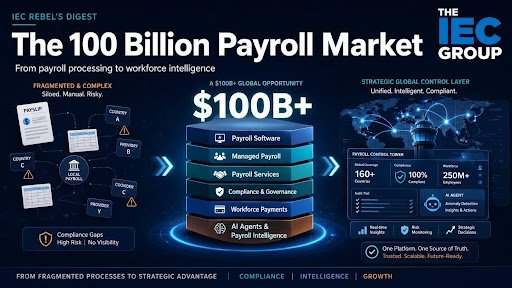
The Rebel’s Digest view is simple: payroll is not a feature. It is a market architecture.
And the strategic prize is not the payroll engine alone. The strategic prize is the control layer around payroll.
- Why USD 100 Billion Is the Right Strategic Lens
Is payroll exactly a USD 100 billion market today?
It depends on the definition.
If we count pure payroll software, no. That is still closer to USD 8–10 billion globally.
If we count payroll outsourcing only, no. That market is often estimated around USD 10–20 billion depending on scope and forecast horizon.
If we count broad payroll services, managed payroll, payroll and bookkeeping services, tax preparation support, compliance processing and payroll-related administration, then the market is already estimated around USD 70 billion and heading toward more than USD 90 billion by 2034.
If we add payroll software, global payroll platforms, AI-enabled compliance, time and attendance integration, workforce payments, contractor payments, EOR payroll, analytics and payroll governance, then the strategic opportunity clearly moves into USD 100 billion-plus territory.
That is the right way to look at the market.
Not as “payroll software.”
Not as “outsourcing.”
Not as “HR admin.”
But as a global workforce-pay, compliance and trust infrastructure market.
That is why the market is becoming more attractive, more contested and more strategic. Vendors from different origins are converging: payroll specialists, HCM suites, EOR platforms, workforce management vendors, accounting firms, BPO providers, HR tech platforms, fintech players and AI-native challengers.
They are not all selling the same product.
But they are all moving toward the same battlefield: control over the employment, pay and compliance data layer.
- The Geography of Payroll: Complexity Is Not Evenly Distributed
Payroll is local by law, but global by business reality.
That is the paradox.
Every country has its own rules, filings, tax logic, social security obligations, payslip requirements, benefits structures, leave rules, termination treatment and reporting expectations. Yet companies increasingly want one global view of workforce cost, compliance exposure, payroll performance and employee experience.
This is where geography becomes decisive.
North America has traditionally been one of the strongest payroll software and outsourcing markets, driven by large employer scale, SaaS maturity, established HR technology buying patterns and high adoption of payroll platforms. Several market reports continue to identify North America as the largest or one of the largest regional contributors to payroll software growth; Technavio, for example, estimates North America will account for 40% of growth in the HR payroll software market during its 2025–2029 forecast period.
Europe is a different story. It is not simply a market. It is a compliance puzzle. PwC’s 2025 Global Payroll Complexity Index assessed more than 50 countries across seven dimensions, from statutory filings to data protection. Its findings highlight Europe as one of the most challenging regions for payroll operations, with France, Italy and Germany among the most complex countries.
Asia-Pacific is the growth engine. It combines enormous workforce scale, rapid digitalization, fragmented country requirements, rising cloud adoption and increasing regional expansion by multinational companies. But APAC is not one market. Payroll in Singapore is not payroll in India. Payroll in Japan is not payroll in Indonesia. The challenge is not only language and regulation, but local operating reality.
Latin America and the Middle East are also becoming more important, particularly as global companies expand into new talent markets, shared service centers and remote work hubs. These regions often require deep local compliance knowledge, strong in-country partner networks and agile regulatory monitoring.
The implication is clear: global payroll leadership will not be achieved by simply adding more country flags to a sales deck. The winners must combine global architecture with local intelligence.
Country coverage is table stakes. Country competence is the differentiator.
- Company Size: One Market, Very Different Pain
Payroll pain changes by company size.
Small businesses want simplicity. They need payroll to work without building a payroll department. Their buying criteria are usually ease of use, affordability, basic compliance, tax filing support, accounting integration and employee self-service.
Mid-sized companies are where the problem becomes more strategic. They often expand into new states, new countries, new worker types and new benefits models before their payroll operating model matures. They want automation, but still depend heavily on manual workarounds. They may have outgrown local payroll tools but are not yet ready for a complex global transformation.
Large enterprises face a different challenge: fragmentation at scale.
They may have a global HRIS, but still operate many payroll engines. They may have regional shared services, but local exceptions everywhere. They may have acquired companies with their own payroll vendors, country practices and legacy contracts. They may have dozens of interfaces, multiple time systems, various benefits providers and different payroll calendars.
PayrollOrg’s 2025 “Getting the World Paid” survey shows the reality clearly: more than one-third of respondents manage payroll in six or more countries, often using a mix of systems and providers. The same survey found that most respondents use a global HR system, while time and attendance tools vary widely.
That is the enterprise paradox: one global HR vision, many local payroll realities.
The bigger the company, the more payroll becomes a governance problem.
- Industry Penetration: Payroll Is Universal, But Needs Differ
Every employer has payroll.
But not every industry has the same payroll challenge.
Technology companies often struggle with global hiring, equity compensation, remote work, contractors and employer-of-record models. Their payroll complexity is driven by growth speed and workforce flexibility.
Manufacturing companies face shift work, overtime, unions, collective bargaining agreements, plant-level practices, time systems and local allowances. Their payroll complexity is operational.
Retail and hospitality companies deal with hourly workers, high employee turnover, scheduling complexity, variable hours, tips, local labor rules and seasonal workforce models. Their payroll challenge is volume and volatility.
Healthcare combines shift work, overtime, credentialing, union rules, allowances and regulatory pressure. Payroll is closely linked to workforce scheduling and compliance.
Financial services face strong control requirements, audit expectations, bonus complexity, deferred compensation, cross-border talent and regulatory oversight.
Professional services and consulting firms often wrestle with cross-border mobility, project-based work, bonuses, partner compensation and international assignments.
Public sector and education payroll may include complex grades, pensions, allowances, union agreements and statutory reporting obligations.
The future payroll platform cannot treat all industries the same. The next generation of payroll leadership will require industry-sensitive capabilities: not just “can we process pay?”, but “do we understand how this industry works?”
That is a major market opportunity.
- The Technology Shift: From Payroll Runs to Payroll Intelligence
The old payroll technology model was built around processing.
Input data.
Run payroll.
Check exceptions.
Approve.
Pay.
File.
Archive.
Repeat next month.
That model is not dead, but it is no longer enough.
The new model is intelligence-driven and continuous.
Payroll must detect upstream data problems before the payroll run. It must compare unusual changes against historical patterns. It must identify missing approvals. It must flag compliance risk. It must simulate employee impact. It must explain changes in plain language. It must connect payroll outcomes to finance, HR, employee experience and compliance controls.
This is where AI becomes powerful.
AI can help identify anomalies across millions of payroll transactions. It can find mismatched pay elements, unusual net-pay movements, late inputs, missing tax data, suspicious corrections or inconsistent country configurations. It can support employee self-service by explaining payslips and deductions. It can help payroll teams understand regulatory changes and map them to impacted populations.
But AI in payroll must be treated differently from AI in marketing or sales.
Payroll errors are not cosmetic. They affect rent, tax, social security, benefits, trust and legal rights. Therefore AI in payroll needs governance, explainability, audit trails, permissions, human oversight and clear responsibility.
The future is not “AI payroll” as a slogan.
The future is governed payroll intelligence.
- AI Agents: Useful, Dangerous and Inevitable
AI agents will enter payroll because payroll is full of repeatable, rules-based, data-heavy workflows.
Agents can chase missing inputs.
Agents can route exceptions.
Agents can prepare reconciliation packs.
Agents can draft employee explanations.
Agents can monitor local compliance updates.
Agents can compare expected and actual payroll outputs.
Agents can prepare audit evidence.
But payroll agents must operate under strict controls.
An agent should not invent statutory guidance.
An agent should not change payroll rules without approval.
An agent should not override controls.
An agent should not silently classify workers.
An agent should not make sensitive pay-equity or termination-related decisions without human accountability.
The right question is not: “Can AI do payroll?”
The right question is: “Which payroll decisions can be safely automated, which must be assisted, and which must remain human-controlled?”
That distinction will separate the serious providers from the demo providers.
- Why Compliance Will Define the Next Market Leaders
Payroll compliance is becoming more difficult, not less.
Remote work creates cross-border tax and social security questions. Pay transparency creates new reporting and data-quality expectations. Worker classification remains a major risk. Data privacy rules shape how employee data can be processed. AI regulation will increasingly affect automated decision-making in HR and employment contexts.
PwC’s Global Payroll Complexity Index highlights that payroll complexity is driven by multiple factors, including statutory filings, data protection and other country-specific obligations.
This matters because compliance is no longer a back-end checklist. It is becoming a front-end buying criterion.
Enterprise buyers will ask:
Can the provider monitor regulatory change?
Can it translate change into payroll rules?
Can it show which employees are affected?
Can it document who approved what?
Can it create evidence for audit?
Can it support local country nuance?
Can it integrate compliance into workflows rather than PDFs?
The winners in payroll will not be the ones who merely pay accurately.
They will be the ones who prove accuracy, compliance and control continuously.
- Market Penetration: The Big Gap Is Not Adoption, But Maturity
Payroll penetration is already universal in the obvious sense: every employer must pay people.
But modern payroll penetration is still uneven.
Cloud adoption is high in many small and mid-market environments, but global enterprises often still operate hybrid models. Large companies may use cloud HR, but payroll remains distributed across local engines and providers. Multi-country payroll solutions are growing, but full global standardization remains rare.
PayrollOrg’s 2025 survey shows that global payroll is becoming more complex, with many organizations operating across multiple countries and using a mix of systems and providers.
So, the opportunity is not basic adoption.
The opportunity is maturity:
From local processing to global visibility.
From manual controls to automated validation.
From country silos to shared governance.
From payroll reports to payroll intelligence.
From employee tickets to AI-assisted self-service.
From compliance after the fact to compliance by design.
That is where the next wave of market growth will come from.
- The Future Payroll Platform
The future payroll platform will not simply be a better payroll calculator.
It will be a workforce operating system for pay and compliance.
It will include:
A global data model.
Local payroll engines or engine orchestration.
Regulatory intelligence.
AI-assisted anomaly detection.
Employee self-service.
Manager workflows.
Integrated time, absence and benefits data.
Payment execution.
Audit trails.
Compliance evidence.
Finance analytics.
Vendor governance.
Country-level rule libraries.
AI agent supervision.
Some providers will build this through one platform. Others will orchestrate networks of country engines. Some will combine software with managed services. Others will specialize by region, industry or company size.
There will not be one winning model.
But there will be one winning principle: payroll must become more intelligent, more governed and more transparent.
- The IEC Group View: A Market Ready for Reclassification
The payroll market is ready for a new evaluation model.
Traditional market views often separate software, outsourcing, managed services and compliance support. That is no longer sufficient. Buyers do not experience payroll in neat analyst categories. They experience payroll as a business outcome: Are employees paid correctly? Is the company compliant? Is the process efficient? Is the data reliable? Can we see risk? Can we scale globally? Can we trust the system?
That is why The IEC Group will launch a new study on the future of payroll.
The study will examine future customer demands, technology development, AI and AI-agent capabilities, compliance transformation, global payroll operating models, geographic coverage, industry requirements, innovation capacity and the ability of providers to transform the market.
As part of the study, The IEC Group will position the 25 leading payroll providers based on their ability to innovate, transform the market and understand future customer requirements.
Participation in the study is free of charge.
Providers interested in participating should contact:
- The Rebel’s Conclusion
The USD 100 billion payroll market is not about payslips.
It is about control.
Control over workforce cost.
Control over compliance risk.
Control over employee trust.
Control over global data.
Control over pay transparency.
Control over AI-enabled automation.
Control over the future employment infrastructure of the enterprise.
Payroll used to close the month.
Now payroll must help the enterprise understand whether its workforce model is legal, fair, affordable, compliant and trusted.
That is a much bigger mission.
And a much bigger market.
The payroll providers that understand this will not merely compete for payroll runs. They will compete for the future control layer of work.
The others will keep processing.
Until the market processes them.
About the IEC Rebel’s Digest
We write for the ones breaking molds, building cross-border teams, and reshaping global work. No buzzwords. Just truths, tools, and tactics for the new era of employment.
IEC Rebel’s Digest— The IEC Group can help you audit your global employment setup by identifying labor leasing risks, verifying licensing requirements, and ensuring your EOR partners meet every compliance standard—before regulators come knocking.
Last but not Least: If you’re facing challenges and wondering how others are managing similar issues, why not join The Leadership Collective Community? It’s a peer group and webcast platform designed for leaders to exchange insights and experiences.
Introducing the IEC Knowledge Network Free Membership – Your Gateway to Seamless Access!
We are thrilled to present a new service that goes beyond the ordinary download experience. In addition to offering you the ability to download the things you love, we are delighted to introduce the IEC Knowledge Network Free Membership.
The Free Membership option grants you access to our library of articles and videos, without the need for tedious registrations for each piece of content.
The publication serves as a trusted resource to support executives in their pursuit of sustainable and successful global expansion. In addition the IEC Practitioners are available to discuss your specific challenge in more detail and to give you clear advise..
Take advantage of this valuable resource to accelerate your global expansion journey

