
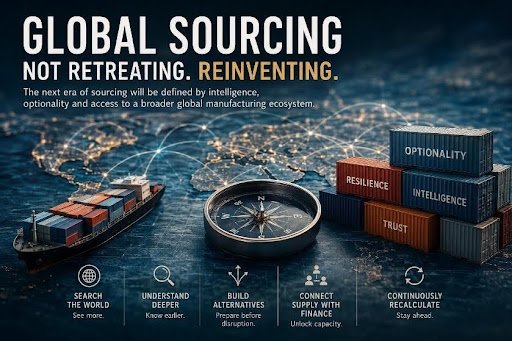
The next sourcing model will be defined by intelligence, optionality and access to a much broader global manufacturing ecosystem
 For much of the past three decades, global sourcing followed a relatively predictable economic logic. Companies searched internationally for manufacturing capacity, consolidated volumes with selected suppliers, optimized logistics and inventory, and used procurement scale to drive down unit costs.
The model delivered enormous economic benefits. It contributed to lower consumer prices, enabled companies to access manufacturing capabilities that would have been uneconomic to build internally, and supported the development of highly specialized industrial clusters around the world.
But the environment in which this sourcing model was created has changed fundamentally.
The disruption of global supply chains during the pandemic was only the most visible warning. Since then, organizations have been confronted with geopolitical fragmentation, sanctions, export restrictions, tariffs, transportation disruptions, energy-market volatility, changing environmental requirements and increasing pressure from governments to secure strategically important manufacturing capacity.
As a result, global sourcing has moved from being primarily a procurement issue to becoming a board-level strategic concern.
Yet one conclusion frequently drawn from this change is misleading.
Global sourcing itself is not disappearing.
What is disappearing is the assumption that global sourcing can continue to be managed primarily around cost, scale and efficiency.
The next generation of sourcing will instead be built around the ability to continuously evaluate cost, capability, resilience, risk, availability and strategic dependency at the same time.
That is a considerably more complex task.
Globalization is changing shape
Despite widespread discussion about deglobalization, global trade remains deeply interconnected. The WTO estimates that global value-chain trade continues to represent approximately 46% of world trade. What has changed is the architecture underneath those flows.
Production is increasingly being redistributed across additional countries and regions. China remains one of the world’s most important manufacturing economies, but organizations are simultaneously developing additional supply relationships in India, Southeast Asia, Mexico, Eastern Europe and other emerging manufacturing locations.
The result is not the end of globalization.
It is the beginning of a more fragmented and more sophisticated form of globalization.
The traditional model was frequently based on identifying a dominant manufacturing geography and building procurement scale around it. The emerging model is much more likely to consist of multiple production options across several regions, with sourcing decisions changing according to economics, geopolitical circumstances, capacity and delivery requirements.
This creates an important distinction.
Moving production is not the same as creating resilience.
A company that relocates sourcing from China to Vietnam may reduce one form of geopolitical exposure while creating another concentration risk. A European organization may believe that sourcing from several suppliers across Poland, Germany and Mexico represents diversification, only to discover that all three rely on the same upstream component producer in Asia.
The physical location of a Tier-1 supplier therefore tells only part of the story.
The real issue is dependency.
Procurement optimized the visible cost — not always the complete cost
For decades, procurement organizations have been measured heavily on negotiated savings. This created strong incentives to focus on unit price, supplier consolidation and purchasing leverage.
Those measures remain relevant. They are simply no longer sufficient.
The lowest quoted component price may ultimately prove significantly more expensive once tariffs, transportation, inventory, financing, quality, disruption risk and working-capital requirements are considered.
A supplier offering a product for $9.50 rather than $10 does not necessarily provide a saving if the sourcing structure requires six additional weeks of inventory, carries a substantially higher geopolitical risk or leaves the buyer without an alternative source of supply.
The sourcing decision therefore needs to move away from a narrow concept of purchasing price toward a broader concept of risk-adjusted total economic value.
That change sounds straightforward, but it represents a substantial shift in procurement practice.
It requires information that historically sat in different organizational functions. Procurement may understand supplier pricing. Logistics understands freight and lead times. Treasury understands currency exposure. Finance understands working capital. Compliance understands sanctions and regulatory requirements. Operations understands the implications of production interruption.
The sourcing decision increasingly requires all of these perspectives simultaneously.
Traditional procurement systems were not designed for that level of dynamic decision-making.
The hidden weakness is often visibility
One of the most persistent problems in global supply chains is that companies generally understand their direct suppliers considerably better than they understand the suppliers behind those suppliers.
Deloitte has reported that only a relatively small proportion of organizations possess meaningful visibility beyond Tier 1.
That limitation is becoming increasingly important.
Modern manufacturing networks are highly interdependent. A supplier that appears geographically diversified may still rely on a single sub-supplier, raw-material producer, semiconductor source or logistics corridor.
The risk may therefore sit several layers beneath the contractual supplier relationship.
The implication is significant.
Supplier diversification must increasingly be evaluated at the network level, rather than simply by counting the number of suppliers or countries involved.
This is also one reason why the concept of a “supply chain” is becoming increasingly inadequate.
A chain suggests a relatively linear sequence.
Modern manufacturing is better described as a supply network — a constantly changing combination of manufacturers, sub-suppliers, logistics providers, financial institutions and distribution channels.
The resilience of that network depends not simply on the strength of individual participants but on the availability of alternative routes when one participant or connection fails.
The sourcing universe is much larger than procurement can currently see
There is another, less discussed weakness in traditional global sourcing.
Companies generally search within a surprisingly limited universe of suppliers.
Large organizations rely on established supplier databases, previous relationships, procurement platforms, industry directories, trade shows, sourcing consultants and online marketplaces. These mechanisms are valuable, but they naturally favor suppliers that are already visible.
This creates a structural bias.
A manufacturer with excellent engineering capability, modern machinery and available capacity may remain almost invisible to international buyers simply because it has limited digital marketing, does not participate in the right marketplace or does not employ an international sales organization.
This applies not only to emerging markets.
There are thousands of small and mid-sized manufacturers in the United States and Europe whose capabilities are poorly represented in conventional procurement databases.
The same is true across Latin America, Africa, Eastern Europe and significant parts of Asia.
This creates what could become one of the most interesting sourcing opportunities of the next decade: the ability to systematically identify what we might call the invisible manufacturing economy.
Historically, discovering those suppliers was expensive.
Procurement teams had to search manually, rely on local intermediaries or physically explore industrial clusters. Even if a potentially interesting supplier was discovered, qualification and verification remained time-consuming.
Artificial intelligence changes that equation.
AI can increasingly interpret company websites, technical descriptions, certifications, machinery profiles, trade information, corporate records and external data to identify manufacturers that conventional sourcing processes may never have discovered.
The sourcing universe can therefore become dramatically larger.
That has implications not only for global procurement but also for domestic manufacturing.
“Domestic first” and “global best” do not have to be contradictions
Political pressure for local manufacturing has increased significantly, particularly in the United States and Europe.
The economic argument behind this is understandable. Governments want to protect strategically important industries, reduce dependency on potentially hostile countries and stimulate domestic investment.
Companies, however, cannot simply replace global sourcing with domestic sourcing regardless of economics.
Nor should they.
The more intelligent approach is to make domestic and regional suppliers part of every relevant sourcing analysis.
Rather than assuming that production must come from abroad, procurement should be able to evaluate domestic, nearshore and global alternatives simultaneously.
The principle could be summarized as:
Local first. Regional next. Global best.
That does not mean automatically selecting the local supplier.
It means ensuring that the local supplier is discovered and properly evaluated before the sourcing decision is made.
In some categories, local manufacturing will remain substantially more expensive.
In others, the difference may become relatively small once transportation, tariffs, inventory requirements and supply-chain risk are included.
And in some cases, organizations may discover domestic manufacturing capabilities they simply did not know existed.
This is particularly relevant for SMEs.
Many smaller manufacturers possess production expertise but lack the commercial infrastructure necessary to compete for large corporate contracts.
Digital sourcing platforms and AI-driven discovery could reduce that imbalance.
The larger transformation is from sourcing events to sourcing intelligence
Perhaps the biggest change required is conceptual.
Sourcing is still typically organized as an event.
A contract approaches renewal. Procurement conducts market research. Suppliers are invited to participate. Quotations are collected. Negotiations take place. A supplier is selected and a contract may remain in place for several years.
That process made sense when supply-market conditions changed relatively slowly.
It becomes much less effective when tariffs, currencies, energy costs, freight rates, regulations and geopolitical risks can alter the economics of a supply relationship within months — or sometimes days.
The logical next stage is therefore continuous sourcing intelligence.
Instead of evaluating the market only when a contract expires, organizations will increasingly be able to continuously compare their existing sourcing arrangements with alternative suppliers and manufacturing locations.
The system may discover that a regional manufacturer has added new capacity.
It may identify that a domestic supplier has invested in automation and is now economically competitive.
It may detect deteriorating financial conditions at an existing supplier.
It may recognize that a change in tariffs has materially changed total landed cost.
It may identify an alternative supplier long before disruption makes switching necessary.
At that point, procurement begins to function very differently.
It stops asking only:
“What supplier should we select?”
and begins continuously asking:
“Is our current sourcing configuration still the best available configuration?”
That is a much more powerful question.
Agentic AI could fundamentally change the economics of sourcing
The emergence of agentic AI makes this continuous model increasingly realistic.
Much of the traditional sourcing process consists of activities that require substantial human effort but follow relatively repeatable patterns: market research, supplier identification, preliminary qualification, information requests, document analysis, comparison of quotations and ongoing risk monitoring.
AI agents can increasingly perform or coordinate significant portions of these tasks.
The importance of this development should not be underestimated.
The first wave of procurement technology digitized transactions.
The next wave could digitize decision-making itself.
A procurement professional could increasingly define a requirement and ask an intelligent system to identify potential manufacturers, verify capabilities, compare geographic alternatives, estimate landed cost, analyze risk, approach suppliers, collect quotations and continuously monitor the resulting supply network.
Human judgment remains essential.
But the amount of market that a procurement team can analyze expands dramatically.
The potential effect is similar to what search engines did for information.
They did not create the world’s information.
They made vastly more of it discoverable.
AI may do something comparable for global manufacturing capacity.
Financing is another missing element
There is also an important connection between sourcing and finance that traditional procurement models often overlook.
A supplier may have the technical ability and capacity to manufacture a product while lacking the working capital necessary to accept a major order.
This is particularly common among smaller manufacturers and suppliers in emerging markets.
From a traditional procurement perspective, that supplier may simply appear financially weak and therefore unsuitable.
But the underlying problem may not be manufacturing capability.
It may be financing.
If verified demand can be connected with verified manufacturing capacity and appropriate supply-chain financing, additional production capacity becomes economically accessible.
This could be especially important in the effort to expand the sourcing universe beyond established Tier-1 suppliers.
The future sourcing ecosystem may therefore bring procurement, supplier qualification and trade finance much closer together.
The objective is optionality
The most resilient companies will not necessarily be those that move the greatest amount of manufacturing home.
Nor will they necessarily be those that source from the largest number of countries.
The strategic advantage will come from something more subtle:
optionality.
An organization with only one highly efficient supplier may have lower costs in stable conditions.
An organization that understands its supplier network, knows its alternatives, has already evaluated alternative production capacity and can switch more quickly when circumstances change possesses a fundamentally different form of competitive advantage.
This does not mean creating redundant suppliers for every component.
That would be economically unrealistic.
It means understanding where dependencies are strategically important and ensuring that alternatives can be activated when required.
The strongest supply network is therefore not necessarily the cheapest network.
It is the network that provides the best combination of economics, capability and adaptability.
A new sourcing paradigm
The history of global sourcing has largely been a history of efficiency.
The next chapter will be about intelligence.
Companies will still source globally.
They will still negotiate aggressively.
They will still pursue lower manufacturing costs.
But the decision framework will become broader.
The question will no longer simply be where a product can be manufactured most cheaply.
It will be where it can be manufactured competitively, reliably, compliantly and sustainably — while preserving alternatives if circumstances change.
Artificial intelligence will make it possible to search a much larger global manufacturing universe, identify previously invisible suppliers and continuously evaluate whether today’s sourcing decisions remain optimal.
That could produce an interesting paradox.
AI may ultimately make global sourcing more distributed rather than more concentrated.
Instead of directing ever larger volumes toward a relatively small group of highly visible global manufacturers, technology could enable corporations to discover and engage thousands of smaller, specialized producers around the world.
Globalization would not disappear.
It would become more accessible, more diversified and considerably more intelligent.
And that may be the real sourcing revolution ahead.
The Rebel’s Take
For years, the debate has been framed around a simple question:
Globalization or reshoring?
We believe that is the wrong debate.
The more important question is whether companies can build supply networks capable of continuously finding the best combination of local, regional and global manufacturing capacity.
The future belongs neither exclusively to China, Mexico, India, Europe nor the United States.
It belongs to organizations capable of seeing the entire sourcing landscape and changing their supply configuration as that landscape changes.
For decades, procurement’s competitive advantage came from negotiating harder.
The next competitive advantage will come from seeing more, knowing earlier and acting faster.
Global sourcing is not ending.
It is finally becoming intelligent.
The IEC Group — Rebel’s Digest
Challenging conventional thinking. Exploring what comes next.

