
From Payroll Processing to Workforce Intelligence
An IEC Rebel’s Digest Perspective
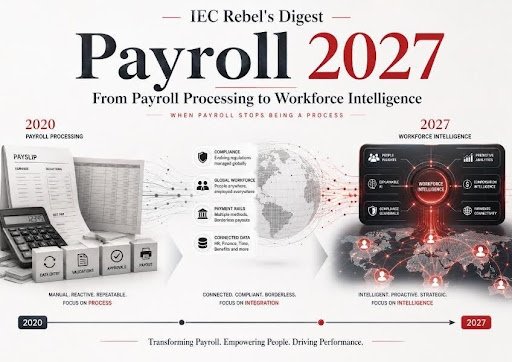 For most of its history, payroll rested on a reassuringly simple idea: companies employed people in known locations, under established contracts and predictable calendars, and paid them through domestic banking systems. The work was complicated, but the operating model was stable.
Mainframes replaced ledgers, cloud platforms replaced locally installed applications and employee self-service replaced printed forms. Yet beneath every modernization wave, payroll remained recognizably the same: a periodic calculation process at the end of the HR and finance chain.
Payroll 2027 begins with a different premise.
The process has not simply become more digital. The assumptions on which it was built have broken down.
An employee may work in one country, live in another, report to a manager in a third and be paid from an entity in a fourth. The workforce may include permanent employees, temporary workers, contractors, agency labor and employer-of-record arrangements. Compensation may combine salary, bonus, equity, commissions, allowances, benefits and on-demand payments.
Regulators increasingly require not only correct pay, but evidence that pay decisions are equitable, explainable and consistently governed.
The result is that payroll is moving from the end of the workflow to the center of the workforce operating model.
Four Eras of Payroll
The history of payroll can be understood in four broad eras.
The first was mechanical payroll: hours multiplied by rates, deductions subtracted and net pay produced through control, repetition and specialist knowledge.
The second was enterprise payroll. ERP and HCM systems connected payroll with employee records, time, finance and benefits. The objective was standardization and efficiency.
The third was global payroll. As companies expanded internationally, the problem became coordination. Multinationals assembled networks of local engines, in-country providers, regional hubs and global aggregators.
The promise was a single view. The reality was often a collection of interfaces, spreadsheets, service teams and reconciliations held together by process discipline.
The fourth era is now emerging: intelligence payroll.
Its purpose is no longer limited to producing a payslip. It must understand the worker, the work, the jurisdiction, the contractual arrangement, the payment route, the compliance obligations and the financial consequences—continuously, not merely at the monthly cut-off.
This is the transition at the heart of Payroll 2027.
The Year the Assumptions Failed
The break became visible in 2020.
The pandemic did not invent remote work, digital employment or distributed teams. It accelerated them so abruptly that organizations could no longer treat them as exceptions.
The International Labour Organization estimated that 557 million people—17.4% of global employment—worked from home during the second quarter of 2020. What had previously been managed through policies, approvals and occasional expatriate processes became an operating reality for large parts of the workforce.
Payroll departments suddenly faced questions their systems were not built to answer.
Where is the employee actually working? Has that created a tax, social-security or permanent-establishment risk? Which entity bears the cost? Is the person still an employee? Can the company pay locally—and explain the decision later?
The immediate response was pragmatic. Companies added remote-work policies, contractor platforms, EOR providers, global payment tools, compliance advisers and new approval workflows.
These solutions solved urgent problems, but they also fragmented the operating model.
By 2027, the market is no longer asking how to accommodate a few exceptions. It is asking how to govern a workforce in which exceptions have become normal.
From Accuracy to Assurance
Traditional payroll buyers asked three questions:
Can the system calculate correctly? Can it meet the deadline? Can it comply with local rules?
Those questions remain essential, but they are no longer sufficient. The new requirement is assurance.
Assurance means knowing why an outcome occurred, which data and rules produced it, where risks are accumulating and what action is needed. It means detecting cross-border exposure before an audit, inconsistent allowances before an employee dispute and labor-cost changes before the quarter closes.
Accuracy is a result.
Assurance is a capability.
That distinction explains why dashboards alone do not create payroll intelligence. A dashboard displays what happened. An intelligence layer interprets it, connects it with legal and business context, and recommends or triggers a response.
The Five E’s of Payroll 2027
IEC believes the new customer demand can be summarized through five requirements.
Payroll must be everywhere, every time, explainable, evidenced and embedded.
Everywhere
Coverage is no longer merely a country count.
Customers want consistent control across employees, contractors, EOR workers and other workforce categories—whether processing occurs on a native engine, partner platform or acquired local system.
The market spent years asking vendors, “In how many countries can you run payroll?”
The more important question for 2027 is, “Across how many countries and worker models can you deliver the same level of visibility, control and accountability?”
A provider may technically cover 150 countries while offering radically different operating experiences across them. Coverage without consistency is not global payroll. It is a collection of local services sold under a global contract.
Every Time
The monthly batch is losing its monopoly.
Salary may remain monthly in many countries, but payroll data is increasingly consumed continuously. Hiring, mobility, time, expenses, commissions, equity, benefits and terminations create events throughout the month.
Payment infrastructure is also resetting expectations. In the euro area, instant euro transfers are now available within seconds and around the clock under the EU’s Instant Payments Regulation.
Once money can move instantly, a payroll operation that requires days of manual prefunding and reconciliation begins to look less like an inevitability and more like an architectural limitation.
Payroll will not necessarily become an entirely real-time process. Tax calculations, statutory reporting and employment rules still require controlled processing. But the intelligence surrounding payroll must become continuous.
Organizations cannot wait until payroll closes to discover that the underlying workforce decision was wrong.
Explainable
Payroll outcomes must be understandable to employees, managers, auditors and regulators.
A worker should not receive a cryptic variance and wait several days for a specialist to reconstruct it. A compliance officer should be able to see which rule was applied. A finance leader should understand the drivers of a payroll increase without exporting five files and convening three teams.
The demand for explainability will become even more important as artificial intelligence enters payroll.
An answer generated by AI cannot simply sound plausible. The system must show the data, rules and assumptions behind it. In payroll, confidence without evidence is not intelligence. It is risk.
Evidenced
Compliance must produce an audit trail, not merely a claim.
The EU Pay Transparency Directive illustrates the direction of travel. Employers face requirements relating to salary information, employee access to comparative pay data, reporting and action where unjustified gender pay gaps reach specified thresholds.
Payroll data therefore becomes evidence within a broader system of workforce governance.
The question is no longer only, “Did we pay according to the rule?”
It is also, “Can we prove that the rule, the job architecture, the pay decision and the resulting outcome were consistent?”
This will place new pressure on data quality. Organizations that have tolerated inconsistent job titles, locally defined pay elements, undocumented exceptions and fragmented employee classifications will find that transparency regulation exposes weaknesses far beyond the payroll calculation itself.
Embedded
Payroll cannot remain a specialist island.
It must operate inside hiring, workforce planning, mobility, time, finance, treasury and employee experience.
A hiring manager should understand the real cost and compliance implications of employing someone before an offer is made. A mobility decision should automatically test tax and social-security exposure. A termination should coordinate final pay, benefits, equity, statutory documents and payment timing as one controlled event.
These five requirements are not product features.
They represent a new definition of the payroll function.
Technology Has Finally Caught Up with the Problem
The market has discussed global payroll transformation for years. What makes the current period different is that several technologies are maturing simultaneously.
First, modern data architectures can separate the workforce data model from individual country engines. An intelligence layer can normalize identities, contracts, pay elements, structures, jurisdictions and results across heterogeneous environments.
This matters because replacing every local payroll engine is rarely realistic. Creating a common language above those engines may be.
Second, event-driven systems can respond to workforce changes as they happen. A location change, promotion, bonus approval or bank-account update can trigger validation, compliance checks and downstream actions without waiting for the next payroll batch.
Third, knowledge graphs and machine-readable policies can connect legislation, collective agreements, company rules and worker circumstances. Payroll compliance is not a library of country summaries, but a network of conditional rules.
Fourth, artificial intelligence can classify exceptions, detect anomalies, summarize regulatory change, explain variances and guide decisions. But uncontrolled AI is least acceptable where pay and employment rights are involved.
Employment-related AI is explicitly treated as a high-risk area under the EU AI Act, with requirements developing around risk management, data quality, traceability, documentation, human oversight, robustness and accuracy.
The winning model will therefore not be “AI replaces payroll.”
It will be AI governed by payroll-grade controls.
Fifth, payment technology is converging with payroll technology.
Payroll vendors are moving into payments and treasury. Payment providers are moving towards workforce disbursement. Global employment platforms are adding payroll. HCM vendors are adding compliance intelligence.
This convergence is not accidental.
Calculation without payment is incomplete. Payment without worker and regulatory context is risky. Intelligence without the ability to execute remains advisory.
The Customer Has Changed Too
The buyer of payroll technology was once primarily the payroll department.
Today, the buying group is expanding.
The people function wants a consistent employee experience and trustworthy data. Finance wants visibility into labor cost and liabilities. Treasury wants control over funding and payment timing. Legal wants defensible evidence. IT wants fewer interfaces. Business leaders want to deploy talent without waiting for specialists to explain every constraint.
This changes the commercial conversation.
A provider can no longer win by demonstrating a prettier payroll run. It must show how it reduces the time required to enter a country, the cost of operating fragmented systems, the number of manual interventions, the risk of worker misclassification, the uncertainty of cross-border employment and the effort required to explain workforce cost.
Customers are moving from buying payroll output to buying workforce control.
Why Legacy Modernization Will Not Be Enough
Established providers will add analytics, chat interfaces, compliance alerts and AI assistants.
But the decisive question is architectural: does the platform understand the relationships among worker, work, entity, location, contract, pay, regulation and payment?
Without that understanding, intelligence remains superficial.
A system may summarize a report or flag an anomaly, yet fail to distinguish a mistake from an approved exception or regulatory change. It may answer a question without preserving the evidence needed to defend it.
This is why the next market battle will not be fought only between payroll engines.
It will be fought between competing control layers above and around those engines.
The strongest platforms will not necessarily replace every local payroll system. They will make the underlying systems more governable. They will unify data, interpret events, apply knowledge, coordinate workflows, control payments and preserve evidence.
Over time, that layer may become more strategically important than the calculation engine beneath it.
What Payroll 2027 Will Mean
By 2027, leading organizations will judge payroll platforms by a different set of outcomes.
How quickly can the company onboard a new country or worker model?
How many exceptions are prevented rather than corrected?
Can every material result be explained?
Can compliance obligations be translated into operational actions?
Can the organization see workforce cost and risk before decisions are made?
Can payments be executed with certainty and reconciled automatically?
Can artificial intelligence be used without sacrificing accountability?
The payroll run will still matter. But it will become the visible output of a much larger capability.
Payroll 2020 was primarily about digitizing, consolidating and globalizing processing.
Payroll 2027 is about making the workforce understandable, governable and executable across borders, systems and employment models.
That is a more profound transformation than moving from on-premise software to the cloud. It is the moment payroll stops being treated as a downstream administrative process and becomes a source of operational intelligence.
The next Rebel’s Digest article will explain how the Payroll 2027 study itself must differ from the payroll studies of the past: what should be assessed, which capabilities will separate leaders from followers, and why traditional country coverage and processing metrics are no longer enough.
This article establishes the reason for that change.
The market is no longer waiting for a better payroll system.
It is waiting for the intelligence layer that can make the new world of work function.

