
Why payroll leadership is moving from processing scale to workforce intelligence
For most of payroll’s history, leadership was associated with scale.
The largest providers processed the most payslips, served the greatest number of enterprises, operated across the widest geographic footprint and possessed the deepest compliance and service infrastructure. Those characteristics still matter. Payroll must remain accurate, compliant, secure and dependable.
But scale is not intelligence.
The next generation of payroll leadership will be defined by how effectively providers transform payroll data into insight, prediction and action.
From payroll processing to workforce intelligence
Payroll has traditionally been treated as a critical administrative process: calculate pay, apply deductions, meet regulatory obligations and produce reports.
That role is changing.
Payroll data contains a detailed record of how an organization operates. It shows where people work, how labor costs are changing, how overtime is developing, where compliance risks may emerge and how workforce decisions affect financial performance.
When payroll data is connected with time, attendance, workforce management, finance, payments and compliance information, it can become a source of enterprise intelligence.
Workforce intelligence enables organizations to understand:
- What happened in payroll and workforce costs
- Why a change occurred
- What is likely to happen next
- Which risks require attention
- What action should be taken
This is a fundamentally different value proposition from payroll processing.
What workforce intelligence does for the enterprise
A workforce-intelligence platform should help organizations move from retrospective reporting to continuous understanding and proactive management.
It should be able to identify unusual payroll variances before employees are paid, explain the source of the deviation and distinguish between a data issue, policy issue or legitimate workforce event.
It should detect rising overtime in a business unit, connect that increase to operational events, project its effect on future labor costs and identify whether working-time rules or internal policies may be at risk.
It should help finance teams understand workforce-cost movements, support more accurate forecasting and connect payroll outcomes with budgets, cash requirements and business performance.
It should help HR and workforce leaders identify patterns in absence, turnover, scheduling, compensation and labor utilization.
It should help compliance teams monitor regulatory exposure across jurisdictions and surface potential issues before they become violations.
It should also recommend appropriate interventions and, where governance allows, initiate controlled actions with human oversight.
The objective is not simply to automate payroll administration.
The objective is to improve the quality, speed and confidence of workforce decisions.
Intelligence requires integration
Artificial intelligence alone does not create workforce intelligence.
A conversational interface that retrieves a payslip is useful, but it is not workforce intelligence.
A dashboard that displays historical labor costs is useful, but it is not workforce intelligence.
An AI assistant placed on top of fragmented payroll databases may improve access to information, but it cannot provide reliable enterprise insight if the underlying data is inconsistent, disconnected or incomplete.
Workforce intelligence depends on integration.
Payroll must connect with:
- Time and attendance
- Workforce management
- Human resources
- Finance and accounting
- Payments and treasury
- Benefits and deductions
- Compliance and regulatory data
- Planning and forecasting systems
The quality of intelligence depends on the quality of the data foundation.
A unified or strongly normalized data model allows organizations to compare workforce costs across countries, business units and employee populations. It also enables AI systems to interpret events in context rather than treating payroll as an isolated transaction.
Integration turns payroll data into operational knowledge.
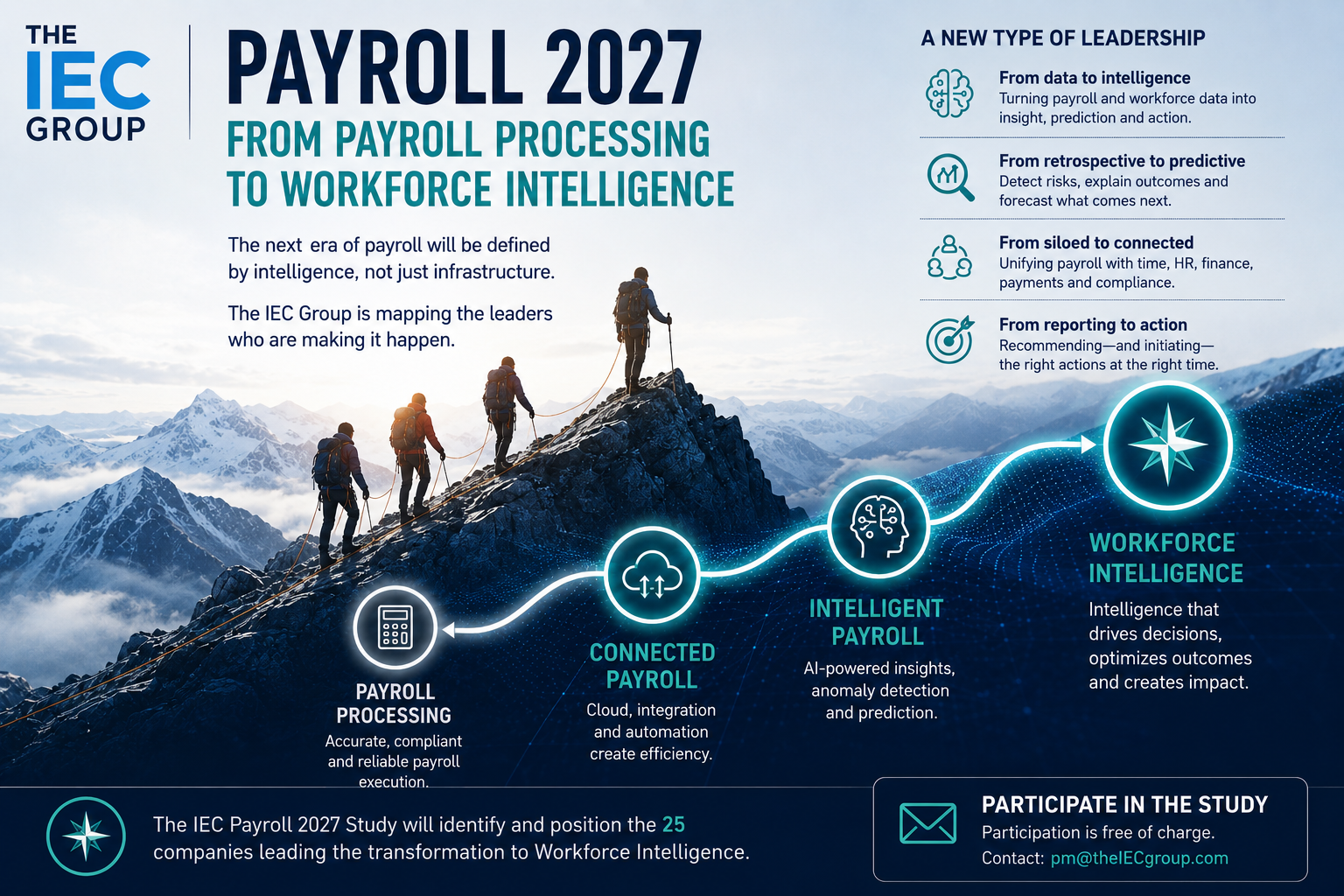
The intelligence maturity journey
Organizations will progress through several stages as payroll evolves.
Payroll Processing focuses on accurate calculation, compliance, reporting and operational service.
Connected Payroll adds cloud delivery, APIs, system integration, consolidated visibility and workflow automation.
Intelligent Payroll introduces anomaly detection, explanation, advanced analytics, prediction and AI-supported payroll operations.
Workforce Intelligence connects payroll with broader workforce and financial data to support scenario planning, prescriptive recommendations and governed action.
The most advanced organizations will use payroll not only to record workforce activity, but also to anticipate its consequences.
They will be able to model the effect of hiring plans, overtime changes, compensation adjustments, geographic expansion, regulatory changes and workforce restructuring before those decisions are implemented.
What separates intelligent payroll from AI marketing
The term “AI” is now used across the payroll and HR technology market. However, capabilities vary considerably.
Some tools provide search, summarization or conversational access to existing information.
Others detect anomalies, explain causes, predict outcomes and recommend action.
The difference is significant.
A mature workforce-intelligence capability should demonstrate:
- A reliable payroll and workforce data foundation
- AI embedded in live operational workflows
- Detection of anomalies and emerging risks
- Explanations that users can understand and verify
- Predictive analysis of costs, liabilities and workforce events
- Prescriptive recommendations
- Connections across payroll, workforce, finance, payments and compliance
- Governance, security and auditability
- Measurable adoption and business outcomes
The most valuable systems will not simply answer questions.
They will help organizations ask better questions, identify issues earlier and make more informed decisions.
The value for end-user organizations
For enterprise users, workforce intelligence can create value across several dimensions.
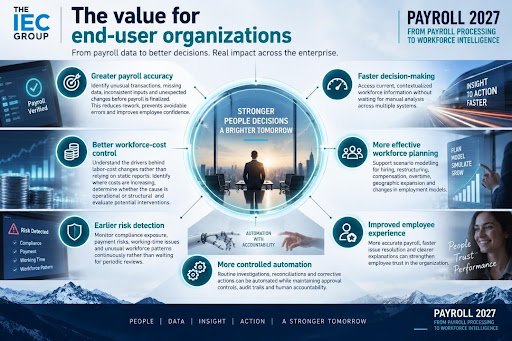
Greater payroll accuracy: Organizations can identify unusual transactions, missing data, inconsistent inputs and unexpected changes before payroll is finalized.
This reduces rework, prevents avoidable errors and improves employee confidence.
Better workforce-cost control: Finance and HR leaders can understand the drivers behind labor-cost changes rather than relying on static reports.
They can identify where costs are increasing, determine whether the cause is operational or structural and evaluate potential interventions.
Earlier risk detection: Organizations can monitor compliance exposure, payment risks, working-time issues and unusual workforce patterns continuously rather than waiting for periodic reviews.
Faster decision-making: Leaders can access current, contextualized workforce information without waiting for manual analysis across multiple systems.
More effective workforce planning: Payroll intelligence can support scenario modelling for hiring, restructuring, compensation, overtime, geographic expansion and changes in employment models.
Improved employee experience: More accurate payroll, faster issue resolution and clearer explanations can strengthen employee trust in the organization.
More controlled automation: Routine investigations, reconciliations and corrective actions can be automated while maintaining approval controls, audit trails and human accountability.
What separates intelligent payroll from AI marketing
The term “AI” is now used across the payroll and HR technology market. However, capabilities vary considerably.
Some tools provide search, summarization or conversational access to existing information.
Others detect anomalies, explain causes, predict outcomes and recommend action.
The difference is significant.
A mature workforce-intelligence capability should demonstrate:
- A reliable payroll and workforce data foundation
- AI embedded in live operational workflows
- Detection of anomalies and emerging risks
- Explanations that users can understand and verify
- Predictive analysis of costs, liabilities and workforce events
- Prescriptive recommendations
- Connections across payroll, workforce, finance, payments and compliance
- Governance, security and auditability
- Measurable adoption and business outcomes
The most valuable systems will not simply answer questions.
They will help organizations ask better questions, identify issues earlier and make more informed decisions.
The value for end-user organizations
For enterprise users, workforce intelligence can create value across several dimensions.
Greater payroll accuracy: Organizations can identify unusual transactions, missing data, inconsistent inputs and unexpected changes before payroll is finalized.
This reduces rework, prevents avoidable errors and improves employee confidence.
Better workforce-cost control: Finance and HR leaders can understand the drivers behind labor-cost changes rather than relying on static reports.
They can identify where costs are increasing, determine whether the cause is operational or structural and evaluate potential interventions.
Earlier risk detection: Organizations can monitor compliance exposure, payment risks, working-time issues and unusual workforce patterns continuously rather than waiting for periodic reviews.
Faster decision-making: Leaders can access current, contextualized workforce information without waiting for manual analysis across multiple systems.
More effective workforce planning: Payroll intelligence can support scenario modelling for hiring, restructuring, compensation, overtime, geographic expansion and changes in employment models.
Improved employee experience: More accurate payroll, faster issue resolution and clearer explanations can strengthen employee trust in the organization.
More controlled automation: Routine investigations, reconciliations and corrective actions can be automated while maintaining approval controls, audit trails and human accountability.
From data visibility to decision intelligence
The most important shift is from visibility to decision intelligence.
Visibility tells an organization what happened.
Intelligence explains why it happened, predicts what may happen next and helps determine what to do.
For example, a traditional payroll report may show that labor costs increased by 8 percent.
A workforce-intelligence platform should be able to identify the business units responsible, connect the increase to overtime, absence, hiring or compensation events, estimate the likely cost for the next quarter, identify relevant compliance considerations and recommend possible actions.
That is the difference between reporting and intelligence.
The future of payroll leadership
The future leader in payroll will not necessarily be the provider with the largest installed base, the longest operating history or the greatest geographic reach.
It will be the provider that can combine payroll reliability with integrated data, intelligent automation, predictive insight and governed action.
The strongest platforms will help organizations:
- Prevent payroll errors before they occur
- Understand workforce-cost movements
- Anticipate compliance and payment risks
- Connect payroll with financial planning
- Improve workforce allocation and productivity
- Model the consequences of workforce decisions
- Automate routine work without sacrificing control
Payroll will remain a critical transaction.
But it will increasingly become something more: a trusted intelligence layer for the economics of work.
Payroll 2027 Study: From Payroll Processing to Workforce Intelligence
The IEC Payroll 2027 study will examine how the market is progressing from payroll administration to workforce intelligence.
The focus will be on transformation, integration, intelligence and measurable value for end-user organizations.
The central question is no longer simply: Can a provider process payroll accurately?
It is: Can the provider turn payroll and workforce data into trusted insight, predictive understanding and practical action?
The answer will define the next generation of payroll leadership.
Payroll accuracy creates trust. Integration creates context. Intelligence creates action.
Participation in the study is free of charge. Interested providers can contact: pm@theiecgroup.com

