
Why the next battle in payroll may not be about who owns the payroll engine
 For most of the history of payroll, the strategic asset was obvious. It was the payroll engine.
The provider that calculated gross-to-net pay, maintained local tax rules, handled statutory requirements and produced the final payroll result effectively controlled the process. Global payroll strategies were therefore largely built around a simple question: Who can process payroll in the countries where we operate?
That assumption is beginning to look increasingly incomplete.
Over the past several editions of the Rebel’s Digest, we have followed payroll’s progression from processing to Workforce Intelligence. We have examined the Workforce Intelligence Gate, the challenge facing the established giants, the opportunity for newer challengers and, most recently, the movement from AI assistants toward increasingly autonomous payroll.
Those developments point toward a larger structural change.
What if the most strategically important layer of payroll is no longer the engine that calculates it?
What if competitive advantage increasingly moves upward—to the technology that controls payroll data, coordinates multiple engines, monitors workflows, identifies risks, connects payroll with the wider enterprise and ultimately decides what needs attention?
That is the emerging Payroll Intelligence Layer.
And the race to own it may reshape the market more fundamentally than the arrival of another global payroll engine.
The payroll engine is not disappearing
Before declaring another technology revolution, an important point needs to be made.
Payroll engines remain essential.
A German payroll engine must understand German payroll. A French engine must correctly interpret French regulation. The same applies across hundreds of tax, social-security and employment regimes worldwide.
There is enormous intellectual property embedded in mature payroll calculation engines.
Artificial intelligence does not eliminate that. Nor does orchestration.
The payroll engine remains the machinery that converts employment and workforce events into a legally correct financial result.
But machinery can be essential without necessarily being the layer where the greatest strategic value resides.
Banks still need payment rails. Airlines still need aircraft. Cloud platforms still need data centers.
Yet customer control, intelligence and competitive differentiation often migrate elsewhere in the technology stack. Payroll may now be entering the same phase.
The problem enterprises actually experience sits above the engine
Ask a multinational payroll organization where most of its frustration resides and the answer is often not the gross-to-net calculation.
The local payroll usually works. The difficulty is everything surrounding it.
- Employee data must move from HR systems into payroll.
- Variable inputs arrive from time systems, compensation processes, spreadsheets and local organizations.
- Different countries require different formats.
- Deadlines differ.
- Approvals differ.
- Payroll results return in different structures.
- Finance needs consolidated cost information.
- Treasury needs funding requirements.
- Employees need explanations.
- Compliance teams need visibility.
And somebody must determine whether 40 apparently successful local payrolls actually represent one controlled global payroll operation.
This is exactly the gap that a new generation of platforms is beginning to address.
The calculation engine remains underneath. But another layer increasingly sits above it.
- It standardizes.
- It orchestrates.
- It validates.
- It monitors.
- It interprets.
- And eventually, it acts.
That is why owning payroll processing and owning payroll control are beginning to become two different things.
The stack is separating
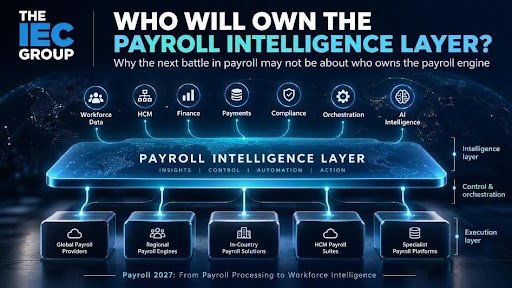
A useful way to understand the emerging market is to think about payroll as a technology stack.
At the bottom sits the execution layer: the engines, regulatory logic and local expertise required to calculate compliant payroll.
Above that sits an increasingly important control and orchestration layer: data exchange, workflow, validation, approvals, consolidated processing and exception management.
Above that emerges the intelligence layer: anomaly detection, explanation, prediction, recommendations and agentic action.
And surrounding all three sits the enterprise environment—HCM, time, finance, payments, workforce planning and compliance.
Historically, one provider often attempted to own most of this vertically.
The future may be less tidy.
Multiple different types of companies now have credible claims on the upper layers.
And that creates a strategic contest far more interesting than a conventional payroll-vendor comparison.
The payroll giants want to extend upward
The traditional global payroll leaders have the most obvious route.
They already own substantial parts of the execution layer.
They possess regulatory expertise, customer relationships, payroll histories and enormous transaction volumes.
Their opportunity is to build intelligence on top of what they already process.
As we discussed in Article 130, this could be extraordinarily powerful if they can normalize information across their own product estates.
The incumbents could turn decades of payroll history into context for AI.
But the difficulty is equally clear.
Their intelligence layer must span different product generations, acquisitions, country engines and operating models.
If the intelligence works brilliantly on the newest cloud platform but inconsistently across the rest of the global estate, the promise of Workforce Intelligence becomes fragmented.
The incumbents therefore have to do more than add intelligence.
They need to make the underlying payroll estate intelligible.
HCM providers have a different advantage: context
Workday, SAP, Oracle, UKG, Dayforce and other HCM providers approach the opportunity from almost the opposite direction.
Payroll may not always be the center of their technology universe.
The employee is.
That matters.
Workforce Intelligence requires context that payroll by itself does not always possess.
- Why did pay increase?
- Was it overtime?
- A job change?
- A promotion?
- A bonus?
- A scheduling event?
- A leave event?
- An organizational change?
A payroll engine can calculate the financial result. An HCM environment potentially understands the workforce event that produced it.
This is why the expansion of agentic AI across HCM matters strategically.
Workday’s Payroll Agent, for example, validates payroll information, explains issues and recommends next actions with human oversight. SAP is connecting payroll assistants with core HR and time agents, while its broader autonomous-HCM strategy explicitly links workforce and financial context. Workday
The HCM vendors therefore have a compelling proposition:
Perhaps the intelligence layer should sit where the workforce context already lives.
But they face the opposite problem of the payroll incumbents.
Context without sufficient payroll depth can produce elegant intelligence around an incomplete operational picture. To own the Payroll Intelligence Layer, HCM companies still need to demonstrate that they understand payroll with the same depth that they understand the employee.
The challengers want to collapse the layers
A third group is attempting something more ambitious. Deel, Rippling, Papaya Global and other newer workforce platforms increasingly combine employment data, payroll, compliance, payments and workforce administration within a common environment.
Their proposition is not simply to put intelligence above existing payroll.
It is often to reduce the boundaries between the layers altogether.
Deel, for example, now combines its own payroll capabilities with Payroll Connect, which brings third-party payroll data and workflows into the same environment. Its platform can therefore provide consolidated status, variances and reporting even where Deel is not necessarily the underlying local payroll engine.
Papaya Global is taking a similarly explicit architectural position. Its current proposition describes OneData as an intelligence layer mapping HCM, ERP and workforce systems into a common data fabric, above which payroll, contingent workforce and payments can be orchestrated.
This is strategically significant. These companies are effectively saying:
The important asset is not only the calculation engine. It is the unified environment through which workforce information, payroll execution and money movement are controlled.
That is much closer to an operating system than a traditional payroll bureau.
But a fourth model may be even more disruptive
There is another category emerging that deserves much more attention.
It does not necessarily want to replace the payroll engine at all.
Instead, it assumes that enterprises may continue using multiple local or regional payroll providers—and builds a global technology layer above them.
This is the independent payroll System of Record and orchestration model.
Paybix is an interesting example. Its proposition explicitly starts from the argument that local payroll expertise is valuable and should remain in place. Its platform instead connects HCM and workforce systems with local payroll providers, standardizes payroll input, automates data exchange and creates a centralized payroll database and control layer above the engines.
In one example, Paybix describes ADP remaining as the payroll execution layer while Paybix automates and controls the preparation and orchestration work upstream.
That is conceptually important. Because it separates two things the market has historically treated as inseparable:
Payroll execution and payroll ownership.
An enterprise could theoretically retain ADP in one country, SD Worx in another, a strong local provider elsewhere—and still have one global payroll control environment above them.
If that model works at scale, the enterprise no longer has to choose between local expertise and global standardization.
It can attempt to have both.
CloudPay shows that the orchestration idea is not limited to independent platforms
The emerging control-layer battle is already visible among established global payroll specialists as well. CloudPay’s new Navigator positioning is particularly revealing.
CloudPay describes Navigator not merely as a dashboard but as an end-to-end payroll operating system that governs payroll and payments, standardizes global processes, automates validation, provides real-time workflow status and shifts teams toward exception-led operation. It is explicitly positioned as a layer that can complement an enterprise’s HCM landscape.
This tells us something important. Different categories of vendors are converging on the same strategic territory.
Payroll incumbents are moving upward.
HCM providers are moving downward.
Global employment providers are moving inward.
Payments platforms are moving closer to payroll.
And independent orchestration platforms are attempting to sit above all of them.
They are all, in different ways, competing for control of the payroll intelligence layer.
Why this matters more than another feature war
Technology markets often focus too heavily on functionality.
Does Vendor A have anomaly detection?
Does Vendor B have an AI assistant?
Does Vendor C support real-time reporting?
Those questions matter, but they may miss the structural change.
The more important question is:
Where does the enterprise’s authoritative payroll intelligence live?
That layer knows which payrolls are ready.
- It knows which inputs changed.
- It understands which exceptions matter.
- It has the normalized payroll results.
- It sees costs across countries.
- It connects payroll with finance.
- It can potentially compare provider performance.
- It increasingly controls approvals.
And in an agentic environment, it may decide which action happens next.
Whoever owns that layer can become the primary interface between the enterprise and the increasingly complex infrastructure underneath.
That is a strategically powerful position.
Could payroll engines become infrastructure?
This does not mean payroll calculation becomes a commodity. Regulatory depth prevents such a simplistic conclusion. But it may increasingly become infrastructural. The distinction matters. Infrastructure can remain complex, valuable and difficult to reproduce while becoming less visible to the end user.
Most enterprise users do not know which cloud server processed their transaction. They care about the service above it.
A similar separation could occur in payroll.
The enterprise may care less about which engine performs the final local gross-to-net calculation if the global intelligence layer provides reliable data, control, governance and accountability across them.
For some organizations, that would represent a profound change in sourcing strategy.
Instead of replacing dozens of local payrolls in order to achieve global standardization, they could standardize above them.
That would potentially reduce transformation risk and preserve strong local provider relationships.
But it also creates a new set of challenges.
Orchestration does not eliminate accountability
The independent intelligence-layer model is attractive precisely because it allows organizations to avoid replacing everything underneath.
But decoupling also creates potential ambiguity. If the global platform validates data but the local provider calculates payroll, who owns an error?
If the orchestration layer identifies an anomaly after the local calculation, which provider resolves it?
If information is normalized across systems, how quickly is that information available?
Can the intelligence layer act directly—or only create another workflow for somebody else to execute?
And when multiple providers sit inside one process, where does end-to-end accountability ultimately reside?
These are not reasons to reject orchestration.
They are reasons to evaluate it carefully.
The winning intelligence layer will need to do more than provide visibility over fragmented infrastructure.
It must make that fragmentation operationally manageable.
The System of Record itself is being redefined
For years, enterprises commonly referred to the HCM platform as the employee System of Record.
That remains logical for core employee data. But payroll introduces another requirement.
A global payroll System of Record must understand more than who the employee is.
It needs to understand what payroll input was supplied, what changed, which version was approved, what was calculated, what was corrected, what was paid and what ultimately reached finance.
That creates an interesting distinction between:
the employee System of Record and the payroll System of Record.
They can be connected without necessarily being the same system.
This may become one of the most consequential architectural decisions enterprises make over the next several years. Because AI needs an authoritative data foundation. If the intelligence layer is unable to determine which payroll data is correct, current and approved, sophisticated AI simply reaches uncertain conclusions faster.
The intelligence layer could reduce vendor lock-in
There is another implication that payroll providers may find less comfortable.
If an enterprise owns—or independently procures—the control and data layer above local payroll providers, switching the engine underneath potentially becomes easier.
Not easy. But easier.
A country provider could be replaced without redesigning the global reporting environment, rebuilding every HCM integration or recreating the entire governance model.
The orchestration layer could remain constant.
That would shift bargaining power. Historically, the enormous integration effort associated with global payroll replacement contributed to vendor lock-in. A persistent intelligence and control layer could make the execution provider more replaceable.
This is precisely why the battle over the upper layer matters strategically.
The company that owns it may control not only the data and user experience—but increasingly the architecture of the customer relationship.
But the integrated model still has a powerful argument
There is an obvious counterargument. Why introduce another layer when one provider can own the entire process?
An integrated provider can potentially eliminate interfaces rather than merely orchestrate them.
- One data model.
- One workflow.
- One accountability structure.
- One technology roadmap.
- One support organization.
If that provider can deliver sufficient country depth and global coverage, the vertically integrated model may produce better real-time intelligence because the data never needs to cross organizational boundaries.
This is why the emerging Payroll Intelligence Layer does not automatically favor independent orchestration. There will probably be no single winning architecture. The more likely outcome is competition between different models. And enterprises will need to determine which one best matches their complexity, geographic footprint, existing investments and appetite for consolidation.
The buyer’s question is therefore changing again
Only a few years ago, a global payroll selection might begin with:
In how many countries can you process payroll?
Increasingly, that question is insufficient. The better question may become:
What layer of my payroll architecture do I want this provider to own?
- Do I want one company to calculate and control everything?
- Do I want my HCM platform to become the primary intelligence environment?
- Do I want a newer workforce platform to combine employment, payroll and payments?
- Or do I want an independent global control layer while retaining strong local engines underneath?
The answer will differ by enterprise. But simply choosing a payroll vendor without first answering the architecture question may increasingly put procurement in the wrong order.
Follow the control points, not the category labels
This also explains why traditional vendor categories are becoming less useful. Is Deel an EOR provider?
Increasingly, that description is insufficient. Is Workday an HCM provider?
Yes—but its agents increasingly participate directly in payroll.
Is Papaya a payroll provider, payments company or workforce platform?
Its architecture increasingly spans all three.
Is CloudPay a managed payroll provider or a payroll operating system?
It is positioning itself as both.
Is Paybix a payroll provider if it deliberately does not replace the local payroll calculation?
Perhaps the more useful question is whether it controls enough of the global process to become strategically important.
The category labels describe where companies came from.
The control points tell us where the market is going.
Workforce Intelligence may become the new control point
This brings the argument back to Payroll 2027.
The transition from Payroll Processing to Workforce Intelligence is not simply a functionality upgrade.
It may reorganize the industry around a new point of strategic control.
The engine determines the payroll answer. The intelligence layer determines what that answer means.
- It sees the exception.
- It connects the context.
- It predicts the consequence.
- It decides what needs attention.
- It may eventually initiate the response.
That gives the intelligence layer influence over the entire environment underneath it.
In technology markets, the layer that controls context, decisions and action frequently becomes more strategically important than the infrastructure executing the individual transaction.
Payroll may be approaching that moment.
So who will own it?
The payroll giants have scale, depth and data. The HCM providers have workforce context.
The newer global platforms have architectural freedom and increasingly unified payroll, employment and payment environments.
Independent orchestration providers offer neutrality and the possibility of separating global control from local execution.
Each has a credible claim.
None has automatically won.
And that may be one of the most important conclusions from the Payroll 2027 research so far.
The competitive boundary is shifting.
The next payroll leader may not simply be the company with the best engine.
It may be the company that can sit across engines, systems and workforce data and turn all of them into one trusted operating environment.
The next battle in payroll may therefore be less about who calculates the pay—and more about who controls the intelligence around it.
That is the Payroll Intelligence Layer.
And whoever owns it may ultimately redefine what it means to own payroll.
Payroll 2027: From Payroll Processing to Workforce Intelligence
The IEC Group is evaluating how established payroll leaders and emerging challengers are moving from AI-assisted payroll toward intelligent and increasingly autonomous operations.
The research will distinguish announcements and roadmaps from deployed customer capabilities—and will examine how providers combine automation with governance, explainability and measurable outcomes.
Participation in Payroll 2027 is free of charge. Contact pm@theiecgroup.com

