
The next battle in Payroll 2027 will not be about who has AI. It will be about how much of payroll AI can safely run.
For the last three editions of the Rebel’s Digest, we have looked at the changing competitive structure of payroll. We introduced the Workforce Intelligence Gate, asked whether the established payroll giants can reinvent themselves, and examined whether the new challengers can turn architectural freedom and innovation into enterprise-scale trust.
Article 132 moves from who might win to what the winning technology model may actually look like.
And one development is becoming increasingly difficult to ignore. Payroll is moving from the age of the AI assistant toward the age of the AI agent. The distinction sounds technical. It is not.
An assistant waits for a question. | An agent watches what is happening. |
An assistant explains. | An agent can investigate. |
An assistant recommends. | An agent can increasingly prepare—and eventually execute—the action. |
This could fundamentally change the economics and operating model of payroll. But it also raises an uncomfortable question: How much payroll should we really allow the machine to run?
The first generation of payroll AI was mostly about access
The initial wave of generative AI in HR and payroll was relatively easy to understand.
- Ask a question in natural language
- Explain a payslip
- Find a deduction
- Generate a report
- Summarize a policy
- Help an administrator navigate a complicated system
These capabilities are useful because they reduce one of enterprise software’s oldest problems: the user has to understand how the software is organized before the software can help them.
Conversational interfaces reverse that relationship. The user asks what they want to know. The system finds it. But this still leaves the human firmly in control of the process. The AI waits.
- Someone must notice that something is wrong before asking the question.
- Someone must interpret the answer.
- Someone must decide what to do.
- And someone must carry out the correction.
That is AI-assisted payroll. The next stage is different.
The agent does not wait to be asked
Agentic payroll begins when software becomes an active participant in the payroll process.
- It continuously monitors the environment
- It identifies an unusual event
- It investigates the possible causes
- It retrieves supporting information
- It evaluates the issue against predefined rules
- It decides whether human attention is required
- And increasingly, it can prepare the next action
This is already becoming visible across the market.
ADP describes Assist agents that identify payroll variances and facilitate remediation under human oversight. Its broader agent model explicitly differentiates simple agents, advanced multi-step agents and autonomous agents capable of managing complex workflows while involving people where appropriate.
Workday’s Payroll Agent identifies missing data and configuration issues, provides proactive payroll insights and is designed to automate end-to-end payroll workflows while retaining human oversight and control.
UKG has gone even further in describing payroll as a real-time system of action. Its Payroll Analyst Agent investigates variances and root causes, while AI-assisted processing can schedule and execute the payroll cycle with administrator review and approval points built into the process.
SAP’s emerging Payroll Assistant coordinates multiple Joule agents to prepare payroll, identify issues earlier and guide administrators toward resolution.
Deel describes payroll AI that operates continuously inside the workflow, catches anomalies before the payroll cycle starts, traces changes to their source and surfaces risk while there is still time to act. Its wider AI Workforce model is designed around agents operating according to customer rules, approvals and risk thresholds.
Oracle provides an interesting contrast. Its current payroll agents emphasize analysis, explanation and troubleshooting: helping administrators validate results, understand tax calculations and navigate directly to the underlying information requiring attention.
These approaches are not identical. Nor should IEC assume that every announced capability is equally mature or equally deployed. But collectively they show where the industry is heading.
Payroll AI is beginning to move from answering questions to participating in work.
Autonomous payroll does not mean payroll without people
This distinction is important. The phrase autonomous payroll can easily create the wrong mental picture: an artificial intelligence system independently calculating and paying thousands of employees while the payroll department disappears.
That is unlikely to be the right model. Nor, in IEC’s view, should it be the objective.
Payroll deals with money, taxation, regulation and people’s livelihoods.
The cost of an incorrect recommendation is very different from the cost of an AI system creating an imperfect meeting summary.
The more realistic destination is something we might call: Controlled autonomy
The system handles what it knows. It escalates what it does not.
Routine processes increasingly disappear into the background.
Exceptions become the primary focus of human attention.
And every consequential action operates within defined authorities, approvals, audit trails and controls.
The payroll professional therefore does not disappear. The job changes.
The practitioner moves from processing transactions toward supervising an increasingly intelligent operating environment.
That is potentially a much larger transformation than simply making payroll teams more productive.
The real breakthrough is exception-driven payroll
For decades, payroll teams have essentially processed the entire payroll population in order to find the relatively small number of cases requiring attention.
AI reverses that logic.
Imagine an organization with 50,000 employees.
Instead of payroll professionals working through enormous volumes of normal transactions, the platform continuously determines which transactions behave as expected.
Most require no intervention.
The system identifies the relatively small number that do not.
But even there, an intelligent agent should not simply produce another alert. It should investigate.
- An employee’s gross pay is 18 percent higher than usual. Why?
- The system sees that overtime increased. Why?
- Time-and-attendance data shows additional weekend shifts. Was that legitimate?
- Scheduling data confirms that the employee covered absences in another team. Is there a compliance issue?
- Working-time rules remain within permitted thresholds. Is the payroll result therefore reasonable? Probably.
The system may not need to interrupt the payroll professional at all.
Now consider another variance. The same investigation finds no corresponding time, compensation or employment event.
The agent identifies a likely incorrect input, determines where it entered the workflow and presents the payroll administrator with the issue and recommended correction.
That is no longer anomaly detection. It is automated investigation. And that is where the economics begin changing.
The future KPI may be how little payroll humans need to touch
For years, payroll transformation programs measured processing time, accuracy, cost per payslip and service levels. Those metrics remain useful. But autonomous payroll may require different measures.
One of the most interesting could become the percentage of payroll requiring human intervention.
Another might measure how many exceptions the system resolves before the payroll practitioner ever sees them.
Or how many potential payment errors are identified before final calculation rather than after payment. This changes the definition of efficiency. The objective is no longer merely to calculate payroll faster.
It is to create a payroll process in which normal activity flows automatically, and human intelligence is concentrated where judgment actually adds value.
The future state may therefore be less about zero-touch payroll than about zero unnecessary touch. That distinction matters. It keeps humans where they create value rather than simply removing them from the process.
Autonomy also creates a paradox: more automation requires more control
The more powerful payroll agents become, the more important governance becomes. This is the autonomy paradox.
- When AI merely explains information, the risk of an incorrect response is manageable.
- When AI prepares a payroll change, the stakes become higher.
- When it executes that change, the stakes increase again.
- When it releases a payment, compliance filing or statutory instruction, governance becomes fundamental.
The most advanced payroll system may therefore not be the one that allows AI to do the most. It may be the one that understands exactly what AI should be allowed to do under which circumstances.
- A €20 data correction may be automatically resolved.
- A €200,000 payroll funding movement should probably require very different controls.
- A routine missing field may be corrected from an authoritative source.
- A disputed termination payment may require human judgment.
The intelligent system needs to understand not only the payroll process but also its own authority.
- That means role-based access
- Separation of duties
- Confidence thresholds
- Approval rules
- Audit trails
- Traceable source data
- Explainability
- And the ability to reverse an action
This is where payroll’s traditional discipline becomes an advantage rather than a burden. The future is not AI replacing payroll controls. It is AI operating inside them.
Explainability becomes more important as autonomy increases
There is another implication. The more action an AI system takes, the less acceptable a black box becomes. If an assistant gives the wrong answer, a practitioner may recognize it. If an agent makes a decision before the practitioner even sees the issue, that assumption becomes much more dangerous.
An enterprise therefore needs to know:
- Why was this transaction flagged?
- Which information was considered?
- Which rule or pattern influenced the recommendation?
- What confidence did the system have?
- What action did it take?
- Who authorized it?
- Could the outcome be reproduced?
For payroll, explainability is not an academic debate about responsible AI. It is part of operational control.
Oracle’s movement toward context-aware explanations of tax calculations illustrates one aspect of this direction, while Workday explicitly exposes the data sources queried by its Payroll Agent. The strongest platforms will increasingly need to show not merely that the AI reached the correct result—but how.
Autonomous payroll depends on something AI vendors cannot fake: context
The underlying data architecture therefore becomes even more important than we argued in previous articles. An agent can only act intelligently if it understands the environment in which it is acting.
- Payroll data alone may show that a payment changed.
- Time data explains part of the reason.
- HCM data may explain another part.
- Finance provides cost context.
- Compliance provides regulatory context.
- Payments determine whether the transaction was completed.
The more autonomous the system becomes, the more dangerous fragmented context becomes. This is why unified data models are strategically significant. It also explains why both incumbents and challengers have credible routes into the autonomous payroll market. The incumbents possess extraordinary volumes of historical payroll information and domain expertise. The challengers often possess cleaner data architectures and more unified workforce environments.
Neither advantage automatically wins. One has to convert depth into usable context. The other has to convert architectural coherence into sufficient domain depth. That is precisely the contest we have been describing throughout Payroll 2027.
From System of Record to System of Action
For enterprise technology buyers, perhaps the biggest shift is conceptual. Traditional payroll is fundamentally a System of Record. It establishes the authoritative answer:
- What was the employee paid?
- What tax was withheld?
- What liability exists?
- What was reported?
The next generation adds a second role. It becomes a System of Intelligence.
- Why did the result change?
- What is unusual?
- What might happen next?
But autonomous payroll introduces a third role. The System of Action
What should happen now? And can the system safely help make it happen?
This is where payroll begins to converge with the broader agentic enterprise.
Workday increasingly talks about managing people, finance and agents on a common platform. SAP is developing networks of cooperating agents. ADP distinguishes between simple, advanced and autonomous agents. UKG describes payroll as a real-time system of action. Deel positions agents across the employee lifecycle.
The language differs. The direction does not. Enterprise systems are beginning to move from storing information to interpreting it—and from interpreting it to acting on it.
This changes what enterprises should ask during payroll selection
The procurement questions need to evolve accordingly. It will no longer be enough to ask: What AI features do you have? Buyers should want to understand how the intelligence operates.
- Does it simply respond to prompts, or does it continuously monitor payroll?
- Can it investigate exceptions without being asked?
- Can it identify root causes across systems?
- Can it prepare a corrective action?
- Can it execute that action?
- Where does human approval enter the process?
- What happens when confidence is low?
- Can the customer define different autonomy thresholds for different types of transactions?
- And can every action be explained and audited?
Those questions reveal something a conventional feature list cannot: how far the provider has actually moved along the autonomy curve.
There will not be one moment when payroll suddenly becomes autonomous
This transition will happen gradually. The simplest and lowest-risk processes will move first.
Data retrieval already has. Explanation is rapidly following. Anomaly detection is becoming common. Investigation and root-cause analysis are emerging. Correction and remediation are beginning to appear. Orchestration of the overall payroll cycle is now being introduced. True autonomous execution of complex, cross-country payroll processes will take longer.
And perhaps it should. Payroll is not an industry that benefits from reckless experimentation. But the direction is becoming clear enough that enterprises making technology decisions today should already be considering it. A payroll platform selected in 2027 may still be operating in 2035.
Buying purely for today’s processing requirements risks locking an enterprise into yesterday’s operating model.
Payroll professionals may gain, not lose, strategic importance
There is understandable concern that autonomous systems will reduce payroll employment. Some transactional roles will unquestionably change. But the more interesting possibility is that payroll expertise becomes more valuable rather than less.
- Someone has to define the rules under which autonomous agents operate.
- Someone must understand whether recommendations make sense.
- Someone needs to design controls.
- Someone needs to manage exceptions that fall outside the system’s confidence.
- Someone must translate regulatory change into operational policy.
And someone needs to understand the relationship between payroll and workforce economics well enough to challenge the intelligence when necessary.
The profession may therefore move from being perceived primarily as an administrative function toward something closer to workforce financial governance.
That would be an extraordinary change in status. The machine handles more processing. The human becomes more responsible for judgment.
The question is no longer whether autonomous payroll will arrive
Elements of it are already arriving. The more useful question is: Which providers can make autonomy trustworthy enough that enterprises will actually use it? That will require considerably more than an AI agent.
- It requires payroll depth
- Integrated data
- Context
- Governance
- Explainability
- Enterprise security
- Operational resilience
- And customer evidence
This brings us back to the central argument of Payroll 2027. Technology leadership cannot be measured by the sophistication of a demonstration. It has to be measured by what the technology can safely accomplish in a real enterprise.
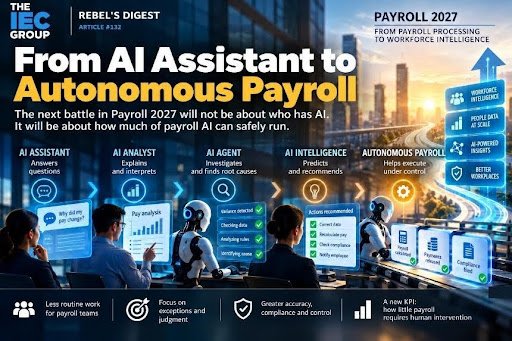
From assistance to autonomy
The evolution of payroll AI can ultimately be summarized quite simply:
The assistant tells you.
The analyst explains it.
The agent investigates it.
The intelligence predicts it.
The autonomous system helps act on it.
Each step creates more value. Each step also creates more responsibility. And that is why the winners in Payroll 2027 may not be the providers promising the highest degree of autonomy.
They may be the providers that find the right balance between automation and accountability. The future of payroll is unlikely to be humans or machines. It will be humans supervising increasingly capable machines within clearly defined rules. That is not zero-touch payroll.
It is something much more consequential:
Payroll that increasingly manages itself—and knows when it needs us.
Payroll 2027: From Payroll Processing to Workforce Intelligence
The IEC Group is evaluating how established payroll leaders and emerging challengers are moving from AI-assisted payroll toward intelligent and increasingly autonomous operations.
The research will distinguish announcements and roadmaps from deployed customer capabilities—and will examine how providers combine automation with governance, explainability and measurable outcomes.
Participation in Payroll 2027 is free of charge. Contact pm@theiecgroup.com

