
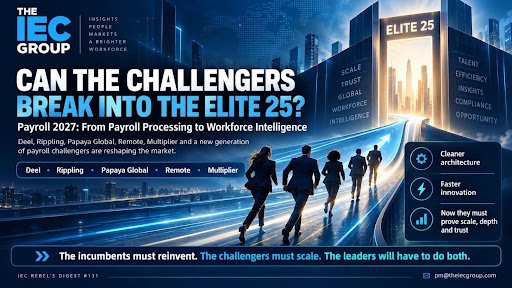
Deel, Rippling, Papaya Global, Remote, Multiplier and a new generation of payroll providers are attacking the market from a very different starting point
In Article 129, we introduced the Workforce Intelligence Gate: the point at which payroll moves beyond visibility and automation toward explanation, prediction, recommendation and governed action.
In Article 130, we asked whether the established payroll giants can reinvent themselves quickly enough to cross that gate.
Now comes the other side of the equation.
Can the challengers scale fast enough to deserve a place among the Payroll 2027 Elite 25?
At first glance, the challengers appear to have an obvious advantage.
They are generally carrying less legacy technology. Many were designed around APIs, unified data models, cloud delivery and global employment from the beginning. They can build AI into workflows without first reconciling decades of acquired platforms. Their product cycles are often faster. Their user experiences are frequently simpler.
But payroll is not a conventional software market.
A clean architecture does not automatically produce regulatory depth.
A rapidly growing customer base does not automatically produce enterprise resilience.
And an impressive AI demonstration does not necessarily prove that the platform can run mission-critical payroll across dozens of countries, legal entities and regulatory environments month after month.
The challengers therefore face almost the mirror image of the incumbents’ problem.
The giants must convert scale into intelligence.
The challengers must convert innovation into trust, depth and enterprise scale.
That may prove equally difficult.
They did not enter through the traditional payroll door
One of the most interesting features of the new competitive landscape is that many of the challengers did not begin as traditional payroll companies. Some entered through Employer of Record. Others through global employment. Others through workforce software, payments, contractor management or AI-enabled compliance.
This matters because they approached the problem from a different direction.
Traditional payroll companies generally began with the payroll calculation itself and expanded outward.
Many challengers began with the worker, the employment relationship or the underlying data platform—and are now moving inward toward payroll.
That difference can shape the architecture.
If employment contracts, compensation, organizational structure, time, expenses, worker classification and payments already exist within the same environment, payroll potentially becomes another event on a common data model rather than an isolated downstream process.
This is strategically important. Workforce Intelligence requires context. And a platform designed around the entire employment lifecycle may have a natural opportunity to build that context.
But opportunity is not the same as execution.
Deel illustrates how quickly the category boundaries are disappearing
Deel is one of the clearest examples.
The company became widely known through global employment and Employer of Record services. It is now positioning payroll as an increasingly central part of its platform.
Its current global payroll proposition combines employees, contractors, EOR workers and third-party payrolls within one environment. Deel says AI continuously checks inputs and results for anomalies, missing data and legal risks, while its broader AI environment can answer questions using workforce and compliance information. It reports more than 40,000 customers and more than $20 billion in payroll processed through its platform. Deel
More interesting than the numbers, however, is the direction of travel.
Deel is publicly arguing that the next stage of payroll AI must move from answering questions toward operating inside workflows—monitoring payroll continuously, identifying errors and helping teams act before they become payslip problems. Deel
That language is remarkably close to the Workforce Intelligence thesis.
But for IEC, similarity of language will not settle the positioning.
The question will be whether that intelligence works consistently across the payroll estate, how much of it is genuinely payroll-native, how deeply it integrates across worker types and countries, and whether enterprise customers can demonstrate measurable outcomes.
Deel no longer looks like an EOR company merely adding payroll.
But neither should the market automatically assume that rapid expansion equals Workforce Intelligence leadership.
Rippling represents a different challenger model
Rippling did not come from EOR. Its competitive argument is built around a unified employee data model spanning HR, payroll, IT and finance. That architecture potentially matters enormously.
Rippling’s payroll materials describe AI performing operational tasks such as comparing payroll costs across entities, identifying discrepancies, adding bonuses and answering employee questions about pay changes. The company explicitly argues that its AI is built across HR, payroll, IT and finance rather than operating as a standalone chatbot. Rippling
For Workforce Intelligence, this is an attractive architectural proposition.
If a platform already understands the employee, organizational structure, compensation, devices, expenses, time and payroll through a common data model, the intelligence layer starts with context that many fragmented environments must reconstruct.
But Rippling faces another test. How far can that model extend into the complexity of global payroll?
Enterprise payroll depth is not defined only by elegant software. It is defined by regulatory exceptions, collective agreements, local tax requirements, retroactive processing, audit requirements, country-specific reporting and the operational realities of multinational delivery.
The question is therefore not whether Rippling has a modern architecture. It does.
The question is whether that architecture can accumulate enough payroll depth and global maturity to challenge companies that have spent decades acquiring it.
Papaya Global has placed intelligence at the center of its argument
Papaya Global represents another approach.
Its proposition brings payroll, payments, workforce information and global employment operations into a common environment. Its 360AI capability is designed to answer questions across workforce data, payroll, payments, invoices and support cases, while the company increasingly argues that AI needs to become a foundation for workforce operations rather than a feature layered on top. Papaya Global
That is an important distinction.
A provider able to connect payroll calculation with payment execution and workforce information may be particularly well positioned to build intelligence around the financial flow of work.
For example, payroll does not merely determine what an employee should receive.
Payments determine whether the money reached the employee.
Finance needs to understand the cash requirement.
Compliance needs to know whether statutory obligations were satisfied.
An intelligence layer that sees all of those stages potentially understands more than a traditional payroll engine.
But Papaya faces the same requirement as every challenger: show that the concept works at scale.
The market will increasingly distinguish between sophisticated functionality, sophisticated positioning and sophisticated customer outcomes.
They are not interchangeable.
Remote may be making one of the most explicit strategic pivots
Remote’s evolution is particularly interesting because the company is now explicitly describing itself as payroll and global employment infrastructure.
In May 2026, Remote said its payroll business had grown more than 300 percent year over year, while the company had passed $300 million in annual recurring revenue and become cash-flow positive. At the same time, it announced a stronger strategic focus on payroll infrastructure and the ability for other applications and AI agents to connect directly with payroll, contracts, compliance data and organizational information. Remote
This is more than a product extension.
It suggests that at least some former EOR challengers increasingly see payroll not as an adjacent service but as the infrastructure around which global employment can be organized.
For enterprise buyers, this raises an intriguing possibility.
Could a newer platform become the orchestration layer that connects existing HCM systems, payroll processes, employment models and AI agents rather than replacing everything underneath?
If so, the battle may not simply be about who owns the payroll engine.
It may become a battle over who owns the intelligence and control layer above it.
That would significantly change competitive dynamics.
Multiplier raises the most important distinction: vision versus proof
Multiplier is another company articulating a future in which payroll becomes an intelligence system.
Its public thinking describes payroll moving from a compliance-oriented cost center toward a strategic intelligence hub, with AI agents eventually supporting calculations, compliance validation, early-warning detection and increasingly continuous payroll processes. Multiplier
The direction is compelling. But it also illustrates why the Payroll 2027 methodology needs to remain disciplined.
Much of the technology industry is describing the future faster than customers are deploying it.
There is nothing wrong with a roadmap.
But an analyst must distinguish between: what the market could become, what the vendor is building, what the product can currently do, and what customers are actually using.
Those are four different stages. A challenger should not receive a Workforce Intelligence position simply because its vision is more advanced than that of an incumbent. Vision creates potential. Evidence creates position.
And the challenger field extends beyond the largest names
The transformation is not limited to five companies.
Playroll, for example, is developing global payroll capabilities alongside its global employment platform and describes AI-powered payroll analytics and a Payroll Manager designed to make changes between cycles more understandable to finance and operations teams. Playroll
Borderless AI is approaching the market from an explicitly AI-oriented global employment model. Its recent development has included AI-based legal and compliance capabilities alongside increasingly detailed payroll adjustment, payment and employment workflows. Borderless
Oyster, meanwhile, has expanded from global employment into multi-country payroll across a growing set of markets. Oyster Help Center
Not every one of these companies will necessarily become a Payroll 2027 leader. That is precisely why the research is interesting. A rapidly changing category creates more contenders than eventual winners.
The challenger advantage is architectural freedom
The challengers share one structural advantage.
They generally have fewer historical constraints.
They can ask: If payroll were designed today, how would we build it?
Rather than: How do we modernize the payroll systems we already have?
That freedom can produce very different answers.
Why should payroll be a monthly batch process?
Why should workforce data move through spreadsheets?
Why should payroll, payments and compliance be separate?
Why should employees wait for payroll teams to answer basic questions?
Why should an anomaly be discovered after payroll rather than before it?
Why should intelligence require analysts to build reports manually?
Why should different employment types live in separate technology environments?
These are powerful questions.
And challengers are often culturally more willing to ask them because they have less existing revenue tied to the old answers.
But that freedom comes with a price. They have less accumulated experience.
Payroll depth is earned the hard way
This is the part of disruption theory that is sometimes forgotten. Complex enterprise software is not merely the product of architecture. It is the accumulation of thousands of edge cases. Payroll may contain more edge cases than almost any other enterprise function.
Different statutory rules.
Different pay frequencies.
Different collective bargaining agreements.
Different benefits.
Different tax treatments.
Retroactive changes.
Multiple currencies.
Cross-border workers.
Terminations.
Bonuses.
Leave.
Court orders.
Local filings.
Audit requirements.
And countless exceptions created by actual human employment. These are not glamorous capabilities. But they are exactly where trust is created.
A challenger may build a better global control plane in three years. It cannot manufacture 40 years of payroll exceptions in three years. It must acquire that knowledge through customers, local expertise, partners, acquisitions, technology—or some combination of all four.
This is why the Payroll Foundation Gate remains essential.
The enterprise buyer faces a different risk with challengers
In Article 130, we argued that buyers should look beneath incumbent AI interfaces and examine whether intelligence can genuinely operate across fragmented architectures.
The challenger question is different. For newer providers, buyers should ask:
What happens when complexity arrives?
The demonstration may work beautifully for ten countries. What happens at 40?
The platform may support standard employment scenarios. What happens when the organization adds collective agreements, complex benefits and unusual local policies?
The implementation may be fast. What happens when the company needs substantial customization or integration with a heavily governed ERP environment?
Support may be highly responsive during growth. What happens when thousands of enterprise cases arrive simultaneously?
And most importantly: Who owns the problem when payroll fails?
These are not arguments against challengers. They are enterprise questions that challengers need to answer convincingly.
Speed can become a competitive moat of its own
The challengers nevertheless possess another advantage that should not be underestimated.
They can move extraordinarily quickly. Modern engineering environments, common data models and fewer product generations can dramatically shorten the distance between idea and deployment.
That matters even more in the AI era. AI capabilities themselves are evolving on timescales measured in months rather than traditional enterprise software cycles.
A provider whose architecture allows it to incorporate new models, new agents and new automation rapidly may compound its advantage.
This creates an unusual race. Incumbents begin with more customers, more payroll expertise and more trust. Challengers may begin with greater architectural flexibility and development velocity. The winner is not necessarily whichever group starts ahead. It may be whichever compounds its respective advantage faster.
Challengers do not need to beat incumbents at their own game
This may be the most important strategic point. A challenger does not necessarily need to become a smaller version of ADP, SAP or another traditional leader. If it tries to replicate every part of the old model, it may eventually inherit the same complexity. The greater opportunity is to change what customers value.
If the buying criteria remain primarily country coverage, processing volumes and service footprint, incumbents retain enormous advantages.
If enterprises begin valuing unified workforce data, predictive insight, payment visibility, real-time compliance and governed automation more heavily, the competitive equation changes.
That is how markets are disrupted. Not because the challenger becomes better at every dimension. But because the dimensions themselves change. Payroll 2027 is designed to examine whether that is now happening.
For buyers, “new” should not be confused with “better”
There is an equal danger on the customer side. Enterprise technology periodically becomes fascinated with the new. Modern user experience looks better. Implementation promises are faster. AI demonstrations are impressive. Legacy frustration makes clean-slate alternatives emotionally attractive.
But payroll is a function where fashionable technology can become very unfashionable at payday if something fails.
The objective should therefore not be to replace incumbents with challengers. It should be to identify which provider—regardless of age—offers the right combination of trust and transformation.
That combination will differ by enterprise. A highly complex organization operating in 70 countries may rationally value proven delivery depth more heavily. A fast-growing international company entering ten new markets may value flexibility and speed.
A company trying to consolidate fragmented payroll may prioritize orchestration.
Another seeking better financial planning may place greater weight on workforce-cost intelligence.
The future payroll market may therefore become more segmented even as the platforms become more integrated.
What would make a challenger an Elite 25 provider?
Not publicity.
Not funding.
Not growth alone.
And not simply a modern architecture.
The challengers that ultimately earn strong positions on the IEC Dynamic Map will need to demonstrate three things simultaneously.
They must show that their technology model is genuinely different—not merely newer.
They must demonstrate that the model survives real payroll complexity.
And they must show that customers are receiving measurable benefits from that difference.
If all three are present, the challenger label may eventually become irrelevant.
The company will simply be a leader.
The next generation may already be becoming the establishment
There is a final irony in this discussion. Several companies still described as challengers are growing quickly enough that the label may soon become outdated.
Deel now reports tens of thousands of customers and very substantial payroll volumes. Remote reports hundreds of millions of dollars in recurring revenue. Rippling has expanded well beyond its original HR proposition. Papaya has spent years building enterprise payroll and payments capabilities.
The question therefore is not simply whether challengers can disrupt incumbents. It is whether they can preserve the attributes that made them challengers—speed, architectural coherence, willingness to rethink the category—as they themselves become large organizations.
That may be harder than breaking into the market in the first place.
Can the challengers break into the Elite 25?
Some almost certainly will. But inclusion in the IEC Payroll 2027 Elite 25 is only the beginning.
The more difficult question is where they will appear on the Dynamic Map.
A company can have high momentum but insufficient payroll depth.
It can have sophisticated technology but limited enterprise adoption.
It can have strong payroll capability without yet demonstrating Workforce Intelligence.
The same rules apply to everyone.
Scale determines bubble size.
Market adoption determines horizontal position.
Validated Workforce Intelligence determines vertical position.
Being new creates no shortcut. Being old creates no protection.
The challengers have already changed the payroll market by forcing the industry to rethink what global employment technology can look like.
Now they need to prove that they can do something harder: turn disruption into durable leadership.
That is what Payroll 2027 will test.
Payroll 2027: From Payroll Processing to Workforce Intelligence
The IEC Group is evaluating established providers and emerging challengers against the same evidence-based framework.
Companies among the current front-runners—and providers outside the 30 that believe IEC is missing material developments—can still participate and challenge the current research view.
Participation is free of charge.
The incumbents must prove they can reinvent. The challengers must prove they can scale. The leaders will have to do both

