
Why scale, data and trust may be the incumbents’ greatest advantage—and their greatest obstacle—in the race to Workforce Intelligence
In the previous Rebel’s Digest, we introduced the Workforce Intelligence Gate.
The argument was straightforward: having AI is no longer enough. Payroll providers will increasingly be judged by whether they can move from processing and reporting toward understanding, prediction, recommendation and governed action.
That raises an uncomfortable question for some of the largest companies in the market.
Can the payroll giants actually make that transition?
At first sight, they should be in the strongest possible position.
The established payroll and HCM providers possess enormous installed bases, decades of payroll expertise, extensive compliance knowledge, deep enterprise relationships and extraordinarily rich workforce datasets.
These are precisely the ingredients artificial intelligence needs.
But they also carry something newer competitors largely do not: decades of technology decisions, acquisitions, country-specific payroll engines, customized implementations, partner networks and multiple generations of architecture.
The result is one of the most interesting contradictions in Payroll 2027.
The companies with potentially the greatest intelligence advantage may also face the most difficult transformation.
Scale used to be the destination. Now it is only the starting point.
The economics of traditional payroll rewarded scale.
A larger provider could distribute regulatory expertise, technology investment and service infrastructure across more customers. Geographic reach mattered. Processing volumes mattered. Compliance teams mattered. Enterprise references mattered.
They still do.
But scale increasingly creates a different kind of opportunity.
Consider what sits inside a mature payroll provider.
Years—or in some cases decades—of information about compensation, working patterns, overtime, taxation, absence, workforce movement, statutory changes and payroll exceptions.
Combined appropriately, this represents an extraordinary knowledge base about how work actually operates.
That could become a formidable AI advantage.
The provider that understands millions of payroll events should, theoretically, be better equipped to recognize what is normal, what is unusual and what requires attention.
It should be able to identify patterns that a smaller platform cannot yet see.
But there is a catch.
Having data is not the same as having usable intelligence.
If data remains divided between platforms, countries, applications and acquired technologies, scale creates volume without necessarily creating context.
And without context, AI has limits.
The real legacy problem is complexity
The word “legacy” is often used too casually in technology.
Old software is not automatically bad software. In payroll, mature systems frequently contain decades of regulatory knowledge and operational refinement.
The bigger problem is complexity.
A global provider may have one payroll architecture in one market and another elsewhere.
It may operate technology developed internally alongside products obtained through acquisition.
Some countries may run natively. Others may depend on partners.
Different customers may be on different product generations.
Data structures may vary.
Integration models may vary.
Workflows may vary.
An enterprise user may see a single branded global interface while significant complexity remains underneath it.
For traditional payroll processing, that complexity can be managed.
For Workforce Intelligence, it becomes much more consequential.
An intelligence layer must understand that a workforce event recorded one way in Germany and another way in the United States represents the same underlying business concept.
It must distinguish between a payroll anomaly and a legitimate local regulatory difference.
It must understand relationships between time, pay, organizational structure, finance and compliance.
That requires more than putting generative AI on top of existing systems.
It requires an architecture capable of creating common meaning.
The race is therefore not primarily about who launches AI first
This is where the current market discussion can become misleading.
The established providers are not standing still.
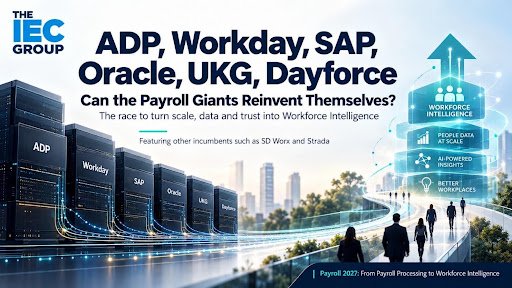
ADP, for example, introduced an ADP Assist payroll agent in 2026 that identifies payroll variances, suggests remediation and supports resolution before errors reach employees. ADP said the capability was available to enterprise clients across more than 40 countries.
Workday’s Payroll Agent is designed to identify missing data and configuration issues, surface trends, support payroll workflows and maintain human oversight. Workday is simultaneously extending its wider AI strategy through Sana across HR and finance.
SAP is embedding agentic AI across SuccessFactors. Its Payroll Assistant is designed to connect time, HR and payroll data, coordinate readiness checks, detect and explain problems and support resolution before payroll is completed.
Oracle has introduced payroll-focused AI agents including Pay Analyst and Payroll Run Analyst capabilities that provide payroll explanations, support validation and help administrators investigate payroll results.
UKG has introduced UKG Pro Pay with Workforce AI and more recently Agentic Pay capabilities aimed at identifying issues earlier, investigating payroll through natural language and keeping human validation within the process.
SD Worx likewise says it is deploying AI across payroll operations, compliance, implementation and agentic processes while maintaining human oversight for exceptions and more complex decisions.
These are important developments.
But they do not settle the question of leadership.
They show that the incumbents recognize where the market is heading.
The more difficult question is whether they can transform these capabilities from intelligent features into an intelligence architecture.
Adding intelligence is easier than becoming intelligent
This distinction will be central to Payroll 2027.
An established provider can add an excellent anomaly-detection engine without fundamentally changing its overall architecture.
It can introduce a payroll copilot while underlying data remains distributed across multiple systems.
It can give employees better explanations of payslips without giving finance predictive insight into workforce costs.
It can automate exception handling without connecting those exceptions to workforce planning.
All of these developments improve payroll.
But they do not necessarily turn payroll into Workforce Intelligence.
The real transformation occurs when intelligence is no longer attached to individual functions and instead begins operating across them.
Payroll sees a rise in overtime.
Time data explains where it came from.
Workforce data identifies the staffing conditions behind it.
Finance understands the cost implications.
Compliance identifies potential working-time exposure.
The system estimates the likely future effect.
Management receives a recommendation.
That is a different architecture—and eventually a different business proposition.
The incumbents possess an advantage challengers would love to have
It would therefore be a mistake to assume that newer technology companies automatically have the advantage.
Modern architecture matters.
But so do domain depth and operational experience.
Payroll is unusually dependent on exceptions.
A platform can be elegant until confronted with thousands of tax rules, collective agreements, retroactive corrections, complex shift arrangements, cross-border employment scenarios and country-specific regulatory requirements.
The established providers have spent decades learning those exceptions.
They also possess something strategically valuable: trust.
Large enterprises do not replace global payroll casually.
The consequences of failure are too significant.
That gives incumbents time and an installed customer base through which new capabilities can be introduced.
It also gives them an extraordinary laboratory.
If intelligence can be deployed across a large installed base, every interaction potentially increases the provider’s understanding of payroll operations.
That could create a powerful feedback loop: more payroll volume creates more operational context; more context improves intelligence; better intelligence increases automation and customer value; increased value strengthens adoption.
But only if the underlying data can participate in that loop.
A fragmented installed base is not automatically a learning network.
Reinvention therefore begins below the user interface
For enterprise buyers, this is perhaps the most important implication.
The visible AI experience may be the least interesting part of the technology evaluation.
The harder questions sit underneath it.
Is there a common data model?
Can intelligence operate consistently across countries?
Does it work across the provider’s entire customer base or only on the newest platform?
How much normalization happens automatically?
How deeply can payroll connect with time, workforce management and finance?
Can the system reason across those domains—or merely retrieve data from them?
What happens when an acquisition introduces another technology stack?
How much of the global experience is genuinely native and how much depends on orchestration?
These questions sound architectural. They are. But they increasingly determine business value.
A beautifully designed AI assistant cannot produce reliable enterprise intelligence if its understanding of the underlying organization is incomplete.
There is another reinvention challenge: the operating model
Technology may not be the hardest part.
Many established payroll businesses were built around substantial service organizations.
People resolve exceptions.
People reconcile data.
People answer employee questions.
People interpret regulations.
People compensate for technology fragmentation.
That service layer has historically been an important competitive advantage.
AI potentially changes its economics.
If intelligent systems can investigate exceptions, reconcile inputs, explain payments and resolve routine cases, the role of the service organization changes.
The strongest established providers may therefore need to reinvent not only their technology but also their delivery model.
Human expertise does not disappear.
It moves upward.
The machine handles increasingly repeatable analysis and administration; human experts focus on ambiguous cases, judgment, regulation, customer strategy and oversight.
That transition could improve margins and customer experience simultaneously.
But it also challenges organizational structures built over decades.
Transformation therefore requires more than a new product roadmap.
It requires a different operating model.
The most difficult decision may be what not to protect
This is a classic incumbent problem.
Successful companies naturally protect the assets that made them successful.
In payroll, those assets may include proprietary country engines, services revenue, established implementation approaches and highly customized customer environments.
But Workforce Intelligence may reward different economics.
Standardized data becomes more valuable.
APIs become more important.
Real-time information becomes more important.
Automation reduces dependence on manual service.
Cross-functional intelligence becomes more important than isolated functionality.
Platforms become more important than products.
An established provider may therefore face a difficult choice:
How much of the old model must be disrupted in order to create the new one?
Incremental modernization can preserve existing economics.
True reinvention may require changing them.
This is why the next two years matter
The payroll giants do not need to start from zero.
In fact, current developments suggest many are already moving rapidly.
But the market is also moving rapidly around them.
Newer companies are trying to combine payroll, global employment, payments, workforce management and finance from a more unified technology foundation.
HCM platforms increasingly view payroll as part of a broader intelligence environment.
Payments businesses are moving closer to the payroll transaction.
AI changes how quickly software capabilities can be developed.
The window for transformation is therefore narrower than it once was.
Historically, payroll markets moved slowly because compliance created enormous barriers to entry.
Those barriers still exist.
But the surrounding technology layer is accelerating.
The providers that modernize successfully can combine the advantages of incumbency with the economics of a new platform.
Those that modernize only at the surface risk becoming extraordinarily efficient processors in a market increasingly interested in intelligence.
What enterprise buyers should watch
For customers, this is not an academic debate about vendor architecture.
It affects technology choices that may remain in place for a decade.
The safest provider today may not necessarily provide the greatest strategic value tomorrow.
But equally, the most innovative provider may not yet possess the operational depth required for a complex global enterprise.
The decision should therefore not be framed as incumbent versus challenger.
It should be framed around evidence of transformation.
When an established provider demonstrates AI, enterprises should look beyond the demonstration and ask whether the capability works across their actual payroll landscape.
When a provider promises prediction, buyers should ask what data supports that prediction.
When it promises autonomous action, they should ask how the action is governed and audited.
And when a vendor speaks about Workforce Intelligence, enterprises should ask who outside the payroll department is actually using that intelligence today.
The answer may reveal considerably more than another feature checklist.
Reinvention will create different kinds of giants
The interesting possibility is that some established providers may emerge from this transition stronger than before.
They possess ingredients that are extraordinarily difficult to replicate: payroll expertise, customer trust, compliance knowledge, enormous transaction volumes and relationships with some of the world’s largest employers.
If those ingredients can be combined with unified data, modern architecture and genuinely intelligent workflows, the result could be formidable.
But incumbency alone will not produce it.
The payroll giants must convert scale into context, context into intelligence and intelligence into action.
That is the reinvention.
And it explains why IEC will not automatically place the largest bubbles at the top of the Payroll 2027 Dynamic Map.
Scale still matters, but it simply answers a different question.
Can the payroll giants reinvent themselves?
The answer is almost certainly not a simple yes or no.
Some will move faster than others.
Some may achieve intelligence across newer products while continuing to carry older platforms.
Some will acquire capabilities.
Others will build them.
Some may transform payroll from within a broader HCM environment.
Others may build an intelligence layer that orchestrates multiple payroll engines beneath it.
The architecture may differ.
The test should not.
Can the provider turn trusted payroll data into a better understanding of the workforce?
Can it do so consistently?
Can customers demonstrate the outcome?
And can the company move quickly enough that today’s enormous installed base becomes an asset rather than an anchor?
That is what Payroll 2027 will examine.
The established payroll leaders have spent decades building scale.
The next phase will determine whether they can convert that scale into intelligence.
The giants do not need to become start-ups. But they may need to become challengers to their own business models.
Payroll 2027: From Payroll Processing to Workforce Intelligence
The IEC Group is evaluating established providers and emerging challengers against the same fundamental principle: leadership must be demonstrated, not inherited.
Participation in the research is free of charge.
pm@theiecgroup.com

