
The next generation of payroll will not be defined by AI features, but by the decisions they enable
For decades, enterprises have judged payroll systems against an unforgiving but relatively straightforward standard: people must be paid accurately, compliantly and on time.
That requirement has not changed.
What is changing is what organizations expect payroll technology to do after that basic obligation has been fulfilled.
The most interesting development in payroll today is therefore not the arrival of another AI assistant, another global dashboard or another automated workflow. It is the possibility that payroll is beginning to evolve from a system that records workforce economics into one that can actually help organizations understand and manage them.
That is the idea behind what The IEC Group calls the Workforce Intelligence Gate.
It represents the point at which payroll stops becoming simply more efficient and starts becoming something strategically different.
For providers, crossing that gate may determine who leads the Payroll 2027 market.
For enterprise customers, the implications are potentially more important: it may change what they should expect from the next payroll platform they buy.
Payroll contains something most enterprises still underuse
Payroll is usually treated as the final stage of an employment process.
Someone is hired. Hours are recorded. Compensation is determined. Benefits are applied. Taxes and deductions are calculated. Money is paid.
But looked at differently, payroll is one of the richest operational datasets in the enterprise.
It contains evidence of what the workforce actually costs rather than what it was budgeted to cost. It reflects overtime, absence, hiring, compensation changes, bonuses, geographic differences, employment models, statutory obligations and many of the consequences of managerial decisions.
The problem is that much of this information has historically arrived too late.
Traditional payroll tells management what already happened.
The opportunity created by better integration, modern data architectures and artificial intelligence is to shorten the distance between an event occurring and the enterprise understanding its significance.
Consider a simple example.
A monthly report shows that labor costs in one business unit increased by 9 percent.
Traditional payroll has done its job: the amount is accurate.
A better analytics platform identifies that overtime was responsible for most of the increase.
An intelligent platform goes further. It identifies where overtime occurred, connects it to absence and staffing patterns, estimates what will happen if the trend continues and highlights potential working-time or budget implications.
The most advanced environment may then propose possible interventions.
That is a fundamentally different product.
The payroll transaction has not disappeared.
But intelligence has been built around it.
The real shift is from processing to anticipation
This distinction matters because much of the current debate around payroll technology is focused on automation.
Automation is valuable. It removes manual work, accelerates processing and can reduce errors.
But automation alone does not transform the role of payroll.
The bigger opportunity is anticipation.
Can the system identify a payroll problem before payroll closes?
Can it recognize that a workforce-cost pattern is moving outside expected parameters?
Can it estimate future liabilities?
Can it identify which employees or locations could be affected by a regulatory change?
Can it tell finance what payroll funding may be required before the cash needs to move?
Can it show HR how hiring, absence or compensation decisions are changing the economics of the workforce?
When systems can begin answering these questions, payroll becomes relevant to a much broader group of executives.
The payroll department remains important, but the audience expands to include finance, HR, operations, compliance and potentially the executive team.
This is the strategic significance of Workforce Intelligence.
AI makes this possible—but does not guarantee it
The payroll market is rapidly becoming saturated with AI terminology.
Almost every major provider is introducing assistants, copilots, agents, anomaly detection, predictive analytics or intelligent automation.
That is to be expected. AI will become a normal component of enterprise software.
But this creates an important challenge for buyers.
A system that uses AI is not necessarily an intelligent system.
The difference lies in the depth of context available to it.
A chatbot connected to payslip information may explain a deduction very effectively. That improves the employee experience.
An AI tool that summarizes a report may save an administrator time.
An anomaly engine may identify an unexpected payment.
All are valuable.
But none necessarily represents Workforce Intelligence.
The critical question is whether intelligence can connect individual payroll events with the wider context of the workforce and the business.
Why did this employee’s pay change?
Why did the cost of this organization increase?
Is this an isolated event or part of a broader trend?
What happens if the trend continues?
Does it create financial, operational or regulatory risk?
What should management consider doing next?
Those questions require more than a language model.
They require integrated data.
They require context.
And they require trust.
The hidden challenge is architecture
This may ultimately prove more important than the AI itself.
Many global payroll environments remain fragmented.
An enterprise may use different payroll engines across countries, several HCM systems, separate time-and-attendance platforms and different financial environments. A global provider may itself rely on a combination of proprietary technology, acquired platforms and local partners.
A consolidated screen can make this environment look unified without actually making the underlying data unified.
That matters because intelligence depends on consistency.
If the same workforce event is represented differently in Germany, the United States and Singapore, an AI system has to understand those differences before it can produce trustworthy global conclusions.
The future competitive advantage in payroll may therefore come not from having the most visible AI assistant, but from having the strongest underlying workforce data model.
This is where enterprise buyers should look beneath the interface.
The most important technology question may increasingly become:
What does the intelligence layer actually understand about my workforce?
What this means for the enterprise buyer
For end-user organizations, the emergence of Workforce Intelligence should change the payroll selection conversation.
Traditional procurement processes tend to emphasize country coverage, implementation capability, payroll accuracy, compliance, service levels and price.
Those factors remain essential.
But they increasingly represent the foundation rather than the full value proposition.
The next procurement cycle should also investigate whether a provider can help the enterprise understand the financial and operational consequences of workforce activity.
A CFO should be interested because payroll is one of the largest recurring cash flows in most organizations.
A CHRO should be interested because compensation, hiring, turnover, absence and productivity all have payroll consequences.
A payroll leader should be interested because intelligent exception management could fundamentally change how much manual investigation is required.
A compliance leader should be interested because continuous monitoring may identify issues earlier.
And the CIO should care because the value of the intelligence will depend heavily on architecture, APIs, data quality, governance and integration.
In other words, Workforce Intelligence is not simply the next payroll feature category.
It could become a cross-functional enterprise capability.
The Workforce Intelligence Gate
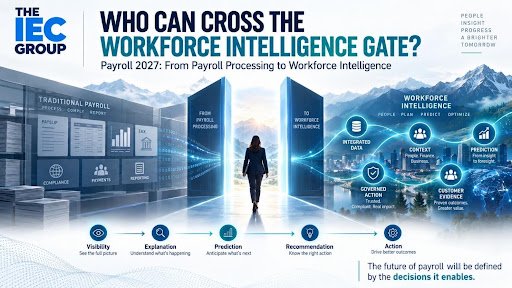
The IEC Payroll 2027 study will therefore apply a deliberately high threshold before describing a provider as a Workforce Intelligence player.
The principle is straightforward.
A provider should not cross the gate because it is large.
It should not cross because it is growing quickly.
It should not cross because it has been included in another analyst shortlist.
And it should certainly not cross because the letters “AI” appear prominently in its product presentation.
It needs to demonstrate that intelligence operates within the real payroll environment.
The evidence should show a progression.
The system sees something unusual.
It understands what caused it.
It assesses what could happen next.
It places the issue in its wider workforce and financial context.
It recommends an appropriate response.
And, where governance allows, it helps execute that response while preserving human accountability.
That progression can be summarized as:
Visibility → Explanation → Prediction → Recommendation → Action
The further a provider can move through this chain in real customer environments, the closer it comes to crossing the Workforce Intelligence Gate.
Why customer evidence becomes decisive
This raises another issue that will become increasingly important in technology research.
Product roadmaps are moving faster than customer adoption.
A capability announced today may technically exist within months. But that does not mean it has been deployed broadly, integrated into complex enterprise environments or demonstrated measurable business value.
This is particularly important in payroll.
The consequences of getting an answer wrong are different from those of an AI system generating an imperfect marketing summary.
Payroll involves people’s income, taxation, statutory obligations and corporate cash.
Trust matters.
IEC will therefore place significant emphasis on what customers can demonstrate—not merely what vendors can demonstrate.
If an AI capability identifies payroll anomalies, how many are prevented before payment?
If a system predicts workforce costs, is finance actually using the forecast?
If a platform highlights compliance risks, are customers acting earlier?
If automation reduces manual work, by how much?
If intelligence recommends an action, is the explanation sufficiently clear for a payroll professional to trust it?
This is where the next phase of payroll competition may be won or lost.
The technology has to work.
The customer has to trust it.
And the outcome has to matter.
The incumbents have an unusual advantage—and an unusual problem
This creates an interesting competitive dynamic.
The largest payroll providers possess something newer challengers cannot quickly replicate: enormous volumes of payroll data, decades of domain expertise, large installed bases and deep enterprise relationships.
In theory, these are tremendous assets for artificial intelligence.
The more workforce events a system understands, the more potential context it can develop.
But scale can also create complexity.
Long histories frequently mean multiple platforms, acquired technology, different generations of architecture and inconsistent data structures.
The incumbents therefore face a paradox.
They may possess the richest potential intelligence asset in the market while simultaneously having the most difficult technical environment in which to exploit it.
Their challenge is not simply to introduce AI.
It is to make decades of payroll infrastructure behave like a modern intelligence platform.
Challengers face the opposite problem
Newer providers often begin with cleaner architectures.
They may have API-first platforms, more unified data models and fewer legacy environments.
That can make innovation faster.
But modern architecture does not automatically create enterprise readiness.
The challengers still need to prove payroll depth, regulatory capability, resilience, governance and the ability to operate at multinational scale.
They also need enough real customer data and operational experience for their intelligence to become meaningful.
This produces one of the most interesting questions in Payroll 2027:
Will Workforce Intelligence be won by incumbents that modernize their enormous installed bases—or by challengers that scale modern architectures faster?
The answer is unlikely to be uniform.
And it may produce a market with a very different definition of leadership from the one payroll has known for the last twenty years.
The Dynamic Map is intended to make this distinction visible
This is why IEC has deliberately separated the three primary signals in the Payroll 2027 Dynamic Map.
Enterprise scale determines the size of the bubble.
Market impact and customer adoption determine horizontal position.
Validated Workforce Intelligence maturity determines vertical position.
The distinction is essential.
A very large company can therefore appear as a large bubble without automatically becoming a Workforce Intelligence Leader.
A smaller technology company may move much higher on intelligence while remaining smaller in scale.
And a provider will only reach the upper-right position when advanced intelligence is combined with meaningful customer adoption.
This avoids one of the traditional problems of analyst maps: treating size, technology, momentum and leadership as though they were the same thing.
They are not.
The question for buyers is changing
Perhaps the most important implication of the Workforce Intelligence Gate is therefore not for providers at all.
It is for customers.
For years, enterprises asked payroll vendors:
Can you pay our employees accurately in all the countries where we operate?
They then asked:
Can you consolidate and automate the process globally?
The next question may be:
What will your platform help us understand that we cannot understand today?
That is a very different buying question.
And it forces vendors to move beyond feature comparison toward business value.
Can the system help reduce payroll risk?
Can it improve labor-cost control?
Can it make workforce planning more accurate?
Can it help finance understand payroll liabilities earlier?
Can it identify the consequences of workforce decisions before those decisions become expensive?
If the answer is yes, payroll begins to move from administration toward management intelligence.
Crossing the gate
More than 100 companies entered the Payroll 2027 research universe.
Thirty currently lead the race for 25 positions on the final Dynamic Map.
But the most important competitive threshold may not ultimately be the difference between company number 25 and company number 26.
It may be the distinction between two fundamentally different kinds of payroll provider.
One makes payroll processing progressively more efficient.
The other uses payroll to make the enterprise progressively more intelligent.
Both have value.
But they are not the same proposition.
That is the purpose of the Workforce Intelligence Gate.
And it is the question IEC will now put to the market:
Who can actually cross it?
Payroll 2027: From Payroll Processing to Workforce Intelligence
The IEC Group is currently conducting the next phase of the Payroll 2027 research.
Participation is free of charge, and providers receive a pre-filled Dynamic Map Provider Input Form rather than a traditional RFI.
Providers that believe their current public profile does not adequately reflect recent developments in their technology, market position or Workforce Intelligence capabilities are invited to challenge IEC’s current view.
Contact: pm@theiecgroup.com
The future of payroll will not be determined by who has AI. It will be determined by who can turn payroll data into better decisions.

