
AI Won’t Save You From Labor Law
Introduction: The New Rules for Automated Workforce Decisions
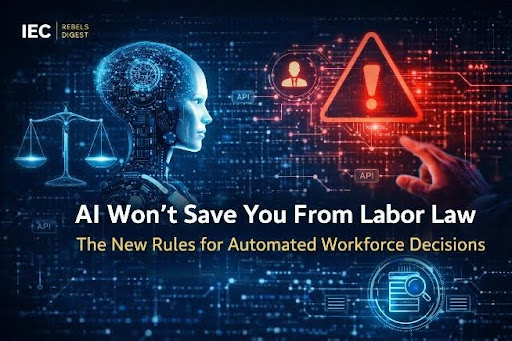 AI is sprinting into HR like it owns the place.
Vendors promise instant onboarding, automated risk scoring, smart compliance checks, and “self-healing” workflows. HR teams—under pressure to move faster with fewer people—want to believe. And honestly, in global workforce operations, automation can feel like oxygen.
But here’s the reality check:
AI won’t save you from labor law.
It can accelerate decisions, yes. It can also amplify liability if those decisions become opaque, inconsistent, or poorly governed.
The organizations that win in 2026 won’t be the ones that “use AI.” They’ll be the ones that use AI with accountability—and back it up with independent audit and certification that proves their workforce infrastructure is trustworthy.
This is the new frontier: not “AI in HR,” but AI in regulated employment execution.
The Big Shift: HR Decisions Are Becoming Automated “Regulated Actions”
Many HR actions aren’t just administrative steps. They are legally meaningful events:
- selecting or rejecting a candidate
- classifying a worker as contractor vs employee
- issuing a contract and defining working time, notice, probation, IP, post-termination terms
- calculating pay, overtime, statutory entitlements
- triggering performance steps that lead to termination
- offboarding someone in a country with strict procedural requirements
Now put AI into that chain.
You’ve just automated a set of actions that—depending on jurisdiction—can trigger:
- employment tribunals
- tax audits
- misclassification enforcement
- discrimination claims
- data privacy investigations
- contractual invalidation
This is why “AI automation” isn’t a feature; it’s a risk multiplier unless controlled.
Where AI Actually Helps (When Done Right)
Let’s be clear: AI has genuine value in global workforce operations. It can strengthen compliance outcomes when used as assisted intelligence, not “auto-pilot.”
1) Onboarding acceleration (with checks)
AI can:
- validate document completeness
- flag missing jurisdiction-specific clauses
- route tasks to the right specialists
- translate and normalize key fields across countries
Done right, it reduces human error.
Done wrong, it accelerates wrong onboarding at scale.
2) Risk scoring and early warning signals
AI can identify patterns that humans miss:
- anomalies in payroll inputs
- inconsistent contract templates by country
- unusual termination patterns
- repeated ticket themes (compliance gaps disguised as support issues)
- high-risk contractor populations
This is powerful—if the risk model is explainable and governed.
3) Case triage and support resolution
AI can categorize tickets, propose responses, summarize previous case history, and reduce response times dramatically.
But if AI starts “deciding” outcomes—especially in disputes—it can create a trail of unaccountable decisions.
The rule: AI may recommend. Humans must decide.
The Liability Trap: “Black Box Compliance”
The most dangerous thing in global workforce management isn’t slow compliance.
It’s invisible compliance.
If an AI model:
- decides worker classification
- recommends a termination path
- flags “low risk” without clear basis
- auto-generates contract terms with unknown logic
- resolves employee support cases inconsistently
…then you’ve built a black box employment engine.
That’s a problem because regulated environments demand:
- transparency
- consistency
- traceability
- evidence
If a regulator, auditor, client, or court asks “why did you do this?” the answer can’t be “the model said so.”
The new buyer question:
“Show me how your AI makes decisions—and where humans remain accountable.”
The New Rules for Automated Workforce Decisions
Here’s what workforce leaders and providers need to operationalize now—especially in EOR and global employment models.
Rule 1: Keep a human in the loop for regulated decisions
AI can assist with:
- drafting
- checking
- routing
- summarizing
- recommending
But decisions that create legal exposure require human accountability, especially:
- classification outcomes
- contract finalization
- adverse actions (disciplinary steps, termination)
- exceptions to policy
- pay-impacting corrections
Human sign-off is not friction. It’s legal safety.
Rule 2: Make your AI explainable—or treat it as non-compliant
If the system can’t explain the outcome, you can’t defend it.
Minimum standard: every AI-supported decision should have:
- the data used
- the rules applied (or model reasoning summary)
- confidence level (and uncertainty)
- reviewer name + timestamp
- final decision record
If you can’t produce this, you’re not running “AI compliance.”
You’re running “AI risk.”
Rule 3: Build audit trails like a financial system
Workforce platforms are entering a world where auditability is a product requirement.
Every key action should be traceable:
- who initiated it
- what was recommended by AI
- who approved it
- what documents were used
- what rule set applied
- what changed (version history)
This isn’t paranoia. It’s the maturity curve of the category.
Rule 4: Avoid “automation theater”
Some providers sprinkle AI labels on workflows that aren’t governed or validated.
In 2026, buyers and regulators will increasingly ask:
- is AI used in production or just pilots?
- how is model drift monitored?
- how often are rule sets updated?
- what is the false positive/negative impact?
- what escalation paths exist when AI is wrong?
“AI-powered” without governance is just branding.
Rule 5: Separate speed from correctness
Speed is seductive. But “faster” is not the goal in regulated employment execution.
The goal is fast and right—and provably so.
The best systems build a “speed lane” for low-risk actions and a “review lane” for high-risk actions.
That’s how you scale responsibly.
The Trust Problem: Why Audit and Certification Matter More Than Ever
Here’s what the market is waking up to:
You can’t build trust in global workforce management through claims.
You build it through evidence.
And evidence is strongest when it’s independently verified.
Why independent audit & certification is becoming critical
Global workforce management now intersects with:
- employment law
- licensing and labor leasing frameworks
- tax compliance
- data privacy and security
- operational controls
- third-party risk management
That complexity demands more than internal assurances. It demands:
- structured controls
- documented processes
- measurable service performance
- repeatable evidence trails
- continuous improvement cycles
This is exactly where independent audit and certification becomes a strategic advantage—not a checkbox.
Enter: IEC Audit & Certification (Trust as Infrastructure)
An independent audit and certification program—such as IEC Audit & Certification—creates a credible trust layer for providers and buyers:
- For providers:
- validates maturity and operational discipline
- strengthens enterprise credibility in procurement cycles
- differentiates from “automation-only” competitors
- improves internal execution through structured control testing
- For buyers:
- reduces vendor risk
- provides assurance beyond marketing decks
- supports procurement, legal, and compliance sign-off
- creates a foundation for continuous performance monitoring
In a market crowded with similar promises, certified operational quality becomes a differentiator that buyers can defend internally.
AI + Compliance + Certification = The New Winning Formula
In the next phase of EOR and global workforce management, the real leaders will combine three capabilities:
- Operational AI that improves speed and accuracy
- Compliance governance that prevents black-box decisions
- Independent audit & certification that proves trust and drives continuous improvement
That trio is how platforms shift from “tool” to infrastructure.
And infrastructure is what enterprises buy when the risk is real.
Where This Is Going: From HR Tech to Regulated Workforce Infrastructure
In 2026, we’re seeing the category evolve fast:
- EOR platforms expanding into broader workforce infrastructure
- buyers demanding deeper compliance proof, licensing clarity, and audit trails
- AI moving from marketing to operations
- and a growing need for external validation to establish trust
The companies that treat AI as a compliance accelerator—with accountability—will win.
The companies that treat AI as a compliance substitute will break—eventually, publicly, and expensively.
The Rebel Take
AI won’t save you from labor law.
It will, however, expose your maturity level.
If your automation is governed, explainable, auditable, and independently certified—AI can become your advantage. If it’s opaque, untracked, and driven by growth pressure, AI becomes your fastest route to risk at scale.
The future of global workforce management isn’t “AI-first.”
It’s trust-first—with AI as the engine and audit as the proof.
Want to build trust through independent validation?
If you want to learn more about IEC Audit & Certification—and how independent audits can strengthen compliance maturity, procurement confidence, and continuous improvement—reach out to: pm@theiecgroup.com
Free participation: EOR Study 2026
Provider participation is free of charge for qualified companies. If you want to ensure your offering is correctly positioned and represented in the market, contact:
pm@theiecgroup.com See you in the study. —The IEC Rebels Digest Team
Why This Matters for the IEC Global EOR Study 2026
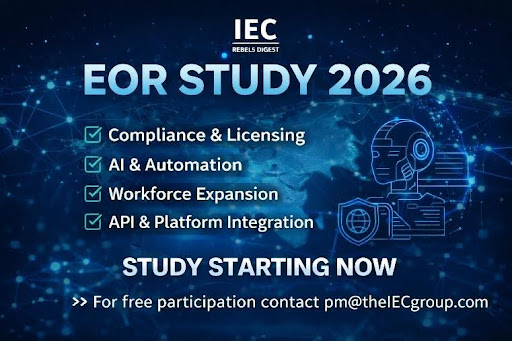 This is not just a market commentary. It’s the exact reason the IEC Global EOR Study 2026 is structured the way it is.
The study will assess providers across eight evaluation categories that reflect the compliance stack reality:
- Global Reach & Legal Infrastructure
- Compliance & Licensing Depth
- Tech Stack & Platform Maturity
- AI & Process Automation
- Client Experience (CX)
- Employee Experience (EX)
- Integration & API Coverage
- Innovation & Market Differentiation
And yes—there will be visibility into who ranks strongest across these categories, alongside insights into rising disruptors and the strategic direction of the market.
Because in 2026, “EOR provider” is not a uniform label. The gap between providers is widening—and the winners will be those who can prove compliance as infrastructure, not claim it as a feature.
A Final Reality Check
Global workforce management is no longer just about hiring talent abroad. It’s about building a defensible employment operating model across legal regimes—and doing it with speed, transparency, and integration.
That is a regulated product challenge.
And that’s why the EOR market is heading toward a compliance-led shakeout.
The platforms that win won’t simply help companies hire globally. They will help companies stand up to scrutiny globally.
About the IEC Rebel’s Digest
We write for the ones breaking molds, building cross-border teams, and reshaping global work. No buzzwords. Just truths, tools, and tactics for the new era of employment.
IEC Rebel’s Digest— The IEC Group can help you audit your global employment setup by identifying labor leasing risks, verifying licensing requirements, and ensuring your EOR partners meet every compliance standard—before regulators come knocking.
Last but not Least: If you’re facing challenges and wondering how others are managing similar issues, why not join The Leadership Collective Community? It’s a peer group and webcast platform designed for leaders to exchange insights and experiences.
Introducing the IEC Knowledge Network Free Membership – Your Gateway to Seamless Access!
We are thrilled to present a new service that goes beyond the ordinary download experience. In addition to offering you the ability to download the things you love, we are delighted to introduce the IEC Knowledge Network Free Membership.
The Free Membership option grants you access to our library of articles and videos, without the need for tedious registrations for each piece of content.
The publication serves as a trusted resource to support executives in their pursuit of sustainable and successful global expansion. In addition the IEC Practitioners are available to discuss your specific challenge in more detail and to give you clear advise..
Take advantage of this valuable resource to accelerate your global expansion journey

