
Compliance Theater Is Over: Why ISO, Cyber Badges, and GDPR Claims Do Not Make an EOR “Fully Compliant”
The IEC Rebels Digest EOR Study 2026 is now live, and one of the eight categories deserves far more scrutiny than the market usually gives it: Compliance & Licensing Depth.
That is where the real divide in the Employer of Record market is becoming visible.
Not in homepage language. Not in “global coverage” claims. Not in polished trust-center pages. And certainly not in the increasingly common vendor line: “We are ISO 27001:2022 certified, Cyber Essentials certified, and fully GDPR compliant — therefore clients can trust that we are fully compliant.”
That statement sounds reassuring. It is also deeply incomplete.
ISO/IEC 27001:2022 is an information security management standard. Cyber Essentials is a UK government-backed baseline scheme focused on common cyber threats and five technical controls. GDPR is a European data protection regulation governing lawful and secure processing of personal data. All three matter. All three are useful. None of them, on their own or together, proves that an EOR provider is operationally compliant as an employer across jurisdictions.
That distinction is the heart of the category.
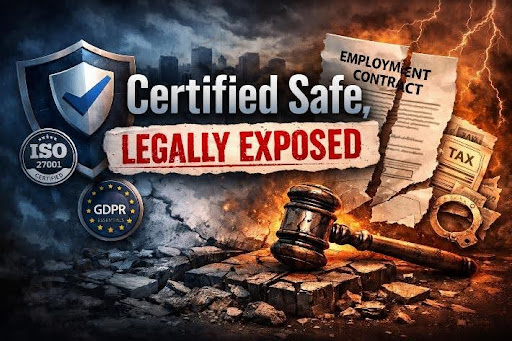 In the EOR market, real compliance depth is not about whether a provider can protect data. It is about whether the provider can legally and operationally employ people in-country, run compliant payroll, administer statutory benefits, manage tax and social contributions correctly, maintain required registrations and filings, structure contracts lawfully, and handle terminations, leave, working time, worker classification, and local employer obligations in a way that would withstand audit, dispute, or regulator scrutiny. Big Four guidance on global employment and remote-work structures consistently points to employment law, payroll, tax, and permanent-establishment risk as separate and material compliance domains.
That is why Compliance & Licensing Depth is one of the most important lenses in the entire EOR Study 2026.
The market’s favorite shortcut
A large part of the EOR sector still relies on a shortcut in buyer communication:
security compliance + privacy compliance = full compliance.
It is an attractive shortcut because it is easy to market. Certificates can be displayed. Badges look tangible. Procurement teams understand them. Security reviews often happen early in enterprise buying cycles. And in a market where many buyers still struggle to distinguish EOR from payroll outsourcing, PEO, staffing, contractor management, and global mobility support, it is tempting for vendors to let those credentials do too much work.
But let’s be blunt: security assurance is not employment-law assurance.
A provider may have an excellent information security management system and still be weak in local employment execution. It may process personal data lawfully under GDPR and still get worker classification wrong, structure non-compliant contracts, mishandle statutory leave, fail to maintain local registrations, or rely too heavily on third parties without consistent in-country controls. GDPR itself focuses on lawful processing, accountability, controller-processor relationships, and protection of data subject rights. It does not certify payroll tax accuracy in Brazil, labor leasing permissibility in Germany, termination process compliance in Spain, or social contribution handling in India.
Likewise, Cyber Essentials is explicitly a minimum cyber standard. Useful? Yes. Impressive? Potentially. Sufficient to validate EOR compliance across 100+ employment jurisdictions? Not remotely.
And ISO 27001? Important, respected, often necessary in enterprise deals. But by ISO’s own description, it is about establishing, implementing, maintaining, and continually improving an information security management system. It is not a certification for employment-law compliance, payroll tax accuracy, statutory benefits administration, or local legal-entity readiness.
So when an EOR vendor presents those three items as proof that it is “fully EOR compliant,” buyers should hear an alarm bell, not a comfort tone.
What real EOR compliance depth actually looks like
The EOR model sits at the intersection of several legal and operational regimes at once. That is exactly why shallow compliance narratives are dangerous.
A credible EOR compliance infrastructure should include, at minimum, strength in six areas.
First, legal employability in-country. Can the provider legally hire in that jurisdiction through its own entity or through a structure that is actually permissible for the use case? In some markets, the difference between direct owned-entity employment and partner-dependent delivery is not just commercial; it changes the risk profile.
Second, payroll and employer tax execution. Payroll is not a side process. It is the compliance engine. Employers must calculate, declare, pay, and document obligations correctly, while maintaining records and responding to tax authority requirements. KPMG and EY both stress that payroll and employment tax obligations remain complex, highly local, and consequential.
Third, statutory benefits and social contributions. A provider is not deeply compliant if it can issue an employment contract but cannot prove that mandatory contributions, insurances, leave entitlements, and local benefit obligations are systematically handled.
Fourth, employment-law process discipline. Hiring is only one checkpoint. Real depth shows up in probation rules, working-time limits, public holiday handling, sick leave, parental leave, collective agreements where relevant, notice periods, severance logic, documentation, and offboarding controls.
Fifth, worker classification and boundary management. Across markets, regulators are paying closer attention to whether workers are truly employees, independent contractors, or part of another regulated labor structure. Misclassification remains a live and costly risk.
Sixth, governance over cross-border risk, including permanent establishment, management control, immigration triggers, and co-employment exposure. Deloitte and PwC both highlight that remote and cross-border employment structures can create tax, labor-law, and governance complications that go well beyond payroll administration.
Put differently: real EOR compliance is multi-layered, jurisdiction-specific, process-heavy, and auditable.
That is why “we are ISO certified” is not the end of the conversation. It is barely the opening slide.
The difference between trust signals and proof
To be fair, security and privacy credentials should not be dismissed. In fact, as EOR platforms become more data-rich and more integrated into enterprise HR stacks, they matter more than ever. Providers are handling sensitive employee data, compensation data, bank information, identity documents, and often cross-border transfers of personal information. Buyers should absolutely care about security controls, processor commitments, access management, encryption, incident response, and governance. GDPR requires organizations to use processors providing sufficient guarantees, and ISO 27001 can support that assurance posture.
But those are trust signals, not full proof of operational employer compliance.
The more mature buyers in 2026 are beginning to separate the questions:
Question 1: Can I trust this provider with sensitive data?
Question 2: Can I trust this provider to act as a compliant employer in the jurisdictions I need?
Those are not the same diligence workstream.
The best vendors understand that and do not blur the boundary. They present security and privacy certifications for what they are, then back them up with separate evidence for employment compliance depth: entity model transparency, licensing where required, documented local process controls, legal review frameworks, payroll governance, benefit matrices, audit trails, exception handling, escalation models, and proof of how they manage country-by-country change, and, potentially, an external EOR Compliance Certificate.
That is where the market is splitting.
Why this matters more in 2026 than in 2024
Because the EOR category has matured.
A few years ago, many buyers were still purchasing speed: Can this vendor hire someone in-country fast enough? That remains important. But enterprise buyers now want more than activation speed. They want risk clarity. They want integration into HR, payroll, finance, identity, and workflow systems. They want less fragmentation between EOR, contractor management, immigration support, workforce planning, and core HR operations.
As the market moves toward full-stack HR integration, the cost of weak compliance depth rises.
Why? Because shallow compliance hidden behind a good front-end becomes more dangerous as adoption scales. One country can be managed manually. Ten countries require repeatable controls. Fifty countries require governance architecture. Once EOR moves from tactical hiring workaround to strategic workforce infrastructure, buyers need to know whether compliance is truly built into the operating model or merely narrated in sales language.
That is exactly why the IEC EOR Study 2026 includes Compliance & Licensing Depth as a distinct evaluation category rather than burying it under a generic “trust” or “service quality” label.
The questions buyers should ask now
If a vendor tells you, “We are ISO 27001:2022 certified, Cyber Essentials certified, and GDPR compliant,” the correct response is not skepticism for its own sake. It is disciplined follow-up.
Ask: In which countries do you employ through your own entities, and in which do you rely on partners?
Ask: Where do you hold licenses or regulated permissions relevant to local employment models?
Ask: How do you monitor local labor-law changes and translate them into operational updates?
Ask: Who owns payroll accuracy, statutory filings, and contribution remittance in each country?
Ask: What evidence can you provide for compliant onboarding, leave handling, and terminations?
Ask: How do you manage worker classification, PE risk, and cross-border line-management issues?
Ask: What is audited, by whom, and how often?
Ask: Which parts of your compliance story are externally certified, and which are simply asserted?
That last question is often the most revealing.
Because the uncomfortable truth in the EOR market is this: many vendors have excellent security certifications and insufficiently evidenced employer compliance narratives.
What leadership in this category will look like
The leaders in Compliance & Licensing Depth in the IEC EOR Study 2026 will not simply be the providers with the most badges. They will be the ones with the most credible, demonstrable compliance architecture.
That likely means vendors who can show:
- A transparent country delivery model.
- Clear evidence of owned infrastructure versus partner dependency.
- Country-specific legal and payroll operating discipline.
- Documented handling of statutory benefits and local employer obligations.
- Strong auditability and governance.
- A defensible answer to the difference between data/security compliance and EOR compliance.
In other words, leadership here is not about saying “trust us.” It is about being able to say, “Here is how compliance actually works.”
That is a much higher bar. And it should be.
The real message to the market
The EOR industry does not need fewer certifications. It needs fewer category mistakes.
ISO 27001 matters. Cyber Essentials matters. GDPR matters. Buyers should value them. But they should value them for what they are: indicators of information security and data governance maturity. They are not a shortcut to proving lawful in-country employment execution.
So the claim, “We are ISO 27001:2022 certified, Cyber Essentials certified, and fully GDPR compliant — therefore we are fully EOR compliant,” should now be treated as what it is: a marketing oversimplification.
And in some cases, a dangerous one.
Because EOR compliance is not a badge bundle. It is a live operating capability spanning labor law, payroll, tax, social contributions, benefits, documentation, process governance, local registrations, and risk management across jurisdictions. That capability must be built, maintained, updated, and evidenced.
The market is maturing fast enough that buyers are beginning to see the difference.
The Study will, too.
And that is precisely why Compliance & Licensing Depth is one of the defining categories of the IEC Rebels Digest EOR Study 2026: not because compliance is fashionable, but because in a category built on the promise of cross-border employment without local entity complexity, compliance depth is the product.
Everything else is packaging.
Want to build trust through independent validation?
If you want to learn more about IEC Audit & Certification—and how independent audits can strengthen compliance maturity, procurement confidence, and continuous improvement—reach out to: pm@theiecgroup.com
Free participation: EOR Study 2026
Provider participation is free of charge for qualified companies. If you want to ensure your offering is correctly positioned and represented in the market, contact:
pm@theiecgroup.com See you in the study. —The IEC Rebels Digest Team
Why This Matters for the IEC Global EOR Study 2026
 This is not just a market commentary. It’s the exact reason the IEC Global EOR Study 2026 is structured the way it is.
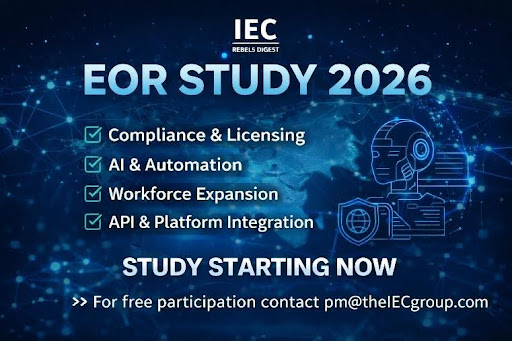
The study will assess providers across eight evaluation categories that reflect the compliance stack reality:
- Global Reach & Legal Infrastructure
- Compliance & Licensing Depth
- Tech Stack & Platform Maturity
- AI & Process Automation
- Client Experience (CX)
- Employee Experience (EX)
- Integration & API Coverage
- Innovation & Market Differentiation
And yes—there will be visibility into who ranks strongest across these categories, alongside insights into rising disruptors and the strategic direction of the market.
Because in 2026, “EOR provider” is not a uniform label. The gap between providers is widening—and the winners will be those who can prove compliance as infrastructure, not claim it as a feature.
A Final Reality Check
Global workforce management is no longer just about hiring talent abroad. It’s about building a defensible employment operating model across legal regimes—and doing it with speed, transparency, and integration.
That is a regulated product challenge.
And that’s why the EOR market is heading toward a compliance-led shakeout.
The platforms that win won’t simply help companies hire globally. They will help companies stand up to scrutiny globally.
About the IEC Rebel’s Digest
We write for the ones breaking molds, building cross-border teams, and reshaping global work. No buzzwords. Just truths, tools, and tactics for the new era of employment.
IEC Rebel’s Digest— The IEC Group can help you audit your global employment setup by identifying labor leasing risks, verifying licensing requirements, and ensuring your EOR partners meet every compliance standard—before regulators come knocking.
Last but not Least: If you’re facing challenges and wondering how others are managing similar issues, why not join The Leadership Collective Community? It’s a peer group and webcast platform designed for leaders to exchange insights and experiences.
Introducing the IEC Knowledge Network Free Membership – Your Gateway to Seamless Access!
We are thrilled to present a new service that goes beyond the ordinary download experience. In addition to offering you the ability to download the things you love, we are delighted to introduce the IEC Knowledge Network Free Membership.
The Free Membership option grants you access to our library of articles and videos, without the need for tedious registrations for each piece of content.
The publication serves as a trusted resource to support executives in their pursuit of sustainable and successful global expansion. In addition the IEC Practitioners are available to discuss your specific challenge in more detail and to give you clear advise..
Take advantage of this valuable resource to accelerate your global expansion journey

