
Employee Experience & Virtual Assistants
Study #3: AI in Employee Experience & People Insights, Category Focus: Employee Experience & Virtual Assistants
Intro: From Portal Graveyards to Practical Copilots
 Every HR strategy deck now has the same slide: “One intelligent assistant as the single front door to the employee experience.”
Reality: people still hop between three portals, five PDFs and a manager who says “no idea, ask HR.” AI-powered virtual assistants promise to fix this—but only if they move beyond clever FAQ bots and actually do work.
In Study #3 of the IEC AI in HR & WFM series, we look at Employee Experience & Virtual Assistants as the conversational layer across HR, IT and the broader people stack. This is where generative AI feels most visible to employees—and where trust can be won or lost in a single bad answer.
This article unpacks how these assistants are used today, what “mature” actually means (CMMI-style Levels 1–5, without turning it into a religion), where providers differ, and what HR leaders should do in the next 12–18 months.
What Counts as “Employee Experience & Virtual Assistants” in the Study?
For this category, we treat virtual assistant as more than a chatbot bolted onto an HR portal. It is the conversational experience layer that:
- Lives where employees already are: Teams/Slack, email, mobile, HR portal, sometimes WhatsApp
- Understands natural language across HR, IT, facilities, finance self-service
- Uses LLMs + your own policies, workflows and data to answer questions
- Can both explain (“What is my parental leave entitlement?”) and act (“Start my parental leave request for 1 October”)
- Feeds People Insights: what people ask, where friction is, what journeys are broken
In Study #3, we evaluate both:
- Provider capabilities – what the platform could do out of the box or with configuration, and
- Customer maturity – how far organizations have actually implemented, governed and adopted these assistants in real life.
Why This Category Matters Right Now
AI in Employee Experience sits at the intersection of three pressures:
- Digital friction is now a measurable cost: time wasted hunting policies, chasing approvals, misunderstanding benefits.
- Hybrid and distributed work mean people can’t just walk to HR or IT anymore; the assistant becomes the “hallway”.
- Generative AI expectations: employees use consumer AI that feels smart and forgiving. A clunky corporate bot feels worse by contrast.
- People Insights gap: HR analytics teams know what is happening (attrition, absence, eNPS) but not why. Conversational data can fill that gap—if used ethically.
Done right, virtual assistants become the frontline of employee trust: the first place people go when something is confusing, unfair, or sensitive. Done badly, they become another ghosted channel that everybody jokes about and nobody uses.
The 5 Levels of Maturity
We use a 1–5 maturity lens—for both providers and users—but we keep it practical, not doctrinal.
Level 1 – Initial: “Random bot experiments”
- Multiple pilots, often owned by IT or a vendor, with no shared standards.
- Bots answer a narrow FAQ set, often outdated, sometimes wrong.
- No clear routing to humans; people learn to avoid it.
Reality check: This is where many organizations still are, even if the slideware says otherwise.
Level 2 – Managed: “HR helpdesk, but with chat”
- A single HR assistant or a small set of coordinated bots.
- Can answer policy questions from a curated knowledge base and log tickets.
- Escalation paths exist, but the assistant mostly reflects existing silos.
- Metrics: deflection rate, time-to-response, basic satisfaction scores.
Value: Reduced email volume, clearer entry point for common queries.
Level 3 – Defined: “Experience journeys, not just tickets”
- Assistant is integrated with HCM, case management, ITSM, and sometimes learning or benefits platforms.
- Supports end-to-end journeys:
- Onboarding: from contract signed to “first 90 days”
- Life events: parental leave, relocation, promotions
- Well-being: nudges towards resources when signals suggest overload
- Tone of voice, escalation rules and knowledge lifecycle are standardized and documented.
Value: Measurable improvements in journey completion, reduced frustration, more consistent answers.
Level 4 – Quantitatively Managed: “Personalized, data-driven copilots”
- Assistant uses context (role, location, schedule, previous questions) to tailor answers.
- Strong People Insights loop:
- Top question clusters are fed into policy and process redesign.
- Conversational sentiment helps prioritize EX investments.
- HR and EX teams use insights dashboards, not just “deflection” stats.
- Governance: clear rules on data retention, monitoring, bias, and use of conversation data.
Value: The assistant not only solves problems but reveals where the system itself is broken.
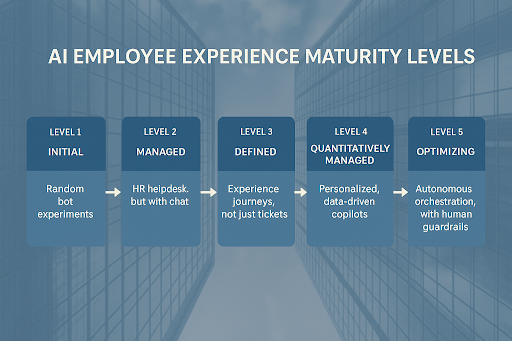 Level 5 – Optimizing: “Autonomous orchestration, with human guardrails”
- The assistant doesn’t just respond; it orchestrates actions:
- Proactively suggests training, benefits, or schedule changes.
- Coordinates with managers and systems when risks are detected (burnout, attrition signals) within strict rules.
- Continuous AB-testing of prompts, flows and interventions, tied to outcomes (retention, well-being, productivity indicators).
- Employees can see and control what the assistant knows about them.
Warning: Many vendors pitch Level 5 while customers are still struggling with Level 2. Our study distinguishes marketing promises from evidence.
What “Good” Looks Like in Employee Experience & Virtual Assistants
Across providers and customers, the more mature patterns share some common traits:
- One conversational front door, not 12 bots
- Employees don’t care which back-end system owns the answer.
- Routing and orchestration happen behind the scenes.
- From “answering questions” to “finishing jobs”
- “How many vacation days do I have?” → shows balance and offers to book time off.
- “I’m moving to another country” → starts a relocation process, shows tax/benefit implications, books an HR consult if needed.
- Retrieval-augmented, not hallucination-augmented
- Answers are grounded in approved policies, knowledge articles and contracts.
- Assistants show sources (“Based on the Global Leave Policy v3.2”) and clearly mark uncertainties.
- Explainable and human in tone
- Payslip explanations, performance rules, equity vesting, or complex benefits are translated into plain language.
- Sensitive topics use careful scripting + AI flexibility, not raw LLM output.
- Deeply integrated with People Insights
- Top themes from conversations feed:
- EX roadmaps (“Too many questions about travel policy → fix the process.”)
- Manager enablement (where teams struggle to apply policies)
- Change communication (which messages didn’t land).
- Analytics includes who’s underserved: locations, job families or shifts that rarely use the assistant or have bad experiences.
- Top themes from conversations feed:
Failure Modes: Where Virtual Assistants Go Off the Rails
Before we fall in love with the vision, it’s worth naming the ways this can go wrong:
- Hallucinated policy and fake certainty
- The assistant invents rules that don’t exist or misreads edge cases.
- Employees act on wrong answers → legal, payroll, and employee-relations risk.
- Channel chaos and brand damage
- One bot in Teams, another in the HR portal, another in the IT app—none aligned.
- Inconsistent answers erode trust faster than having no assistant at all.
- Stealth surveillance via “insights”
- Mining conversations for micro-productivity metrics or targeting individuals.
- Employees discover it and stop using the channel completely.
- Frozen knowledge
- Policies and processes change, but no one owns the knowledge update pipeline.
- The assistant becomes a museum of old rules.
- Shadow AI
- If your corporate assistant is useless, employees use consumer AI with internal data.
- Suddenly your real risk is outside IT’s control.
The mature implementations in our study treat governance, privacy and change management as first-class features—not afterthoughts.
The Study Lens: How We Evaluate Providers in This Category
In the IEC AI in Employee Experience & People Insights Study, we assess Employee Experience & Virtual Assistants across a set of pragmatic dimensions, both for the platform and for real customer deployments:
- Experience Design & Reach
- Channels supported (Teams, Slack, mobile, web, email, voice).
- Multilingual capabilities and accessibility.
- Quality of conversation design: guardrails, tone, escalation.
- Knowledge & Content Architecture
- How easy is it to connect to policies, KBs, case management, intranets?
- Retrieval quality and version control of content.
- Tools for HR/EX teams to manage prompts, intents and content without coding.
- Workflow & Orchestration Depth
- Can the assistant trigger and track HR, IT, finance workflows?
- Support for complex journeys (onboarding, mobility, health & safety).
- Integration with HCM, ITSM, LMS, time & attendance, benefits platforms.
- Trust, Security & Compliance
- Data segregation, access controls, regional hosting options.
- Content grounding and hallucination mitigation techniques.
- Audit trails of conversations and decisions.
- People Insights & Outcome Evidence
- Analytics on topics, sentiment, friction points.
- Ability to link assistant usage to EX outcomes (eNPS, service levels, error reduction).
- Case studies where the assistant changed how work gets done—not just how FAQs are answered.
- Implementation & Operating Model
- How customer-friendly is the journey to Level 3–4 in practice?
- Templates, best-practice journeys and governance frameworks.
- Partner ecosystems and customer success maturity.
This is the backbone of how we place providers on the IEC Dynamic Map for Employee Experience & Virtual Assistants—and how we separate hype from proven capability.
What HR and EX Leaders Should Do in the Next 12–18 Months
If you are leading HR, EX or People Analytics, here’s a pragmatic playbook:
- Start with three high-value, low-drama journeys
Pick use cases where:
- Policies are mature.
- Data quality is “good enough”.
- Risk of a slightly imperfect answer is manageable.
Typical candidates:
- Time off & leave (incl. parental leave variants).
- Onboarding and offboarding.
- Benefits & well-being resources.
- Design for “solve my problem”, not “show me information”
For each use case:
- Ask: What is the job-to-be-done?
- Configure the assistant to complete the job (create a case, initiate a workflow, notify a manager), not just recite policy.
- Build a light-weight governance model from day one
- Assign clear owners for:
- Knowledge (policies, KB articles)
- Conversation flows & prompts
- Monitoring and incident response
- Define when the assistant must hand over to a human:
- Sensitive ER cases
- Complex legal questions
- Health and discrimination topics
- Invest in employee-facing transparency
Tell people:
- What the assistant can and cannot do.
- What data it uses and how conversations are stored.
- That they can always request a human, and how.
Transparency is not a compliance burden; it’s your main trust accelerator.
- Use People Insights intentionally and ethically
- Aggregate and anonymize conversation analytics.
- Use themes to inform:
- Policy simplification
- Communication improvements
- Manager enablement
- Explicitly rule out “creepy” use cases (individual monitoring, performance policing) and write that down.
Align your roadmap with the 5 maturity levels—but don’t cosplay Level 5
- Honestly assess where you are today—L1, L2, maybe early L3.
- Define what Level 3 and 4 mean for your organization, not in a vendor demo.
- Let outcomes (reduced case volume, improved EX metrics) drive when you advance, not fashion.
Bottom Line
Move from bots that answer questions to assistants that earn trust and fix work.
Treat Employee Experience & Virtual Assistants as the front door to your people systems and the microphone by which employees tell you where the experience is broken. Ground them in your real policies, wire them into real workflows, govern them with real guardrails, and measure them by real outcomes—not just deflection rates.
Do that, and AI in Employee Experience becomes more than another portal project. It becomes the operating system for how people actually experience work.
Take part in the study, share your use cases and pain points, and get early access to the IEC Dynamic Map Quadrants AI for Employee Experience & Virtual Assistants. If you’re building the next generation, don’t just ship features — show leadership. Join the study, share your strongest use cases and pain points from the front line.
———————————————————————-
Closing note & invitation
 Provider comparisons—and the identification of the leading AI provider in Talent Acquisition—will be a core part of the first global IEC study on “AI in Talent Management and Development.” Participants are invited to join free of charge.
Participation: pm@theIECgroup.com
Study scope (AI-first lens):
Study #1: AI in Talent Intelligence & Development
- AI-Driven Talent Acquisition
- Performance & Talent Intelligence
- Learning & Development (incl. internal mobility/marketplaces)
Study #2: AI in Workforce Operations & Pay
- AI in Scheduling & Time Management
- AI for Payroll & Compliance
- Total Workforce Orchestration (VMS/FMS, contractors, EOR)
Study #3: Employee Experience & People Insights
- Employee Experience & Virtual Assistants
- Workforce Analytics & Planning
Over the next few weeks, we’ll zoom into each of the eight categories in IEC Rebel’s Digest—one deep dive at a time, with practical use cases, KPIs, and the vendor patterns to watch.
IEC Rebel’s Digest— The IEC Group can help you audit your global employment setup by identifying labor leasing risks, verifying licensing requirements, and ensuring your EOR partners meet every compliance standard—before regulators come knocking.
Last but not Least: If you’re facing challenges and wondering how others are managing similar issues, why not join The Leadership Collective Community? It’s a peer group and webcast platform designed for leaders to exchange insights and experiences.
Introducing the IEC Knowledge Network Free Membership – Your Gateway to Seamless Access!
We are thrilled to present a new service that goes beyond the ordinary download experience. In addition to offering you the ability to download the things you love, we are delighted to introduce the IEC Knowledge Network Free Membership.
The Free Membership option grants you access to our library of articles and videos, without the need for tedious registrations for each piece of content.
The publication serves as a trusted resource to support executives in their pursuit of sustainable and successful global expansion. In addition the IEC Practitioners are available to discuss your specific challenge in more detail and to give you clear advise..
Take advantage of this valuable resource to accelerate your global expansion journey

