
You can’t “AI” your way out of a broken workforce stack.
Executive Summary
 AI in HR is no longer just about pretty chatbots on your career site. In Study #2: AI in Workforce Operations & Pay, we look at the hard stuff: how AI actually runs work, workers, and money across VMS, FMS, contractors, EOR, in-country entities and payroll.
We call this emerging category Total Workforce Orchestration — the AI “brain” that decides who does the work (FTE vs contractor vs EOR), where they sit, how they’re engaged, and what they’re paid, then pushes the right workflows into your existing stack.
The article introduces a 5-level AI maturity model from ad-hoc bots and siloed tools to fully orchestrated, continuously learning workforce operations with strong guardrails for compliance, ethics, and pay equity.
This piece is part of the IEC AI in HR & Workforce Management Study and feeds into our IEC Dynamic Map (Quadrant) for AI in Workforce Operations & Pay.
Vendors and users can participate free of charge: contribute a 30-minute briefing to ensure your solution or organization is correctly reflected, benchmark your AI maturity, and secure your positioning on the map.
The full article and study participation details are freely accessible via IEC Rebel’s Digest
Study #2: AI in Workforce Operations & Pay – Category spotlight: AI for Total Workforce Orchestration.
Intro: You can’t “AI” your way out of a broken workforce stack.
 That’s the uncomfortable truth behind Study #2: AI in Workforce Operations & Pay in our IEC series. Everyone wants shiny copilots. But the real leverage isn’t in adding yet another chatbot on top of your mess of systems — it’s in using AI to orchestrate how work actually flows through VMS, FMS, contractor setups, in-country entities, and EOR partners.
Welcome to the category we call Total Workforce Orchestration.
This is where AI stops being a slide in your board deck and starts deciding:
- Who does the work (FTE vs contractor vs EOR vs agency temp)
- Where they sit (country, cost center, entity)
- How they’re engaged (local contract, EOR, freelance, SOW)
- What they’re paid (rate cards, internal equity, market data)
- Which systems fire (VMS, FMS, HCM, payroll, AP, ERP)
And because you asked for it explicitly: we’re framing all of this through a 5-level maturity model — from Level 1 chaos to Level 5 orchestrated excellence.
What We Mean by “Total Workforce Orchestration”
Most organizations today live in tool sprawl:
- A VMS for agencies and temps
- One or more FMS platforms for freelancers & gig talent
- An HCM / ATS stack for core employees
- A mix of in-country entities + EOR providers for global hires
- Payroll engines, time systems, ERPs, AP workflows… all “integrated” via spreadsheets and midnight heroics
On paper, you have everything – in practice, it’s a fragmented, policy-breaking maze.
Total Workforce Orchestration (TWO) is the category we see emerging from Study #2:
A decision + automation layer that sits on top of your VMS/FMS/EOR/HRIS/Payroll stack and uses AI to coordinate how work, workers, and money move through the system.
Three key ideas:
- One view of the workforce
Employees, contractors, EOR hires, gig workers, extended workforce — all visible in a single, queryable layer.
- Policy-aware decisions
AI engines that understand your policies (classification, pay bands, vendor rules, approval flows) and make recommendations within those constraints.
- Automated execution
Once a decision is made (“use EOR in Spain at Band C with this rate & policy bundle”), the orchestration layer kicks off workflows in the right systems automatically.
When we talk about AI in Workforce Operations & Pay, we’re talking about the intelligence inside this orchestration layer — not random bots bolted onto legacy workflows.
The AI Jobs in Workforce Operations & Pay
Across interviews and implementations, the same AI use cases keep showing up in the TWO space:
- Classification & engagement choice
- Should this be an FTE, contractor, or EOR hire in Country X?
- Which engagement route is lowest risk, fastest, and cost-appropriate?
- Rate, pay & cost simulation
- “If we staff this project with mix A vs mix B (EOR + contractors + internal), what’s the cost, margin, and pay-equity impact?”
- Dynamic, data-driven rate cards instead of static PDFs nobody updates.
- Workflow routing & approvals
- Auto-routing requisitions to the right channel: VMS, FMS, internal mobility, EOR partner, or agency.
- Pre-populating contracts, POs, and requests with policy-compliant terms.
- Risk & anomaly detection
- Flagging misclassification risks, suspicious time entries, or overtime patterns.
- Spotting when “contractors” behave like de facto employees.
- Performance & vendor optimization
- Identifying high-performing vendors, sourcing channels, or talent pools across your entire stack.
- Recommending reallocation of spend and roles.
The question for your organization isn’t whether you’ll use AI for these jobs. It’s how mature that use will be — and how quickly you can climb the curve.
The 5 Levels of AI Maturity in Total Workforce Orchestration
Here’s the maturity lens we use in Study #2, loosely modeled on CMMI but tuned for VMS/FMS/EOR reality.
Level 1 – Ad Hoc Automation (“We Have Bots. Sort Of.”)
This is where most organizations quietly are.
- Data reality:
- Each channel (VMS, FMS, HCM, EOR, payroll) is a silo.
- No unified worker ID; no shared job taxonomy; duplicate vendors everywhere.
- AI reality:
- Maybe there’s an LLM add-on in your VMS.
- Someone built a script to parse invoices or summarize contracts.
- But none of it talks to anything else.
- How it feels internally:
- Tools feel clever in demos but irrelevant in real operations.
- Operations teams still live in spreadsheets and email.
- Risk of staying here:
- False comfort — leadership hears “we’re doing AI in VMS/payroll,” but structurally nothing changed.
- You’re still one audit, one misclassification scandal, or one payroll error away from chaos.
Your job at Level 1: Forget “AI projects.” Start with data hygiene and visibility. You can’t orchestrate what you can’t see.
Level 2 – Tactical Use Cases (“AI for Individual Systems”)
At Level 2, AI is still system-bound, but it’s no longer purely gimmicky.
- Data reality:
- Some normalization inside each system (standard job templates, vendor categories).
- Still no consistent workforce taxonomy across VMS/FMS/EOR/HCM.
- AI reality:
- Use cases like:
- Vendor suggestion inside VMS
- Skill-based matching in FMS
- Basic anomaly detection in payroll
- Each platform vendor sells “AI features” — and you’re actually using some of them.
- Use cases like:
- How it feels internally:
- Ops people appreciate some genuine time-savers.
- But decisions about where to send work (internal vs contractor vs EOR) are still human-only and often political.
- Risk of staying here:
- Optimization inside silos can reinforce fragmentation: each system does its own AI thing, but the overall workforce picture gets fuzzier.
Your job at Level 2: Start designing a cross-system data model and policy spine:
- Global job families and skill ontology
- Shared definition of “worker” across employment types
- Common cost and rate structures, even if implemented differently per system
This is the scaffolding for Level 3.
Level 3 – Defined Orchestration Layer (“One Brain, Many Hands”)
This is where Total Workforce Orchestration becomes real.
- Data reality:
- You have a unified view of workers and work across systems.
- VMS, FMS, HCM, EOR, and payroll feed into a central model (data warehouse, lakehouse, or specialized orchestration platform).
- AI reality:
- AI agents can:
- Recommend engagement routes (“FTE vs EOR vs contractor”)
- Suggest rate ranges based on market + internal equity
- Pre-populate contracts, SOWs, and requisitions with compliant details
- AI outputs still require human approval — but they’re starting to drive behavior.
- AI agents can:
- How it feels internally:
- HR, Procurement, and Finance are finally looking at the same truth.
- You start having conversations in terms of total workforce strategy, not “payroll vs vendors.”
- Risk of staying here:
- Decisions are better, but still reactive.
- Without quantitative management, you can’t prove to the CFO that AI-driven orchestration improves margin, speed, or risk.
Your job at Level 3: Turn orchestration from “fancy routing” into a measurable operating system:
- Define KPIs: time-to-fill, cost-per-output, misclassification risk, rate leakage, vendor concentration.
- Instrument every workflow so you know exactly what AI-driven orchestration is doing to those KPIs.
This sets you up for Level 4.
Level 4 – Quantitatively Managed Orchestration (“We Can Show the ROI”)
Now we’re in classic CMMI Level 4 territory: quantitative control.
- Data reality:
- Metrics are not a dashboard afterthought; they’re built into workflows.
- You have trend lines and baselines for key workforce and pay metrics across channels.
- AI reality:
- AI doesn’t just recommend options — it optimizes for defined goals:
- Cost vs time vs risk vs retention
- Scenario engines run “what if” models:
- “What if we moved 15% of our EOR population in Country X to local entities?”
- “What if we reduce reliance on a single vendor in Region Y?”
- AI doesn’t just recommend options — it optimizes for defined goals:
- How it feels internally:
- Discussions with Finance change from “AI is cool” to “This orchestration reduced blended cost per project by X and cut time-to-fill by Y days.”
- HR & Procurement can defend workforce mix decisions with data, not anecdotes.
- Risk of staying here:
- You risk becoming over-optimized on cost or speed if you don’t deliberately factor in ethics, fairness, and long-term talent strategy.
Your job at Level 4: Guard against being a cold algorithmic machine:
- Bake fairness, DEI, and pay-equity constraints into your optimization goals.
- Implement human-in-the-loop review for high-impact AI decisions (e.g., large vendor shifts, mass reclassification, pay bands).
- Build governance boards that include legal, HR, and operations — not just data and finance.
Level 5 – Continuous Learning & Autonomous Orchestration (“The System Gets Better While You Sleep”)
This is the “Optimizing” level in CMMI terms — and it’s where very few organizations genuinely operate.
- Data reality:
- Feedback loops are explicit: outcomes (project success, quality, attrition, dispute rates) feed back into the orchestration brain.
- You maintain active data quality programs; you don’t treat cleanup as a one-time project.
- AI reality:
- AI agents autonomously run micro-adjustments within predefined guardrails:
- Nudging rate cards
- Rebalancing vendor allocations
- Suggesting new EOR vs entity trade-offs
- The system learns from successes and failures, and you regularly re-train models on your own operational reality.
- AI agents autonomously run micro-adjustments within predefined guardrails:
- How it feels internally:
- Your workforce operation becomes a strategic flywheel, not a cost center.
- Leadership asks, “What should we stop doing in-house because the orchestration system shows a better pattern?”
- Risk at Level 5:
- Complacency. The moment you treat this as “done,” your models drift, regulations change, markets move, and your “smart” system starts making dumb decisions.
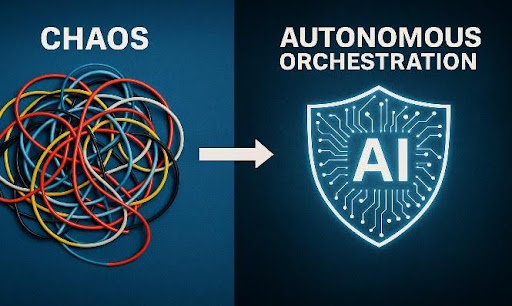 Your job at Level 5: Stay paranoid. Keep:
- Rotating in new data sources (labor market intel, tax/reg changes, local benchmarks)
- Auditing models for bias, drift, and compliance
- Evolving your guardrails as your business and regulatory landscape change
Quick Reference: The Five Levels
Level | Name | Reality Check in One Line |
|---|---|---|
1 | Ad Hoc Automation | Isolated bots, zero orchestration, spreadsheets run the show. |
2 | Tactical Use Cases | Helpful AI features inside systems; total picture still fragmented. |
3 | Defined Orchestration Layer | One brain on top of many tools; AI-guided decisions, human approved. |
4 | Quantitatively Managed Orchestration | AI decisions measured, optimized, and defensible to the CFO. |
5 | Continuous Learning & Autonomous | Self-improving orchestration with strong guardrails and governance. |
Use this table as a brutally honest mirror: where are you really?
The Rebel’s Playbook: How to Climb the Ladder
Close your deck app for a moment. If you want to move up even one level, this is the work.
- Map Your Actual Workforce Stack (Not the Fantasy One)
- Document every system where people or pay show up: HCM, VMS, FMS, EOR portals, payroll, time, ERP, AP.
- Identify the shadow systems: spreadsheets, email approvals, homegrown tools.
- Visualize how a single requisition might snake through this maze today.
This is your Level 1 truth-telling exercise.
- Design Your Total Workforce Data Model
Before you buy another AI tool:
- Define a canonical worker object that covers employees, contractors, EOR workers, gig workers.
- Create a job and skills taxonomy that all systems can map to.
- Standardize key pay and rate attributes (band, currency, allowance types, tax treatments).
This is the foundation of Level 2–3.
- Choose One High-Impact Orchestration Use Case
Don’t launch “AI in workforce ops.” Launch something like:
- “AI-powered engagement routing for cross-border roles”
- “Orchestrated hiring choice: internal vs contractor vs EOR for all roles in Region X”
- “Rate card optimization for top 5 project types in our VMS + FMS”
Make it:
- Cross-functional (HR, Procurement, Finance)
- Measurable (time-to-fill, cost, risk)
- Executable in < 6–9 months
This becomes your Level 3 proof of concept.
- Instrument Everything
From day one, treat metrics as product features, not reporting afterthoughts:
- Embed tracking into workflows: who overrode AI recommendations, why, and with what outcome.
- Benchmark pre- and post-orchestration metrics.
- Build simple, honest dashboards for operations teams — not just leadership.
This is your bridge to Level 4.
- Build Governance and Courage
You’ll need both:
- Governance to prevent AI from making reckless classification or pay decisions.
- Courage to let AI recommendations stand when they challenge legacy habits, pet vendors, or job protection politics.
At Level 5, the most dangerous thing isn’t bad tech — it’s good tech that no one is willing to use to its full potential.
Where Study #2 Takes You Next
In the full Study #2: AI in Workforce Operations & Pay, we go deeper into:
- Real-world archetypes of organizations at each maturity level
- How VMS/FMS/EOR providers are repositioning around orchestration
- The emerging playbooks for CFOs, CHROs, and CPOs who want to lead this shift
- Pitfalls: where AI in workforce ops has already gone wrong, and what to learn from it
But you don’t need to wait for another 50-page PDF to act.
Pick your level.
Pick one orchestration use case.
Commit to moving up one rung.
That’s how AI in workforce operations & pay stops being a buzzword — and becomes the operating system for your entire workforce.
Take part in the study, share your use cases and pain points, and get early access to the IEC Dynamic Map Quadrants for AI in Workforce Operations & Pay. If you’re building the next generation of AI for payroll and compliance, don’t just ship features — show leadership. Join the study, share your strongest use cases and pain points from the front line.
———————————————————————-
Closing note & invitation
 Provider comparisons—and the identification of the leading AI provider in Talent Acquisition—will be a core part of the first global IEC study on “AI in Talent Management and Development.” Participants are invited to join free of charge.
Participation: pm@theIECgroup.com
Study scope (AI-first lens):
Study #1: AI in Talent Intelligence & Development
- AI-Driven Talent Acquisition
- Performance & Talent Intelligence
- Learning & Development (incl. internal mobility/marketplaces)
Study #2: AI in Workforce Operations & Pay
- AI in Scheduling & Time Management
- AI for Payroll & Compliance
- Total Workforce Orchestration (VMS/FMS, contractors, EOR)
Study #3: Employee Experience & People Insights
- Employee Experience & Virtual Assistants
- Workforce Analytics & Planning
Over the next few weeks, we’ll zoom into each of the eight categories in IEC Rebel’s Digest—one deep dive at a time, with practical use cases, KPIs, and the vendor patterns to watch.
IEC Rebel’s Digest— The IEC Group can help you audit your global employment setup by identifying labor leasing risks, verifying licensing requirements, and ensuring your EOR partners meet every compliance standard—before regulators come knocking.
Last but not Least: If you’re facing challenges and wondering how others are managing similar issues, why not join The Leadership Collective Community? It’s a peer group and webcast platform designed for leaders to exchange insights and experiences.
Introducing the IEC Knowledge Network Free Membership – Your Gateway to Seamless Access!
We are thrilled to present a new service that goes beyond the ordinary download experience. In addition to offering you the ability to download the things you love, we are delighted to introduce the IEC Knowledge Network Free Membership.
The Free Membership option grants you access to our library of articles and videos, without the need for tedious registrations for each piece of content.
The publication serves as a trusted resource to support executives in their pursuit of sustainable and successful global expansion. In addition the IEC Practitioners are available to discuss your specific challenge in more detail and to give you clear advise..
Take advantage of this valuable resource to accelerate your global expansion journey

