
Pay Transparency Is Coming: Why HR Can’t Wait Until 2026
The EU Directive will force companies to prove that
 Introduction:
There are regulations that sit quietly in legal departments. Then there are regulations that move straight into the operating system of a company.
The EU Pay Transparency Directive belongs to the second category.
This is not just another HR compliance update. It is not a narrow gender pay reporting exercise. It is not a DEI communication campaign. And it is definitely not something companies can solve with one policy memo in June 2026.
The Directive forces companies to answer a much more uncomfortable question:
Can you prove that your pay decisions are fair, objective, explainable, documented, and defensible?
For many organizations, the honest answer today is: not yet.
That is why HR organizations need to act now.
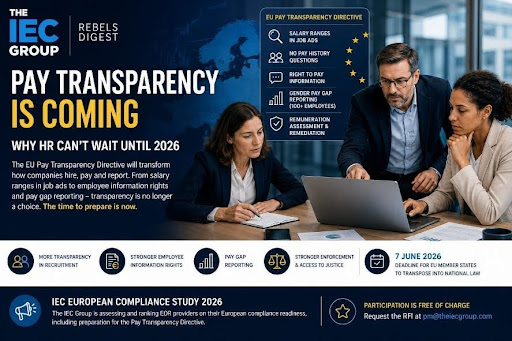
The EU Pay Transparency Directive requires EU Member States to transpose the rules into national law by 7 June 2026. Its purpose is to strengthen the principle of equal pay for equal work or work of equal value between women and men through pay transparency and stronger enforcement mechanisms. The European Commission summarizes the practical impact clearly: employers will need to give job seekers information about starting pay or pay ranges, stop asking about pay history, provide workers with information on individual and average pay levels for comparable work, publish gender pay gap information for employers with at least 100 employees, and carry out a pay assessment where reporting reveals an unjustified gender pay gap of at least 5%.
That is a serious change.
But the real challenge is not the legal text. The real challenge is the machinery behind it.
This Is Not Just About Publishing Salary Ranges
Many companies are treating pay transparency as if the main task is to decide whether salary ranges should appear in job advertisements.
That is a dangerous oversimplification.
Yes, salary-range transparency is important. Yes, job applicants will have stronger rights to understand pay before joining. Yes, employers will need to remove pay-history questions from recruitment processes. But those are only the visible parts of the iceberg.
The deeper issue is whether the organization can explain how pay is set in the first place.
What is the role? What level is it? What skills and responsibilities justify the salary? Which employees are doing the same work or work of equal value? What objective criteria explain differences? Are those criteria consistently applied across countries, business units, entities, managers, and worker populations?
That is where many companies will struggle.
Because in too many organizations, pay still reflects a messy combination of legacy decisions, negotiation power, market pressure, urgency, manager discretion, acquisitions, local habits, incomplete job architecture, and inconsistent promotion practices.
The Directive does not eliminate complexity. It exposes it.
HR Needs to Stop Thinking in Policies and Start Thinking in Evidence
For HR, this is the central shift.
The question is no longer: “Do we have a policy on equal pay?”
The question is: “Can we prove how pay decisions are made?”
That is a completely different standard.
A policy says what the company believes. Evidence shows what the company actually does.
Companies will need to show job architecture, salary bands, pay criteria, reporting logic, data quality, employee communication processes, recruitment controls, remediation procedures, and governance. They will need to explain how pay differences are justified. They will need to respond to employees who request information. They will need to understand which employee populations are in scope. They will need to prepare for national variations across Europe.
For multinational organizations, this becomes even more complicated. The Directive sets an EU minimum framework, but the operative rules will be implemented through national law. That means companies cannot prepare with one generic European checklist. They need a country-by-country view. The European Commission has confirmed that, following the transposition deadline of 7 June 2026, it will assess the conformity of national legislation with Directive 2023/970.
In other words: the EU sets the standard, but the compliance work happens locally.
That is exactly why HR must begin now.
The Ten Questions Companies Need to Answer
Every company with workers in the EU, or with operations that touch EU employment, should already be working through ten questions.
First: who is in scope?
Which entities, countries, employees, worker populations, applicants, subsidiaries, branches, and employment models are covered? Are employees hired through local entities? Through EOR arrangements? Through acquisitions? Through remote-work structures? Through international mobility programs?
Second: what is the country implementation status?
The Directive must be transposed into national law, but implementation will not be identical across Europe. Some countries will be faster. Some will be late. Some will go beyond the EU minimum. HR needs a live country tracker, not a one-off legal memo.
Third: can the company define equal work or work of equal value?
This is the heart of the Directive. If the organization cannot explain which roles are comparable, pay transparency becomes a risk multiplier.
Fourth: is the job architecture defensible?
Job titles are not enough. HR needs role levels, responsibility criteria, skill requirements, seniority logic, career paths, and compensation frameworks that can survive scrutiny.
Fifth: are salary ranges ready for recruitment transparency?
Companies need to know what range will be communicated, when it will be communicated, who owns it, and whether it is based on objective and gender-neutral criteria.
Sixth: have pay-history questions been removed?
Recruiters, hiring managers, agencies, interview scripts, applicant tracking systems, and compensation approval processes must all be checked. A policy is not enough if the practice continues informally.
Seventh: can employees request pay information and receive a proper answer?
Workers will have stronger rights to information about their own pay and average pay levels for categories of workers doing the same work or work of equal value. HR needs a process, data source, approval path, and response template.
Eighth: are HR, payroll, compensation, and people data systems ready?
Pay transparency compliance depends on data. If the data is fragmented, outdated, inconsistent, or impossible to compare, the company has a problem.
Ninth: what happens if an unjustified pay gap is found?
Remediation cannot be improvised. Companies need a process for analysis, explanation, correction, documentation, communication, and legal review.
Tenth: who owns compliance internally?
This cannot sit with HR alone. Legal, compensation, payroll, finance, data protection, DEI, works councils, country management, recruiters, and business leaders all have a role.
These questions are not theoretical. They are the readiness agenda.
Why HR Organizations Must Act Now
The biggest mistake companies can make is to wait until national laws are finalized.
Yes, national implementation matters. Yes, details will differ. Yes, legal teams will need to review local requirements. But most of the hard work does not depend on the final wording of national law.
Companies already know enough to start.
They can map scope. They can review job architecture. They can clean compensation data. They can identify missing salary bands. They can stop pay-history questions. They can train recruiters. They can review offer processes. They can assess employee information request capability. They can test reporting data. They can identify unexplained pay gaps. They can design governance.
Waiting until 2026 means compressing all of that into a legal panic.
And that will not work.
Pay transparency readiness is not a one-month project. It touches the foundations of people management: how jobs are designed, how salaries are set, how managers make decisions, how promotions are handled, how data is stored, how payroll systems connect to HR systems, how employees are categorized, and how the company explains itself when challenged.
For many HR organizations, the Directive will expose years of underinvestment in job architecture and compensation governance.
That is why the smart organizations are not asking, “What exactly will our country law say?”
They are asking, “Can we already prove that our pay system is fair?”
This Is a Governance Issue, Not a Communications Issue
Pay transparency is often misunderstood as a communications problem.
Should the salary range be shown in the job ad? How do we explain this to employees? What do we say if someone asks why they are paid less than a colleague? How do we avoid reputational damage?
Those questions matter. But they come too late.
Communication without governance is dangerous. If the underlying pay system is weak, transparency does not create trust. It creates exposure.
The governance questions are harder.
Who approves salary ranges? Who can make exceptions? Are exceptions documented? Are promotion increases consistent? Are market adjustments controlled? Are managers trained? Are acquisitions harmonized? Are remote roles treated consistently? Are bonuses included in analysis? Are benefits considered? Are part-time and full-time workers comparable? Are outsourced or EOR workers included in any analysis? Do country HR teams use the same criteria? Are works councils involved where required?
This is where HR leadership needs to move the discussion from “compliance project” to “operating model.”
The Directive is not simply asking companies to disclose more. It is pushing companies to manage pay better.
The Multinational Trap
For multinational companies, the risk is fragmentation.
One country team has salary bands. Another does not. One region has job levels. Another uses titles. One subsidiary has cleaned its HR data. Another still relies on spreadsheets. One recruiter has removed pay-history questions. Another still asks informally. One business unit has consistent promotion criteria. Another gives increases based on retention panic.
In normal times, this inconsistency is inefficient.
Under pay transparency, it becomes evidence risk.
Employees will have more visibility. Applicants will ask sharper questions. Works councils, unions, regulators, equality bodies, lawyers, and the media will have more material to work with. The burden of proof can shift. Penalties and compensation mechanisms become more relevant. The European Commission notes that the Directive strengthens access to justice, including compensation for workers who suffer gender pay discrimination and penalties set by Member States for breaches.
This is why HR cannot treat pay transparency as a local country issue only. It is both local and global.
Local, because the national rules matter.
Global, because the company’s pay philosophy, job architecture, data model, and governance need consistency.
The EOR and External Workforce Question
Even companies that do not directly employ every worker in Europe need to pay attention.
Modern workforce models are mixed. Companies use local subsidiaries, EOR providers, contractors, freelancers, consultants, staffing firms, and remote hiring structures. The Pay Transparency Directive is formally about employment relationships and applicants, but the operational reality is broader: companies influence pay decisions across multiple workforce channels.
This is especially relevant for EOR.
Where an EOR is the legal employer, the EOR will have direct employer obligations under the relevant national law. But the client company often defines the role, seniority, budget, salary range, hiring decision, performance expectations, and promotion logic. That means the client may hold critical information needed for compliance.
So HR needs to know: where do we use EOR? Who sets the salary band? Who communicates pay information to applicants? Who holds the data? Who responds to employee requests? Who owns remediation if a pay issue arises because of a client-side decision?
The same logic applies more broadly to workforce governance. Companies cannot separate “our employees” from “our workforce” without understanding where legal obligations and operational control overlap.
The End of Pay Opacity
The old pay model relied on opacity.
Employees did not know enough. Applicants did not ask enough. Managers had too much discretion. Companies had too little data. Pay differences could be explained vaguely or not at all.
That model is fading.
The new model is not perfect. It will be complex. It will be implemented unevenly across countries. It will create legal uncertainty. It will create administrative burden. It will create uncomfortable conversations. But it is coming.
And for HR leaders, the direction of travel is obvious: pay decisions must become more structured, more transparent, more explainable, and more evidence-based.
That is not only a compliance requirement. It is a leadership requirement.
Employees will increasingly judge organizations by whether they can explain fairness. Candidates will judge employers by whether they are transparent before hiring. Regulators will judge companies by whether they can produce evidence. Boards will judge HR by whether it saw the risk early enough.
The organizations that act now will turn compliance into trust.
The organizations that wait will turn transparency into crisis management.
IEC Rebel’s Take
The EU Pay Transparency Directive is not a paperwork exercise. It is a mirror.
It will show whether companies really understand their pay systems. It will show whether job architecture exists beyond PowerPoint. It will show whether salary bands are disciplined or decorative. It will show whether managers follow objective criteria or private habits. It will show whether HR data is fit for purpose. It will show whether multinational companies have real governance or just local improvisation.
And in the EOR market, it will show something else: which providers are genuinely prepared to support compliant employment in Europe — and which ones are still relying on the phrase “we are compliant.”
Announcement: IEC European Compliance Study 2026
To support greater transparency in the European workforce market, The IEC Group is launching the IEC European Compliance Study 2026.
The study will assess and rank EOR providers on their European employment compliance readiness, including their preparation for the EU Pay Transparency Directive, country-by-country employment compliance, contractor and freelancer classification controls, EOR operating models, payroll and social security controls, client–EOR responsibility allocation, auditability, and independent proof of compliance.
The purpose is simple: to identify which EOR providers are best prepared for the next phase of European workforce compliance — and which providers can prove their claims.
Participation for EOR providers is free of charge. Providers who wish to participate can request the RFI from:
Because in Europe, the future of compliance will not be decided by who says the right thing.
It will be decided by who can prove it.
Legal Framing:
The article uses the Directive’s core legal framing from the European Commission and EUR-Lex: pay-range information for job seekers, pay-history restrictions, employee information rights, pay-gap reporting for employers with at least 100 employees, joint pay assessment where an unjustified gap of at least 5% is found, compensation and penalties, and the 7 June 2026 national transposition deadline.
About the IEC Rebel’s Digest
We write for the ones breaking molds, building cross-border teams, and reshaping global work. No buzzwords. Just truths, tools, and tactics for the new era of employment.
IEC Rebel’s Digest— The IEC Group can help you audit your global employment setup by identifying labor leasing risks, verifying licensing requirements, and ensuring your EOR partners meet every compliance standard—before regulators come knocking.
Last but not Least: If you’re facing challenges and wondering how others are managing similar issues, why not join The Leadership Collective Community? It’s a peer group and webcast platform designed for leaders to exchange insights and experiences.
Introducing the IEC Knowledge Network Free Membership – Your Gateway to Seamless Access!
We are thrilled to present a new service that goes beyond the ordinary download experience. In addition to offering you the ability to download the things you love, we are delighted to introduce the IEC Knowledge Network Free Membership.
The Free Membership option grants you access to our library of articles and videos, without the need for tedious registrations for each piece of content.
The publication serves as a trusted resource to support executives in their pursuit of sustainable and successful global expansion. In addition the IEC Practitioners are available to discuss your specific challenge in more detail and to give you clear advise..
Take advantage of this valuable resource to accelerate your global expansion journey

