
The Global Trade Reality Check
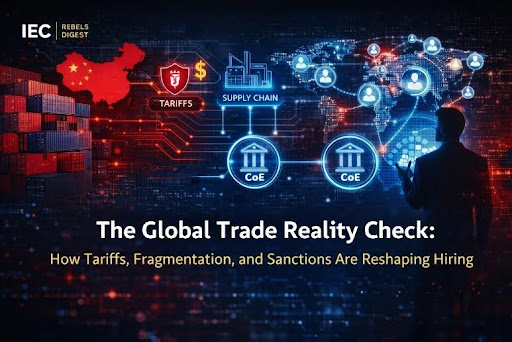
Introduction: How Tariffs, Fragmentation, and Sanctions Are Reshaping Hiring
 For a decade, globalization sold one core promise: optimize everything, everywhere.
Source from the cheapest location. Manufacture in the most efficient jurisdiction. Hire where talent is abundant and costs are favorable. Move money and data freely. Scale with minimal friction.
Then reality showed up.
Tariffs returned. Sanctions became structural. Export controls tightened. Supply chains broke. Shipping lanes became risk maps. And governments started caring—deeply—about where things are made, where data sits, and where people work.
This is the global trade reality check. And it’s quietly reshaping one of the most important business systems of all: how companies hire and organize talent across borders.
HR doesn’t drive trade policy. But HR lives with its consequences.
In 2026, global hiring strategy is increasingly shaped by forces that look more like geopolitics than People Ops: fragmentation, compliance, regional blocs, industrial policy, and the steady expansion of “restricted” categories—from chips to cloud services to dual-use tech.
That’s why this is not an HR article.
This is a strategy and operations article—with HR as the execution layer.
The Old Model: Globalization as a Cost Game
The classic globalization playbook was built on three assumptions:
- Trade is broadly open (or trending that way)
- Cross-border operations are mostly stable
- Labor is mobile and scalable
That model produced familiar outcomes:
- global manufacturing hubs
- centralized shared services
- multi-country hiring for cost optimization
- “follow-the-sun” teams
- aggressive outsourcing and contractor strategies
But as trade and policy shifted, companies started discovering a painful truth:
Workforce strategy is downstream of supply chain strategy.
And supply chain strategy is now deeply political.
The New Model: Fragmented Globalization
Today’s global economy isn’t deglobalizing. It’s reorganizing into fragmented globalization:
- multiple trade blocs
- strategic nearshoring
- controlled technology transfer
- local content requirements
- sanctions and restricted-party screening
- data localization and privacy regimes
- heightened scrutiny of cross-border employment and tax exposure
In this environment, “global hiring” doesn’t just mean “hire the best person anywhere.”
It increasingly means:
- hire where your supply chain and customers are moving
- hire where you can operate compliantly and predictably
- hire where risk is manageable
- hire where your entity footprint makes sense
- hire where your execution stack can handle complexity
This is where we see a direct line from tariffs and sanctions to EOR demand and global workforce redesign.
Tariffs → Supply Chain Redesign → Talent Relocation
Tariffs don’t just increase costs. They rewrite operating models.
When companies redesign supply chains, they usually trigger one of these shifts:
1) China+1 → Multi-hub manufacturing and operations
Even if a company retains China exposure, it often builds secondary hubs in:
- Vietnam, Thailand, Malaysia, Indonesia
- India (increasingly attractive for scale)
- Mexico (for US-adjacent production)
- Eastern Europe (for EU regional resilience)
Every new hub creates new needs:
- plant leadership
- QA / supply chain management
- regulatory and customs expertise
- finance controllers
- local HR operations
- IT security and infrastructure staff
And those hires need to happen fast—often before the entity exists.
2) Nearshoring → Regional operating centers
Nearshoring isn’t just factories. It includes:
- customer support
- engineering support
- shared services
- procurement
- compliance and documentation teams
When operations cluster regionally, talent follows—creating demand for a different global workforce architecture.
3) Dual sourcing → Distributed technical teams
If a company runs dual sourcing, it often needs parallel teams for:
- supplier management
- technical validation
- compliance documentation
- vendor risk
- local operations
That multiplies talent demand, often in the same regions.
The Rise of Centers of Excellence (CoEs): A Trade-Driven Workforce Shift
One of the most important outcomes of trade fragmentation is the rise (or rebirth) of Centers of Excellence.
CoEs are not a trendy HR idea. They’re a strategic response to risk.
Companies are consolidating critical capabilities into fewer, more controllable hubs:
- engineering and product CoEs
- cybersecurity CoEs
- compliance CoEs
- finance and reporting CoEs
- procurement and supply chain CoEs
- customer success CoEs
Why?
Because operating in many countries with scattered headcount creates:
- compliance overhead
- data complexity
- inconsistent execution
- local employment law exposure
- hidden tax and permanent establishment risk
- difficult governance
Trade pressure pushes organizations to simplify—and CoEs are simplification with leverage.
The talent implication
Instead of “hire a bit everywhere,” companies now often:
- choose 2–5 strategic hubs
- hire aggressively into those hubs
- connect the hubs via remote work (where possible)
- limit high-risk jurisdictions unless required
This creates a new global hiring map.
The Talent Map Is Shifting: LatAm, Africa, and “Neutral” Growth Markets
Fragmentation is reshaping which regions are “hot” for hiring.
Not just based on cost—but based on:
- political and trade alignment
- stability and predictability
- access to customers
- ability to scale quickly
- compliance feasibility
- time zone coverage
- infrastructure maturity
LatAm continues to rise
Nearshoring to the US, time zone alignment, and growing talent pools make LatAm increasingly strategic—not just “cheap.”
Africa moves from “future” to “now”
Africa’s tech ecosystems are maturing. Global companies are hiring in:
- software development
- customer support
- finance operations
- data labeling and ML operations
- regional sales and partnerships
But this growth often requires strong employment infrastructure and local compliance support—driving EOR demand.
APAC diversifies
APAC is not one market. It’s a portfolio:
- Southeast Asia for manufacturing-adjacent operations
- India for scale and tech talent
- Singapore for regional leadership
- Australia for high-compliance markets
- Japan for high-value market access (and high complexity)
The workforce strategy becomes “APAC nodes,” not “APAC as one strategy.”
What This Does to Entity Strategy
Trade fragmentation forces companies to rethink entities.
The old logic:
- “We set up entities where we have revenue.”
- “We hire contractors until we grow.”
- “We’ll fix it later.”
The new logic:
- “We need optionality.”
- “We need speed.”
- “We need compliance and auditability.”
- “We can’t afford hidden exposure.”
This leads to three common entity strategies:
1) Lean entity footprint + EOR for flexibility
Companies keep entities in core markets and use EOR for:
- pilot hiring
- scaling into new regions
- building CoEs quickly
- bridging M&A integration
- reducing time-to-hire
2) Hybrid: EOR first, entity later
EOR becomes the “entry ramp”:
- hire the initial team
- test demand and regulatory complexity
- build operational maturity
- establish entity only if justified
This is the most common model in uncertain markets.
3) Strategic entity build for control
In high-value or high-risk markets, companies invest in entities because:
- they need long-term commitment
- licensing and contracts require local presence
- the headcount is large enough to justify it
- customers and regulators expect it
Even here, EOR often supports interim hiring, transition teams, and early leadership.
Sanctions & Export Controls: The Workforce Impact Nobody Plans For
Sanctions are typically treated as a finance/legal issue.
But sanctions increasingly affect workforce planning.
Companies must consider:
- where employees are located
- where work is performed
- whether the work touches restricted technologies
- whether a worker’s nationality triggers export control requirements
- whether collaboration across borders creates compliance exposure
This is particularly true in:
- semiconductors
- cybersecurity
- AI and advanced compute
- aerospace and defense-adjacent industries
- cryptography and encryption
- cloud infrastructure
The result?
Companies may restrict hiring in certain regions not because of talent—but because of risk. They may relocate teams. They may centralize sensitive work in specific jurisdictions. They may split roles across regions.
This drives demand for:
- compliant hiring frameworks
- controlled access policies
- strong employment documentation
- clear entity strategy
- trusted workforce partners
Why EOR Demand Grows in a Fragmented World
EOR demand doesn’t rise only because companies want global hiring.
It rises because companies want global hiring without irreversible commitments.
In a fragmented trade environment, uncertainty is permanent. That creates demand for three EOR superpowers:
1) Speed without entity setup
When supply chain and trade decisions move fast, hiring must follow.
Entities take time. EOR can move now.
2) Compliance as infrastructure
Companies don’t have bandwidth to interpret labor law in 15 countries while also redesigning supply chains.
EOR becomes the compliance layer—if it’s real.
3) Flexibility under uncertainty
If a market becomes risky, an entity becomes a liability.
EOR can be scaled up or down with less structural lock-in—within legal boundaries.
This is why EOR becomes strategically attractive when global stability decreases.
The New EOR Buyer: Not Just HR
Here’s the shift: the EOR buyer is no longer only HR.
Trade fragmentation pulls in:
- Strategy and corporate development
- Supply chain and operations
- Finance and tax
- Legal and compliance
- IT and data security
- Procurement
EOR decisions now sit at the intersection of:
- operating model design
- risk management
- cost structure
- growth strategy
- geopolitical exposure
That’s why the EOR market is evolving into “global workforce infrastructure,” not just “employment outsourcing.”
The Next Competitive Battleground: Integration Into the HR Stack
In the old model, EOR could be a standalone tool.
In the new model, fragmentation forces governance and visibility.
Enterprises need:
- unified reporting across geographies
- compliance audit trails
- consistent policies
- standardized onboarding and access controls
- finance integration for cost allocation
- HRIS integration for lifecycle management
This drives demand for EOR providers that offer:
- APIs and integrations
- strong dashboards and analytics
- governance controls
- standardized global processes with local compliance execution
In short: EOR becomes part of the workforce system of record—whether providers like it or not.
What This Means for Providers: The Market Direction
Trade fragmentation is creating a new EOR competitive landscape.
Winners will be those who can prove:
- compliance depth (including licensing where required)
- partner governance and operational controls
- integration and API maturity
- country-specific excellence in high-growth regions
- scalability for CoE buildouts
- credible support for remote and distributed workforces
Losers will be those who rely on:
- headline country count without infrastructure
- weak partner oversight
- limited auditability
- inconsistent employee experience
- “AI” marketing without operational reality
As the buyer profile expands beyond HR, the bar rises fast.
The Rebel Conclusion: Hiring Strategy Is Now Geopolitics With Org Charts
Trade policy is rewriting the map of business.
Not slowly. Not politely. Not with a transition plan.
And workforce strategy is no longer insulated from these shifts. The reality is:
- tariffs reshape supply chains
- supply chains reshape operating models
- operating models reshape talent hubs
- talent hubs reshape entity strategy
- entity strategy drives EOR demand
This is why global employment is entering its infrastructure era.
In a fragmented world, the organizations that scale best won’t be the ones who “hire globally.” They’ll be the ones who hire globally with control, compliance, and flexibility—and who can reconfigure their workforce as the geopolitical landscape shifts.
That’s the global trade reality check.
And it’s already reshaping hiring.
Want to build trust through independent validation?
If you want to learn more about IEC Audit & Certification—and how independent audits can strengthen compliance maturity, procurement confidence, and continuous improvement—reach out to: pm@theiecgroup.com
Free participation: EOR Study 2026
Provider participation is free of charge for qualified companies. If you want to ensure your offering is correctly positioned and represented in the market, contact:
pm@theiecgroup.com See you in the study. —The IEC Rebels Digest Team
Why This Matters for the IEC Global EOR Study 2026
 This is not just a market commentary. It’s the exact reason the IEC Global EOR Study 2026 is structured the way it is.
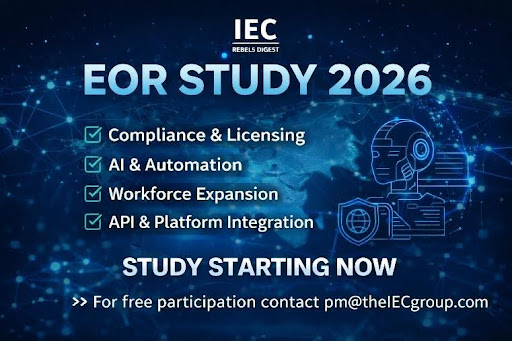
The study will assess providers across eight evaluation categories that reflect the compliance stack reality:
- Global Reach & Legal Infrastructure
- Compliance & Licensing Depth
- Tech Stack & Platform Maturity
- AI & Process Automation
- Client Experience (CX)
- Employee Experience (EX)
- Integration & API Coverage
- Innovation & Market Differentiation
And yes—there will be visibility into who ranks strongest across these categories, alongside insights into rising disruptors and the strategic direction of the market.
Because in 2026, “EOR provider” is not a uniform label. The gap between providers is widening—and the winners will be those who can prove compliance as infrastructure, not claim it as a feature.
A Final Reality Check
Global workforce management is no longer just about hiring talent abroad. It’s about building a defensible employment operating model across legal regimes—and doing it with speed, transparency, and integration.
That is a regulated product challenge.
And that’s why the EOR market is heading toward a compliance-led shakeout.
The platforms that win won’t simply help companies hire globally. They will help companies stand up to scrutiny globally.
About the IEC Rebel’s Digest
We write for the ones breaking molds, building cross-border teams, and reshaping global work. No buzzwords. Just truths, tools, and tactics for the new era of employment.
IEC Rebel’s Digest— The IEC Group can help you audit your global employment setup by identifying labor leasing risks, verifying licensing requirements, and ensuring your EOR partners meet every compliance standard—before regulators come knocking.
Last but not Least: If you’re facing challenges and wondering how others are managing similar issues, why not join The Leadership Collective Community? It’s a peer group and webcast platform designed for leaders to exchange insights and experiences.
Introducing the IEC Knowledge Network Free Membership – Your Gateway to Seamless Access!
We are thrilled to present a new service that goes beyond the ordinary download experience. In addition to offering you the ability to download the things you love, we are delighted to introduce the IEC Knowledge Network Free Membership.
The Free Membership option grants you access to our library of articles and videos, without the need for tedious registrations for each piece of content.
The publication serves as a trusted resource to support executives in their pursuit of sustainable and successful global expansion. In addition the IEC Practitioners are available to discuss your specific challenge in more detail and to give you clear advise..
Take advantage of this valuable resource to accelerate your global expansion journey

