
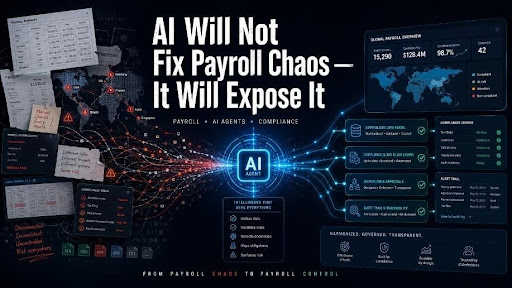
AI Will Not Fix Payroll Chaos — It Will Expose It
Payroll, AI Agents & Compliance: The Rebellion Against Payroll Fragmentation
 The payroll mess nobody wants to admit
Payroll has always had a strange status inside global enterprises.
It is critical, but rarely celebrated.
It is complex, but often underfunded.
It touches every employee, but is still treated as “admin.”
It can trigger legal, tax, reputational and employee-trust disasters, but somehow it is still expected to run on spreadsheets, local heroics, vendor workarounds and a monthly miracle.
And now everyone wants to add AI.
Brilliant.
Because nothing says “future of work” like asking an AI agent to navigate twenty-seven payroll systems, fourteen local vendors, inconsistent HR data, missing time inputs, different cut-off calendars, country-specific statutory rules, shadow spreadsheets and a compliance process held together by Sandra from Finance, who is currently on holiday.
The uncomfortable truth: global payroll is not ready for AI everywhere. But AI is exactly the pressure that will force payroll to grow up.
The market is changing from payroll as a processing function to payroll as an operating and compliance intelligence layer. The old question was: “Did we pay people correctly?” The new question is: “Can we continuously prove that every employment, pay, tax, time, benefit and reporting obligation is correct, compliant, auditable and explainable?”
That is a very different game.
- The data says what payroll teams already know
The global payroll landscape is fragmented. Not slightly fragmented. Structurally fragmented.
PayrollOrg’s 2025 “Getting the World Paid” survey found that more than 36% of respondents manage payroll in six or more countries, and 7% manage payroll in 51 or more countries. The same report says 86% of respondents use a global HRIS as the system of record for employees, but payroll itself is far less unified. While 52% say they process payroll in one global system, the report notes that many of those are mainly operating in only one to five countries, especially the US and Canada; the 48% without a single global payroll system are typically the ones paying employees in six or more countries.
That is the real enterprise problem: the bigger the footprint, the less elegant the model.
The same PayrollOrg survey shows that only 28% of organisations have a formalised global payroll strategy, 30% are still working on one, and 42% have not started. In other words: many companies operate global payroll, but do not yet manage global payroll as a strategic global capability.
Even companies that use a global payroll provider often do not have a clean model. PayrollOrg reports that, among the 33% using a global payroll provider, more than 26% still use an additional two to five providers to cover parts of their footprint. The most common reality is hybrid: a mix of in-house, outsourced, global provider and in-country provider models.
This is the market in one sentence: global payroll has global ambition, but local plumbing.
- Why enterprises ended up with so many payroll systems
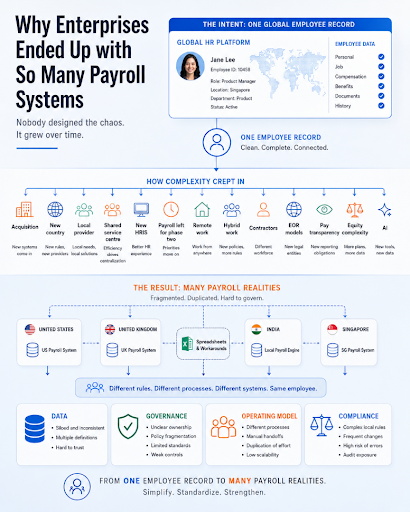 Nobody woke up one morning and said, “Let’s create an unmanageable payroll ecosystem.”
It happened naturally.
A company acquired another company.
A new country opened.
A local team selected a local provider.
A shared service centre was created.
A new HRIS was implemented, but payroll was left for “phase two.”
Phase two never came.
Then came remote work.
Then hybrid work.
Then contractors.
Then employer-of-record models.
Then pay transparency.
Then equity complexity.
Then AI.
And here we are.
Large enterprises often have a beautiful global HR system on the front end and a swamp of local payroll engines on the back end. HR believes the company has one employee record. Payroll knows the truth: one record becomes many realities once it hits time, tax, benefits, absence, local allowances, statutory deductions, collective agreements and reporting obligations.
That is why payroll complexity is not only a technology problem. It is a data, governance, operating model and compliance problem.
Deloitte’s 2024 payroll benchmarking work focused specifically on large and mega-enterprise companies with 25,000 to 240,000 active employees. That focus matters because the complexity at that scale is not about running payroll; it is about controlling an ecosystem.
And ecosystem control is precisely where many organisations are weakest.
- The hidden cost: fragmentation kills visibility
Fragmented payroll does not only create operational pain. It destroys visibility.
When payroll is split across many systems and providers, leaders struggle to answer basic questions quickly:
How many people are we paying globally?
What is total employer cost by country?
Where are the recurring payroll corrections?
Which countries have the most supplemental runs?
Which vendors are creating delays?
Where are we exposed to compliance risk?
Which pay elements are inconsistent?
Where are allowances, bonuses or benefits handled manually?
Which controls are preventive, and which are just detective theatre after the fact?
In a fragmented model, the answer is often: “We can find out, but it will take time.”
That answer is dying.
Boards, regulators, employees and finance teams increasingly expect payroll data to be available, accurate and explainable. CloudPay’s 2024 Global Payroll Efficiency Index argues that multinational companies need better payroll metrics to benchmark and optimise payroll performance and cost; its fifth edition was based on data from more than one million payslips across AMER, APAC and EMEA.
That is where the market is going: from payroll processing to payroll intelligence.
- Compliance: the real battlefield
Payroll technology vendors like to talk about automation. Buyers like to talk about efficiency. Consultants like to talk about transformation.
But the battlefield is compliance.
EY’s payroll research with GPMI found that 75% of respondents identify accuracy and compliance as top priorities for the next three years. EY also notes that accuracy and compliance, while considered table stakes, are still seen as major obstacles to achieving the desired payroll experience for employees and internal stakeholders.
That is a polite way of saying: the basics are still hard.
And they are getting harder.
Every country has its own payroll logic: tax, social security, statutory benefits, reporting requirements, payslip rules, pension obligations, sick pay, maternity or parental leave, termination payments, garnishments, unions, collective bargaining agreements, working-time obligations, data privacy rules and penalties.
PwC’s Global Payroll Complexity Index assessed payroll complexity across more than 50 countries and ranked 40 countries by relative complexity. PwC’s report highlights that payroll complexity is driven not only by payroll rules themselves, but also by evolving regulations and penalties for non-compliance.
Now add AI regulation, pay transparency, cross-border remote work and increasing government digitisation.
The result is clear: payroll compliance is moving from periodic checking to continuous control.
- AI agents enter the building
AI in payroll will not be one thing. It will come in layers.
First, AI will explain.
“Why is my net pay different this month?”
“What does this deduction mean?”
“Which payroll inputs are still missing?”
“What changed in this country’s legislation?”
Then AI will detect.
“This employee’s net pay moved outside the normal range.”
“This bonus looks inconsistent with policy.”
“This country has a higher correction rate.”
“This pay element is mapped differently across regions.”
Then AI will recommend.
“Review these ten cases before approval.”
“Update this workflow.”
“Check this local tax rule.”
“Escalate this exception.”
Then AI will act.
It will open cases, route tasks, draft responses, reconcile files, prepare audit packs, compare vendor outputs and monitor cut-off risk.
That is where payroll becomes agentic.
But payroll agents cannot be treated like generic productivity bots. A payroll AI agent operates in a high-risk environment. It touches compensation, tax, employment rights, employee trust and legal obligations. The standard cannot be “the answer sounds plausible.” The standard must be “the answer is correct, sourced, permissioned, logged and auditable.”
This is why the next payroll market will not be won by the loudest AI claim. It will be won by the strongest governance model.
- The offering is changing: from payroll engine to control tower
The old payroll offer was simple:
“We process your payroll.”
The new offer is different:
“We help you control employment-related pay, compliance, data, risk and employee experience across countries.”
That means the market is moving toward five connected layers.
Layer 1: Execution
Pay people accurately, on time, in the right currency, with the right taxes, deductions, benefits and filings.
Still essential. Still hard. Still non-negotiable.
Layer 2: Integration
Payroll cannot be better than its inputs. HR, time, absence, benefits, compensation, equity, finance and vendor data must connect cleanly.
The most dangerous payroll error is often born upstream.
Layer 3: Compliance intelligence
Companies need to know what changed, where, who is affected, what must be done, when it must be done and what evidence proves it was done.
Compliance can no longer live only in local inboxes and PDF newsletters.
Layer 4: AI and automation
AI should remove noise, detect risk, accelerate responses and support payroll teams. But it must operate inside defined workflows, permissions, controls and escalation paths.
No cowboy agents in payroll.
Layer 5: Assurance
This is the layer many vendors underplay. But it will matter most.
Who approved the calculation?
Which data source was used?
What rule was applied?
Was there human review?
Was the exception resolved?
Can we prove it six months later?
In the future, the audit trail is not a by-product. It is part of the product.
- Why “one global payroll system” is not always the full answer
There is a seductive idea in the market: one global payroll system to rule them all.
Nice idea. Complicated reality.
Some countries are too complex. Some local providers are deeply embedded. Some payrolls are too small to justify full migration. Some regulations change too quickly. Some legacy systems are tied to collective agreements, finance processes or statutory filing mechanisms. Some acquisitions make standardisation a moving target.
So the future may not be one system everywhere.
The future is one governance layer everywhere.
That is an important distinction.
Enterprises may still use multiple engines, local providers or hybrid service models. But they need one global view of data, controls, process status, risk, cost, service quality and compliance evidence.
The payroll engine calculates.
The governance layer controls.
The intelligence layer explains.
The agent layer acts.
The assurance layer proves.
That is the architecture that can survive reality.
- What must change now
The payroll market is not waiting. Vendors are already repositioning around AI, global payroll platforms, managed services, compliance, analytics and employee experience. But buyers must also change.
Here is the hard truth: buying new technology will not fix a broken operating model.
Before AI agents can safely help payroll, companies must clean the foundation.
They need a global payroll strategy. PayrollOrg’s finding that only 28% of organisations have a formalised global payroll strategy should be a wake-up call.
They need standardisation. PayrollOrg reports that only 19% to 20% of respondents achieve the aspirational 80%-plus standardisation level for policies, procedures and processes, and warns that lower levels of standardisation make scalability and governance harder.
They need better talent models. The same report says 74% find global payroll talent difficult to find, either generally or depending on location.
They need cleaner data ownership. HR cannot throw data over the wall. Finance cannot treat payroll as a black box. Legal cannot appear only when something burns. Payroll must become an integrated control function between HR, Finance, Legal, Tax, IT and Compliance.
Most importantly, they need courage to simplify.
Because complexity has a lobby. Every local exception has a defender. Every legacy process has a story. Every manual workaround has a person who says, “We’ve always done it this way.”
The rebel move is to ask: “Should we?”
- Where this leads us
Payroll is becoming one of the most strategic data and compliance functions in the enterprise.
Not because payroll asked for fame.
Because the world made payroll unavoidable.
Pay transparency makes compensation data visible.
AI regulation makes automated decisions risky.
Remote work makes tax and social security more complex.
Global hiring makes local compliance harder.
Employees expect consumer-grade answers.
Finance wants real-time labour cost insight.
Regulators want evidence.
Boards want risk control.
So payroll can no longer be a monthly processing ritual.
It must become a continuous trust infrastructure.
That means the future payroll function will look very different. It will have fewer manual reconciliations and more exception intelligence. Fewer country silos and more global governance. Fewer hidden spreadsheets and more controlled data flows. Fewer reactive audits and more continuous assurance. Fewer “ask the local provider” moments and more transparent rule management.
And yes, more AI agents.
But the good ones will not replace payroll professionals. They will make weak payroll models visible and strong payroll teams more powerful.
The payroll professional of the future is not just a processor. They are a data steward, compliance translator, risk manager, automation designer, vendor controller and employee-trust guardian.
That is not a downgrade.
That is the promotion payroll has been waiting for.
- The Rebel’s conclusion
The market is moving from fragmented payroll delivery to governed payroll intelligence.
The old world was: many systems, many providers, many spreadsheets, many local exceptions, limited visibility.
The new world must be: connected data, standardised controls, local compliance intelligence, AI-assisted operations, global visibility and evidence by design.
Enterprises do not need “AI payroll” as a slogan.
They need payroll that is ready for AI.
That means clean data, clear ownership, documented rules, controlled integrations, standardised processes, human oversight and auditable decisions.
Otherwise, AI will not transform payroll. It will simply automate the chaos.
Payroll used to be the function that closed the month.
Now it must become the function that tells the enterprise whether its workforce model is legal, fair, affordable, compliant and trusted.
That is where the market is going.
And honestly?
It is about time.
About the IEC Rebel’s Digest
We write for the ones breaking molds, building cross-border teams, and reshaping global work. No buzzwords. Just truths, tools, and tactics for the new era of employment.
IEC Rebel’s Digest— The IEC Group can help you audit your global employment setup by identifying labor leasing risks, verifying licensing requirements, and ensuring your EOR partners meet every compliance standard—before regulators come knocking.
Last but not Least: If you’re facing challenges and wondering how others are managing similar issues, why not join The Leadership Collective Community? It’s a peer group and webcast platform designed for leaders to exchange insights and experiences.
Introducing the IEC Knowledge Network Free Membership – Your Gateway to Seamless Access!
We are thrilled to present a new service that goes beyond the ordinary download experience. In addition to offering you the ability to download the things you love, we are delighted to introduce the IEC Knowledge Network Free Membership.
The Free Membership option grants you access to our library of articles and videos, without the need for tedious registrations for each piece of content.
The publication serves as a trusted resource to support executives in their pursuit of sustainable and successful global expansion. In addition the IEC Practitioners are available to discuss your specific challenge in more detail and to give you clear advise..
Take advantage of this valuable resource to accelerate your global expansion journey

