

The next question after The Global Talent Hunt is not who can find the AI Architect. It is where the wider AI bench actually lives.
 In the first article, The Global Talent Hunt, the argument was that complex AI hiring is no longer a simple recruiting exercise. It is a global talent access challenge. This follow-on takes the next logical step: if the scarce strategic hire is the AI Architect, where should companies look for the broader AI bench — the programmers, ML engineers, data engineers, AI implementation specialists, and flexible technical capacity that turn strategy into execution?
The answer is not one country. Nor is it “find the cheapest programmers.” The market has become more nuanced. Employers expect 39% of workers’ core skills to change by 2030, with AI and big data among the fastest-growing skill areas, while global hiring data points to a rising use of contractors and consultants rather than pure full-time hiring. The practical question is therefore not only where talent is cheapest, but where it is good, scalable, deployable, and suited to the role.
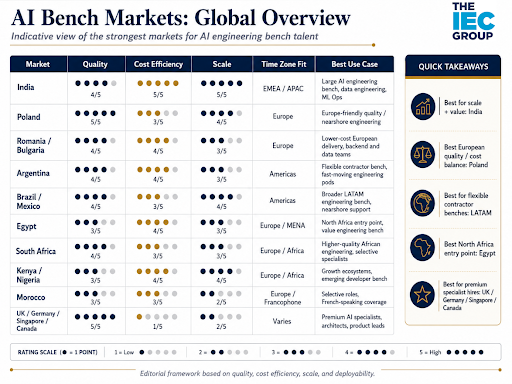
The strongest conclusion is this: for AI bench talent, companies should think in regional portfolios, not single-country bets. India remains the best market for scale and cost efficiency. Poland leads for Europe-friendly quality. LATAM is increasingly attractive for flexible contractor-heavy benches. And Africa — especially Egypt and South Africa, with Kenya and Nigeria rising — is more credible than many buyers assume.
- The AI bench is not the AI Architect
Too many companies still treat all AI hiring as one category. That is a mistake.
The AI Architect is usually a rare, strategic hire: expensive, senior, and often best sourced through global search. The AI bench is different. It is the execution layer: engineers who can build data pipelines, integrate models, work on ML ops, tune infrastructure, productionize use cases, and support bursts of delivery as the product roadmap evolves.
That distinction matters because the sourcing logic is different. For the AI Architect, employers should prioritize precision. For the bench, the real question is where to find the best balance of quality, cost, scale, timezone fit, and flexibility.
This is also why the labor model matters more than many talent teams admit. Oyster’s 2025 Global Hiring Trends & Impact Report found a 46% increase in new contractor engagements from 2023 to 2024, while the number of new full-time hires dipped slightly, and consulting hires increased sharply. That is a signal that more companies are solving capability gaps with flexible, expertise-on-demand structures rather than trying to force every capability into permanent headcount.
So the first principle is simple: do not search for the AI bench the same way you search for the AI leader.
- What changed: why the search for the bench went global
Three forces are driving this shift.
First, the skills are moving faster than job descriptions. The World Economic Forum says AI and big data are the fastest-growing skill category through 2030, and employers expect 39% of core skills to change by then. That makes static hiring models weaker, because role definitions age quickly.
Second, the bench is often fragmented across geographies. The right AI implementation talent may not be where the company is headquartered, and it may not even be where the best strategic AI leadership sits. CBRE’s Global Tech Talent Guidebook says AI development talent is concentrated most heavily in the U.S. and India, with demand growing fastest in Poland, the U.S., and Germany, and notes that Bengaluru has the most AI-related professionals among the markets it tracks.
Third, the market is shifting toward flexible capacity. Deel’s 2025 State of Global Compensation Report says contractor hiring is booming in Argentina, Mexico, and Brazil, while markets such as the U.S. and Germany remain more full-time-heavy. That matters because for the AI bench, flexibility is often a feature, not a compromise.
That combination changes the buyer’s question. The question is no longer “where is tech talent?” The question is: which market is best for which type of AI bench role?
- India remains the scale play
If the objective is to build a large, affordable, technically capable AI bench, India still sits at the top of the list.
The reason is not hype. It is scale. GitHub’s 2024 Octoverse says India is one of the fastest-growing developer ecosystems and is expected to have the world’s largest developer population on GitHub by 2028. CBRE’s 2025 guidebook adds that AI development talent is concentrated most strongly in the U.S. and India, and that Bengaluru has the most AI-related professionals among tracked markets.
For the AI bench, that makes India the best option for:
- AI engineering scale
- data engineering and pipeline work
- ML ops and productionization
- implementation-heavy delivery
- cost-conscious growth builds
The caution is equally clear. India is not one homogeneous market. The breadth is a strength, but it also means quality variation is wider. Screening, technical assessment, and role segmentation matter much more than in smaller or more mature nearshore markets. The buyer who says “let’s hire in India because it’s cheap” is likely to be disappointed. The buyer who says “let’s use India for the right layers of the bench, with disciplined evaluation” is much more likely to succeed.
The right conclusion is not that India is universally best. It is that India is the strongest scale-and-value anchor in a multi-market AI bench strategy.
- Poland is the quality-nearshore play for Europe
If India is the scale play, Poland is the most credible Europe-based quality/cost tradeoff.
CBRE’s 2025 guidebook says demand for AI talent is growing fastest in Poland, the U.S., and Germany. That matters because it signals both relevance and momentum. Poland is not the cheapest market in Europe, but it offers something many buyers care about more: strong engineering capability, better timezone alignment for European firms, and a more predictable delivery environment.
For the AI bench, Poland is best used for:
- higher-consistency engineering teams
- backend, data, and ML engineering
- product-adjacent engineering roles
- nearshore support for Europe-based product and commercial teams
The trade-off is obvious: Poland is not bargain-basement hiring. But that is precisely why it works. It is a quality market that still makes economic sense, especially compared with Western Europe, the U.K., or North America. For Europe-based firms trying to avoid the complexity of distant offshore models, Poland is often the cleanest first stop.
Romania and Bulgaria belong in the same broader conversation. They do not have Poland’s market momentum, but they remain relevant as lower-cost European delivery options for selected engineering roles.
- LATAM is the flexible bench play
If the requirement is not only talent, but agility, then LATAM becomes much more interesting.
Deel’s 2025 State of Global Compensation Report says contractor hiring is booming in Argentina, Mexico, and Brazil. That single datapoint is strategically important, because it suggests these markets are increasingly suited to companies that want a flexible engineering bench rather than only full-time permanent teams.
This makes LATAM attractive for:
- contractor-heavy engineering pods
- burst capacity around product releases
- nearshore teams for North American buyers
- product engineering with better working-hour overlap
- flexible deployment models where speed matters
Each market serves a slightly different purpose. Argentina is especially interesting for high-value contractor benches. Brazil offers greater scale. Mexico adds proximity and operating convenience for U.S.-centric teams. Taken together, the region works well when the company needs deployable capacity with decent quality and good timezone fit, not just lower cost.
The key insight is that LATAM is not simply “cheaper America.” It is increasingly a contractor-rich, flexible bench region, and that matters a great deal for AI delivery models where workload volatility is high.
- Africa deserves a more serious look
Africa is still underused in many global talent strategies, and that is beginning to look outdated.
The AI Talent Readiness Index for Africa 2025 shows that readiness is uneven across the continent, but it also makes clear that there are credible markets emerging. South Africa ranks at or near the top of the continent depending on the source summary, while Egypt consistently appears among the strongest performers, and Morocco, Kenya, and Nigeria all matter for different reasons.
For buyers, the most useful segmentation is this:
Egypt is the best North African starting point. It offers a better combination of value, regional relevance, and ecosystem maturity than many buyers assume. For Europe and MENA-linked firms, it is especially interesting.
South Africa is the strongest premium African market. It is not the cheapest, but it is one of the best choices on the continent for quality, maturity, and reliability.
Kenya and Nigeria are growth stories. GitHub’s Octoverse highlights Africa and notes strong developer growth in regions including Africa, while external summaries continue to identify Kenya and Nigeria as part of the continent’s more dynamic tech ecosystems. These markets are highly relevant for long-term pipeline building and selective sourcing, even if they are less obvious first choices for a deep specialist AI bench today.
Morocco is more selective. It is attractive for French-language, Europe-adjacent, and specific delivery needs, but it is not yet the first market to build a large AI bench.
The main point is this: Africa should not be treated as a fringe option. It should be treated as a portfolio of emerging and selective AI bench markets, especially for firms willing to do proper market mapping rather than rely on lazy assumptions.
- Do not optimize only for cheap
This is where many talent strategies go wrong.
The question “where can I find good and cheap programmers?” is understandable, but incomplete. Cheap is useful only if the talent is also deployable. And deployable means more than technical ability. It means workable communication, enough maturity for distributed teams, fit with the product cadence, and a labor model that the company can actually use.
That is why the strongest AI bench strategies are rarely single-country bets. They are usually layered:
- use one market for scale,
- another for quality and product alignment,
- another for flexible contractor capacity,
- and premium markets only for the rarest specialists.
That is also why the buyer should think in bench architecture, not only talent sourcing. A good AI bench strategy might look like this:
- India for large-scale engineering throughput,
- Poland for Europe-friendly, higher-consistency engineering,
- LATAM for flexible contractor pods,
- Egypt or South Africa for selective African capacity,
- premium markets for the few specialist or leadership-heavy roles.
That is more complex than “find cheap engineers,” but it is also much closer to how global winners are actually building capability.
- So where should companies look first?
For companies building an AI bench, the practical ranking looks like this.
First, start with India if scale and cost efficiency are central. It remains the strongest overall market for broad AI bench capacity.
Second, start with Poland if the company is Europe-based and wants the cleanest balance of quality, timezone fit, and economic logic.
Third, use Argentina, Brazil, and Mexico if flexible contractor-heavy capacity is the priority, particularly for U.S.-adjacent teams.
Fourth, include Egypt and South Africa in the search if Africa is relevant to the footprint or if the company wants to diversify its sourcing strategy. Egypt is the better value play; South Africa is the stronger quality play.
Fifth, use Morocco, Kenya, and Nigeria selectively rather than as default first-stop markets. They are real options, but they reward targeted use more than broad-brush hiring strategies.
Bottom line
The follow-on question after The Global Talent Hunt is not “who can find me the AI Architect?” It is “where does the broader AI bench actually sit?”
The answer is that the AI bench is now global by design.
India remains the strongest market for scale and value. Poland is the best Europe-friendly quality play. LATAM is increasingly the best region for flexible contractor-heavy bench models. Africa — especially Egypt and South Africa, with Kenya and Nigeria rising — is more relevant than most legacy talent strategies assume.
The bigger lesson is this: companies should stop looking for one country that solves everything. The smarter strategy is to build a regional portfolio of bench markets aligned to role type, cost tolerance, timezone needs, and delivery model.
That is the real evolution in global hiring.
The winners will not be the firms that ask where programmers are cheapest. They will be the ones that understand where different types of AI bench talent are best sourced, best deployed, and best managed — and that build their talent strategy accordingly.
About the IEC Rebel’s Digest
We write for the ones breaking molds, building cross-border teams, and reshaping global work. No buzzwords. Just truths, tools, and tactics for the new era of employment.
IEC Rebel’s Digest— The IEC Group can help you audit your global employment setup by identifying labor leasing risks, verifying licensing requirements, and ensuring your EOR partners meet every compliance standard—before regulators come knocking.
Last but not Least: If you’re facing challenges and wondering how others are managing similar issues, why not join The Leadership Collective Community? It’s a peer group and webcast platform designed for leaders to exchange insights and experiences.
Introducing the IEC Knowledge Network Free Membership – Your Gateway to Seamless Access!
We are thrilled to present a new service that goes beyond the ordinary download experience. In addition to offering you the ability to download the things you love, we are delighted to introduce the IEC Knowledge Network Free Membership.
The Free Membership option grants you access to our library of articles and videos, without the need for tedious registrations for each piece of content.
The publication serves as a trusted resource to support executives in their pursuit of sustainable and successful global expansion. In addition the IEC Practitioners are available to discuss your specific challenge in more detail and to give you clear advise..
Take advantage of this valuable resource to accelerate your global expansion journey

