
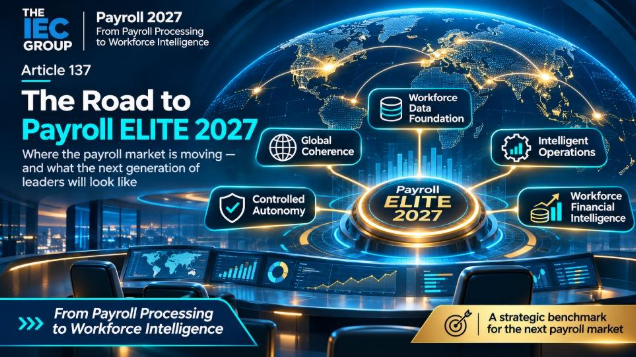
Where the payroll market is moving — and what the next generation of leaders will look like
The Payroll 2027 research has reached an interesting stage. Article 135 explored what the evidence is beginning to tell us. Article 136 explained how IEC will separate scale, market adoption and genuine Workforce Intelligence.
But perhaps the most important question is still ahead: Where is the market actually going?
More than 100 payroll and workforce-technology providers were considered at the beginning of the research. Thirty currently lead the race for 25 places in IEC Payroll ELITE 2027.
Yet the real significance of the final positioning will not be who finishes a few places ahead of whom. It will be whether we can see which providers are moving toward the operating model enterprises are likely to need next. Because something bigger than vendor rankings is happening.
Payroll is gradually moving from being an administrative process to becoming part of the intelligence infrastructure around the economics of work.
And that changes almost everything.
Payroll is moving beyond payroll
For decades, the objective was relatively straightforward.
Calculate people correctly. Pay them on time. Remain compliant.
Do it efficiently and reliably across as many countries as possible.
Those requirements are not disappearing. They remain the foundation of payroll.
But they are no longer the destination. Enterprises increasingly want payroll to help answer questions such as:
- Why are workforce costs changing?
- Where are labor costs deviating from plan?
- Which payroll anomalies indicate a broader operational problem?
- What will overtime, bonus, absence or headcount decisions mean for future cost?
- Where is compliance risk emerging?
- What action should management take before those issues reach payroll close?
That moves payroll into a much larger management conversation. The future payroll platform is therefore unlikely to be judged only by how efficiently it calculates the past.
It will increasingly be judged by how effectively it helps an enterprise understand and influence what happens next.
Strategic value is moving upward from the engine
The payroll engine remains indispensable. But the competitive value around it is changing.
Think of the emerging payroll architecture as three broad layers.
- At the bottom sits execution: gross-to-net calculation, statutory logic, local compliance and payments.
- Above it sits control and orchestration: data collection, validation, workflow, approvals, provider coordination, reconciliation and global visibility.
- Above that is the emerging intelligence and action layer: understanding what happened, why it happened, what may happen next and what should be done about it.
Historically, enormous strategic value sat in owning the engine. Increasingly, value may also sit in controlling the layers above it. That creates opportunities for very different companies.
Global payroll providers can extend upward.
HCM providers can move downward from workforce context.
Global employment platforms can combine employment, payroll and payments.
Orchestration providers can create global control without necessarily replacing local engines.
There may therefore be more than one winning architecture. But the strategic destination is increasingly similar: The winners will make the complexity underneath payroll less visible while making the intelligence above it more valuable.
Global coverage is becoming global coherence
This may be one of the most important changes in how providers compete.
For years, country coverage was a powerful differentiator. 100 countries. 150 countries. 180 countries.
Those numbers still matter. But the next competitive question is becoming more demanding:
Do those countries operate as one environment?
An enterprise does not ultimately want 100 payrolls. It wants one global understanding of 100 payrolls.
That means common data definitions, consistent controls, unified workflow, comparable reporting and eventually intelligence that works regardless of which country or engine generated the underlying transaction.
The future winner may therefore not necessarily be the provider with the largest country number. It may be the provider that creates the greatest global coherence. This is a fundamental shift.
The market is moving from:
Global coverage toward: Global control + global data + global intelligence.
The data model may become the new payroll moat
AI receives most of the attention. But one of the strongest conclusions emerging from Payroll 2027 is that the more strategic asset may sit underneath it. The data.
Payroll information becomes significantly more valuable when it can be understood alongside time, attendance, workforce structure, compensation, benefits, finance, payments and planning.
The challenge is not merely bringing those datasets together. It is giving them common meaning.
That requires normalization. Context. History. Relationships between workforce events.
And an architecture that allows intelligence to understand what changed and why.
This is where the next generation of platforms may begin to create a significant competitive moat.
The provider with the best AI interface will not necessarily win.
The provider whose AI has the best context might.
AI is moving from interface to operating model
The first wave of payroll AI has largely been about assistance.
Ask a question. Retrieve information. Explain something. Identify a variance.
Those capabilities are useful, but they are only the beginning.
The market is already moving toward systems that continuously monitor payroll rather than waiting for somebody to ask a question.
The progression is becoming increasingly clear:
Assist → Detect → Diagnose → Predict → Recommend → Act.
That changes AI from a user feature into part of the payroll operating model itself. The end state is unlikely to be “human-free payroll”. It is more likely to be exception-driven payroll.
Normal transactions flow automatically. Technology identifies what deserves attention. Intelligence investigates it. Low-risk situations can increasingly be handled automatically. Higher-risk events reach a payroll professional with the explanation and context already assembled.
This creates a radically different productivity equation. The next competitive KPI may therefore not be how many AI capabilities a provider offers. It may be:
How much unnecessary human intervention has the platform eliminated?
Controlled autonomy could become a defining capability
As payroll becomes more autonomous, governance becomes more important rather than less.
A system that recommends an action needs explainability.
A system that changes payroll data needs permissions.
A system that initiates payments needs controls.
The companies moving furthest toward autonomous payroll will therefore also need sophisticated governance architectures.
- Confidence thresholds.
- Approval rules.
- Audit trails.
- Source traceability.
- Role-based authority.
- Human escalation.
The market is unlikely to reward automation without accountability. The more powerful model is controlled autonomy. This may become particularly important to large enterprises, where the ability to trust automation will determine how much automation can actually be deployed. The future leader may therefore not be the provider whose AI can theoretically do the most.
It may be the provider whose AI the enterprise is willing to allow to do the most.
Payroll is becoming part of workforce financial intelligence
Perhaps the largest strategic opportunity sits beyond payroll operations altogether. Payroll contains one of the richest datasets in the enterprise. It shows what an organization actually spends on people.
Not annual compensation assumptions. Not planned headcount. Actual labor economics.
- Salary.
- Bonus.
- Overtime.
- Absence.
- Allowances.
- Taxes.
- Benefits.
- Employer costs.
- Location differences.
- Workforce movements.
Historically, much of this information arrives after the fact. The next generation of platforms can make it increasingly useful before decisions are made. Imagine payroll data connected continuously with finance and workforce planning.
The question changes from: “What did payroll cost last month?”
to: “What is happening to our workforce cost, why is it happening, and where are we heading?”
That is where payroll begins to become Workforce Intelligence.
And it dramatically expands the strategic relevance of the category to CFOs, CHROs, CIOs and business leadership.
The competitive boundaries will continue to dissolve
This explains why the 30 companies currently leading the IEC research race are so different.
Traditional competitors such as ADP, SD Worx, Strada, Zalaris, activpayroll, Mercans and Neeyamo increasingly meet HCM platforms such as Workday, SAP, Oracle, UKG and Dayforce.
At the same time, Deel, Rippling, Papaya Global, Remote, Multiplier, Playroll, Oyster and Borderless AI approach the market from newer global employment or technology architectures.
Then companies such as CloudPay and other orchestration-oriented platforms create yet another model around global control.
These companies did not all start in the same category. Increasingly, that matters less. Their strategic paths are converging around a common set of questions:
- Who owns the global payroll data?
- Who owns the workflow?
- Who owns the employee and financial context?
- Who identifies the issue?
- Who recommends the action?
And ultimately:
- Who owns the intelligence layer?
That may become a far more important competitive distinction than whether a company historically called itself payroll, HCM, EOR or global employment.
The next winners will compete on outcomes, not functionality
Another change is likely to follow. Feature comparisons are becoming less useful. Most credible platforms will have
- dashboards.
- APIs.
- Analytics.
- AI.
- Integrations.
- Automation.
- Mobile applications.
The differentiation increasingly moves toward outcomes.
- How much manual work disappears?
- How early can problems be detected?
- How quickly can exceptions be resolved?
- How much more accurately can workforce cost be forecast?
- Can finance obtain global payroll information without waiting for spreadsheets?
- Can compliance risks be identified before they become incidents?
- Can an employee receive an accurate explanation without opening a payroll ticket?
These are not feature questions. They are operating-model questions.
And they may become some of the most important measures of payroll leadership over the next five years.
Different starting points — but a converging destination
This is why the Payroll 2027 race is strategically fascinating.
The incumbents have scale, trust, payroll depth and enormous datasets. | Their opportunity is to transform those assets into intelligence. |
The challengers have architectural coherence, speed and fewer legacy constraints. | Their opportunity is to scale without recreating the complexity they set out to eliminate. |
HCM providers have broader workforce context. | Their opportunity is to connect that context with sufficiently deep payroll execution. |
Orchestration providers can potentially create neutrality across multiple engines. | Their opportunity is to prove that control and intelligence do not always require ownership of calculation. |
There may not be one winning architecture. But the winning characteristics are becoming clearer.
- Trusted payroll execution.
- A normalized global data foundation.
- Cross-domain workforce context.
- Exception-driven operations.
- Predictive and prescriptive intelligence.
- Controlled autonomy.
- And measurable customer outcomes.
The strategic race is about who can combine them.
The IEC Dynamic Map should become a strategic benchmark
his is also why the final IEC Payroll 2027 Dynamic Map matters beyond analyst recognition.
r yproviders, the most interesting question should not simply be: “Did we make Payroll ELITE 2027?”
It should be: Where are we relative to the companies we actually compete with?
- Are we perceived as a scaled payroll platform or an emerging intelligence leader?
- Is our market adoption ahead of our technology — or is our technology ahead of adoption?
- Which competitors are moving faster toward Workforce Intelligence?
- Where is our architectural advantage?
- Where are we vulnerable?
- Which control point in the future payroll stack do we actually own?
- And what would have to change for us to move into a stronger position?
That is what makes positioning useful. A ranking provides recognition. A strategic benchmark provides direction.
The market is moving before the category name catches up
Payroll may continue to be called payroll for a long time. But the capabilities increasingly being built around it extend well beyond traditional payroll processing.
- Global workforce data.
- Financial intelligence.
- Risk detection.
- Operational orchestration.
- AI agents.
- Payments.
- Planning.
- Decision support.
Eventually, the category itself may need a different definition. For now, Workforce Intelligence describes the direction more accurately than another generation of “global payroll”.
The final IEC Payroll ELITE 2027 positioning should therefore tell us more than who leads today. It should help answer a much more important strategic question: Who is building toward where payroll is going next?
Thirty companies currently lead the research race. Twenty-five will ultimately be recognized as IEC Payroll ELITE 2027. But the most valuable outcome will not be the number 25.
It will be seeing the distance between the providers, the different strategic routes they are taking and which of those routes appear most capable of creating the next generation of payroll leadership.
The next payroll market will not be won simply by processing more payroll. It will be won by turning payroll into a trusted source of intelligence — and intelligence into better decisions.
Payroll 2027: From Payroll Processing to Workforce Intelligence
The IEC Group is completing the final research and provider positioning for IEC Payroll ELITE 2027 and the IEC Payroll 2027 Dynamic Map.
The final study will provide a detailed view of provider positioning, competitive strengths, market direction and the capabilities shaping the transition from payroll processing toward Workforce Intelligence.
About The IEC Group
The IEC Group is the leading fully integrated research, advisory and consulting company for mid-sized and large organizations, maximizing the business value of their international expansion initiatives through innovative, neutral and independent expert advice and membership approach. The IEC Group offers a membership subscription service, consulting services, market surveys, vendor rating, conferences, round tables, web casts and publications related to international expansion, human resource issues, as well as technology trends. Our Membership includes unlimited access to our global expansion experts as well as strategy consulting and sourcing support. For more information please contact our office or send us an Email to pm@theIECgroup.com

