
What Payroll 2027 is beginning to tell us about the next generation of payroll leadership
For the past several months, the IEC Rebel’s Digest has developed a series of hypotheses about the future of payroll.
We argued that scale is not intelligence. We introduced the Workforce Intelligence Gate. We asked whether established payroll giants can reinvent themselves, whether challengers can scale, how AI may evolve toward increasingly autonomous payroll, whether the intelligence layer could become more strategic than the underlying engine, and why traditional payroll RFPs may now be asking the wrong questions.
Those were propositions about where the market might be heading.
The Payroll 2027: From Payroll Processing to Workforce Intelligence research is now beginning to provide something more valuable: Evidence.
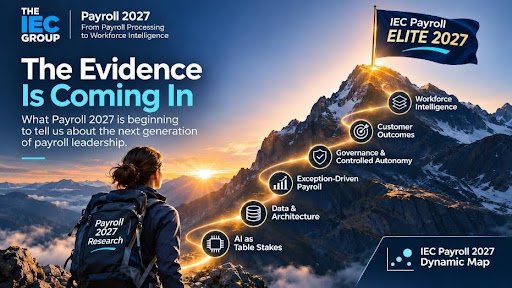
IEC began with more than 100 payroll and workforce-technology providers. Thirty emerged as current front-runners for 25 places in the IEC Payroll Elite 2027. Those providers will ultimately be positioned on the IEC Payroll 2027 Dynamic Map.
The final scoring is not complete and no final positioning has been decided. But several findings are becoming increasingly difficult to ignore. And some challenge the traditional way the payroll market has been understood for years.
There may no longer be one payroll market
The payroll market used to be relatively easy to categorize. There were global payroll providers, regional specialists, payroll software companies, HCM suites and outsourcing organizations. More recently, Employer of Record and global-employment providers entered the picture.
Those labels still describe where companies came from. They are becoming much less useful for describing where they are going.
Established payroll providers are introducing AI agents and broader workforce analytics. HCM platforms are moving deeper into payroll operations. Global employment companies are adding native payroll, payments and workforce infrastructure. Payroll specialists are building orchestration and intelligence layers. Independent technology platforms are attempting to create global Payroll Systems of Record without necessarily replacing local payroll engines.
The result is not simply a larger payroll market. It is a market whose traditional boundaries are dissolving.
For enterprise buyers, that means providers that historically would not have competed in the same sourcing process increasingly may.
The more useful question is no longer: What kind of payroll provider are you?
It is: Which part of the future payroll operating model can you credibly own?
That distinction will matter significantly in determining the IEC Payroll Elite 2027.
AI is becoming table stakes
At the beginning of Payroll 2027, artificial intelligence looked as though it might become one of the clearest differentiators between providers. The research increasingly suggests the opposite. AI is becoming ubiquitous.
Large incumbents are introducing payroll agents, copilots and variance analysis. HCM companies are deploying agents across HR, finance, time and payroll. Newer challengers are embedding AI directly into cloud-native platforms. Specialists are applying machine learning to validation, compliance and exception management.
Soon, virtually every serious provider will be able to say: “We have AI.”
That statement alone will have little analytical value.
The real differentiation begins with what happens next.
- Can the platform identify an issue before the payroll team sees it?
- Can it explain why the issue occurred?
- Can it connect the event with time, workforce, finance or compliance data?
- Can it predict what may happen if the trend continues?
- Can it recommend what should happen next?
- And eventually, can it initiate a controlled action?
This is why IEC is increasingly moving away from measuring AI presence toward measuring intelligence maturity. AI is becoming a feature. Intelligence is becoming an operating capability.
The companies that ultimately make the IEC Payroll Elite 2027 will not do so simply because they can demonstrate AI functionality. The more important question is whether intelligence materially changes how payroll is operated.
The real battle sits underneath the AI
One of the strongest findings so far is that the quality of payroll intelligence may ultimately depend less on the AI model than on the architecture beneath it. Global payroll remains highly fragmented.
A multinational organization may operate multiple payroll engines, country-specific systems, acquired technologies, external partners and different data structures.
A modern AI interface can sit elegantly above that complexity. But it cannot automatically eliminate it. If the underlying data lacks consistency, context or common meaning, even sophisticated AI begins with an uncertain foundation.
That makes the payroll and workforce data model one of the most strategically important assets in Payroll 2027.
The strongest providers are increasingly trying to create a normalized understanding of payroll and workforce events across countries and systems.
And importantly, that may not require one global payroll engine. This creates a potentially significant change in payroll transformation strategy:
Global standardization may increasingly be possible without complete engine consolidation.
If an enterprise can create one control, data and intelligence environment above multiple payroll engines, the traditional assumption that global payroll transformation requires replacing everything underneath becomes less certain.
That may prove to be one of the most important structural developments in the market.
The intelligence layer is becoming strategic
Payroll engines remain essential. Gross-to-net calculation, statutory logic, local expertise and regulatory compliance do not disappear. But much of the operational pain surrounding payroll sits above the calculation itself.
It sits in data collection, validation, approvals, interfaces, provider coordination, exception management, reporting, reconciliation, payments and finance integration.
This creates room for an increasingly important layer above the engines: one that standardizes data, orchestrates workflow, monitors exceptions and increasingly applies intelligence across the process.
Different categories of providers are now competing to own this layer.
Traditional payroll companies want to extend upward.
HCM platforms want to extend downward.
Global employment companies want to combine payroll, employment and payments.
Independent orchestration platforms want to create a control environment across multiple engines and providers.
This suggests an important structural development:
Payroll architecture may become more modular even as the user experience becomes more unified.
The technology underneath may remain complex.
The enterprise should increasingly not have to experience that complexity.
Incumbents and challengers face opposite problems
The Payroll 2027 evidence also challenges simplistic assumptions about disruption.
Established providers remain formidable.
They possess deep compliance expertise, enormous payroll histories, trusted enterprise relationships, global delivery organizations and vast amounts of workforce data.
In an AI environment, those are valuable assets.
If incumbents can normalize their historical data and make it available to a modern intelligence layer, scale becomes more than a commercial advantage.
It becomes an intelligence advantage.
But the transformation challenge is substantial.
Their platforms may span acquisitions, multiple technology generations and different country architectures.
The problem is therefore not age.
It is whether historical complexity can be converted into modern context.
The challengers face almost the opposite problem.
They often begin with cleaner architectures, unified data models, modern APIs and greater development speed.
But payroll is built on thousands of regulatory, contractual and operational exceptions that cannot simply be designed away.
The incumbents must simplify complexity.
The challengers must accumulate complexity without losing architectural coherence.
That may ultimately be more useful than the traditional “old versus new” distinction.
Who can combine operational depth with architectural coherence?
That is one of the questions that will help determine the IEC Payroll Elite 2027.
Country coverage is becoming a weaker proxy for leadership
Country coverage remains operationally important. But it is becoming a less useful proxy for technology leadership. Two providers may support the same number of countries while delivering completely different global experiences.
One may normalize data, workflows and controls consistently across native and partner payrolls. Another may simply aggregate local providers behind a common interface.
The better question is therefore no longer simply: How many countries do you support?
It is: How consistently can you control, understand and apply intelligence across those countries?
This is why country coverage should not determine leadership on the IEC Payroll 2027 Dynamic Map.
Coverage tells us where a provider can operate.
It tells us much less about how intelligently it can operate there.
The next productivity breakthrough may be exception-driven payroll
The research also reinforces our view that autonomous payroll is unlikely to mean payroll without humans.
The more realistic destination is exception-driven payroll.
Normal transactions should increasingly flow without intervention.
Technology identifies what is unusual.
Intelligence investigates the reason.
Low-risk issues may be corrected automatically.
Higher-risk cases are escalated with explanation, context and recommended action.
This suggests a new way of thinking about payroll efficiency.
Historically, organizations measured processing time, cost per payslip and accuracy.
Increasingly, they may also need to ask:
How much of payroll still requires human intervention?
That may reveal more about real automation maturity than an AI demonstration.
A provider may have sophisticated technology while customers continue reconciling spreadsheets manually.
Another may quietly eliminate large amounts of routine work.
The objective is not zero human involvement.
It is: Zero unnecessary human involvement.
That could become one of the defining productivity measures of the next generation of payroll.
More autonomy requires more governance
The more capable payroll AI becomes, the more important governance becomes. When AI retrieves information, the risk associated with an incorrect answer may be manageable. When it recommends changing somebody’s pay, the stakes increase.
When it executes the change or initiates a payment, authority, explainability and auditability become fundamental.
The most advanced payroll platform may therefore not be the one that allows AI to do the most.
It may be the one that allows AI to do the: Most that the enterprise can safely trust.
That means defined permissions, human approval where appropriate, traceable source data, confidence thresholds, escalation rules and complete audit trails.
In payroll, governance may therefore become an enabler of innovation rather than a constraint on it.
For the IEC Payroll Elite 2027, controlled intelligence will matter more than uncontrolled autonomy.
Customer behavior may become the strongest evidence
Perhaps the most important lesson from the research so far is that provider claims are becoming increasingly difficult to differentiate. Customer behavior is not.
- If Workforce Intelligence is genuinely transforming payroll, customers should operate differently.
- Payroll teams should investigate fewer routine exceptions.
- Finance should receive reliable workforce-cost information faster.
- Employees should receive explanations more quickly.
- Compliance risks should be identified earlier.
- More payroll should flow without intervention.
- And management should be able to make decisions that were previously difficult because payroll information arrived too late or lacked context.
This is why one of IEC’s most important research questions is becoming:
What can the customer stop doing — or begin doing — because this capability exists?
That may tell us more about transformation than a feature list. It also provides a stronger test of whether AI and automation have moved from product capability to measurable enterprise value.
What this means for the IEC Payroll 2027 Dynamic Map
These findings are influencing the final methodology. The Dynamic Map cannot become another measure of company scale disguised as technology analysis. Nor should it reward compelling innovation narratives that have not yet survived enterprise reality.
That is why IEC separates three dimensions.
- Enterprise Scale determines bubble size. This reflects installed base, organizational scale, customer footprint and enterprise delivery maturity.
- Market Impact & Customer Adoption determine horizontal position. This measures adoption, customer evidence, momentum and the provider’s ability to influence the market.
- Validated Workforce Intelligence Maturity determines vertical position. This evaluates whether the provider is progressing beyond processing and automation toward context, prediction, recommendation and controlled action.
The separation matters. A very large provider can have one of the largest bubbles while remaining below the Workforce Intelligence threshold.
A smaller provider may demonstrate advanced intelligence but remain further left because adoption and enterprise maturity are still developing.
Only providers combining validated intelligence with meaningful market impact and customer adoption should qualify as Workforce Intelligence Leaders.
That may produce a relatively small leadership group.
That would make leadership more meaningful, not less.
The IEC Payroll Elite 2027 is not a conventional Top 25
The IEC Payroll Elite 2027 should not be interpreted as a simple league table of the 25 largest payroll companies. Nor is it intended to reward the loudest innovators.
The objective is to identify the providers most relevant to the transition from Payroll Processing to Workforce Intelligence.
Different companies may qualify for different reasons. Some may possess extraordinary enterprise scale and operational depth. Others may be redefining architecture. Some may demonstrate unusually advanced intelligence. Others may create new models of orchestration, payroll control or workforce data management.
What matters is whether the provider has established a credible position in the emerging payroll operating model.
The Dynamic Map will then show how those providers differ.
That is more useful than pretending one number can capture every dimension of leadership.
The research is changing the question
When Payroll 2027 began, the obvious question was: Who are the next leaders in payroll?
The research increasingly suggests that a more important question is:
What kind of company will be capable of leading the next payroll market?
- Will it be a global payroll incumbent that successfully transforms its installed base?
- An HCM provider that turns broader workforce context into payroll intelligence?
- A cloud-native challenger that reaches enterprise scale without recreating legacy complexity?
- A global employment company combining payroll, employment infrastructure and payments?
- An independent orchestration platform separating global control from local execution?
- Or a model that does not yet fit neatly into any traditional category?
That is what makes the next phase of Payroll 2027 especially interesting. We are not simply comparing companies inside an established market. We may be watching the structure of the market itself change.
From hypothesis to evidence
The previous Rebel’s Digest articles developed a series of hypotheses. Payroll leadership is changing. AI alone does not create Workforce Intelligence.
The giants must reinvent. The challengers must scale. Autonomous payroll requires controlled autonomy. The intelligence layer may become more strategic than the underlying engine. And enterprise buyers need to ask different questions. The evidence now suggests that these developments are connected.
Payroll is evolving from a predominantly transactional system toward something broader: A controlled data and intelligence environment around the economics of work.
Calculation remains essential. Compliance remains essential. Service remains essential. But increasingly, they are the foundation rather than the destination. The next layer is context. Then intelligence. Then action.
That is the transformation Payroll 2027 is designed to measure.
And it is what will ultimately determine which providers qualify for the IEC Payroll Elite 2027, where they are positioned on the IEC Payroll 2027 Dynamic Map, and which can credibly be described as Workforce Intelligence Leaders.
Which providers can turn payroll reliability into context, context into intelligence, and intelligence into measurable enterprise value?
The evidence is beginning to tell us.
Payroll 2027: From Payroll Processing to Workforce Intelligence
The IEC Group is now moving into the next phase of the Payroll 2027 research and the final assessment of providers for the IEC Payroll Elite 2027.
The current findings remain provisional and do not constitute final Elite 25 selection or Dynamic Map positioning.
Providers that believe IEC is missing material developments in their technology, architecture, market position, customer adoption or Workforce Intelligence capabilities can still provide additional evidence.
Participation remains free of charge.
The first phase of Payroll 2027 asked where payroll is going. The evidence is now beginning to show what it will take to lead it.

