
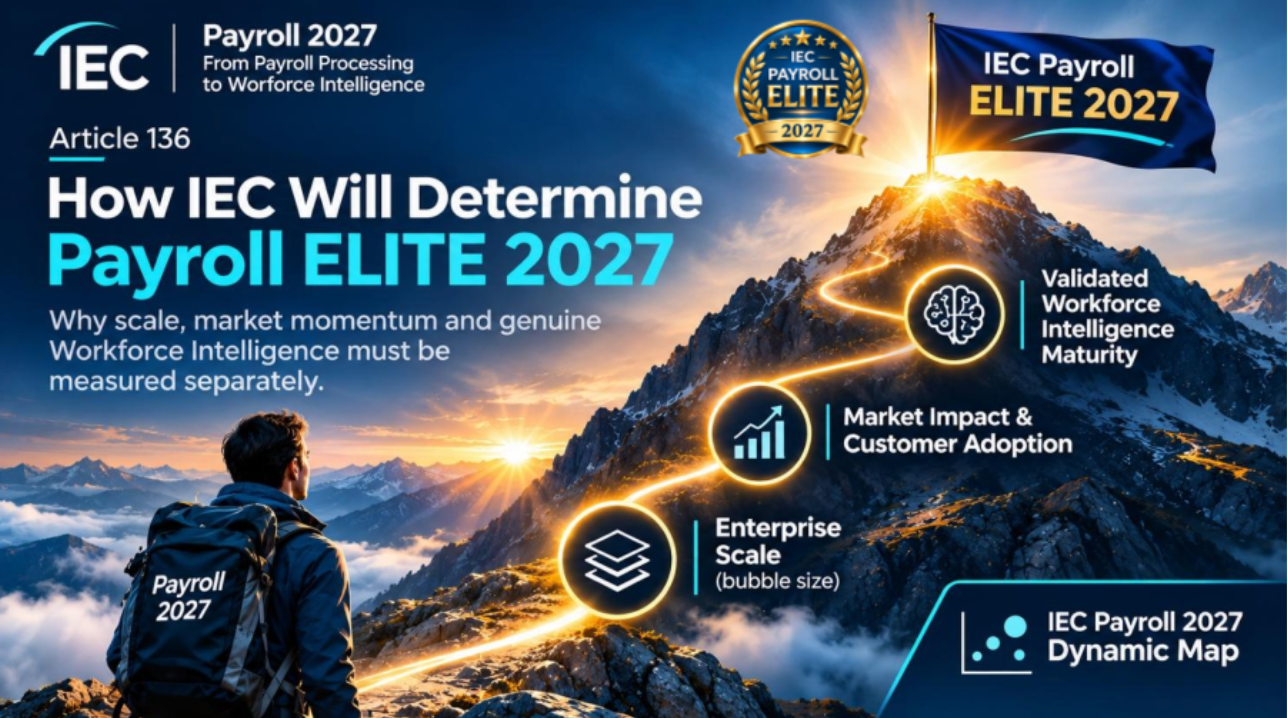
Why scale, market momentum and genuine Workforce Intelligence must be measured separately
The last Rebel’s Digest asked a simple question: Who will qualify for IEC Payroll ELITE 2027?
The next question is more important. How should they be judged?
That sounds straightforward. It is not.
Payroll analyst assessments have traditionally rewarded some combination of company scale, country coverage, installed base, service capability, product breadth and brand strength. Technology rankings often add innovation, cloud architecture and, increasingly, AI.
All of those things matter.
But if Payroll 2027 is really about the transition from payroll processing to Workforce Intelligence, they cannot simply be blended into one score.
A provider can be enormous without being intelligent. A newer company can be technologically impressive without yet proving enterprise resilience. A global payroll platform can have broad coverage without creating consistent global control. And an HCM platform can have extraordinary AI capability while still lacking sufficient payroll depth.
IEC Payroll ELITE 2027 is therefore being designed around a different principle:
Scale should be measured as scale. Market adoption should be measured as adoption. Intelligence should be measured as intelligence.
Only then can we see who is actually leading the next payroll market.
This is not a conventional Top 25
IEC Payroll ELITE 2027 is not intended to be a league table of the 25 largest providers, nor a list of the companies making the most ambitious technology claims.
The purpose is to identify the providers most relevant to the market’s transition from Payroll Processing to Workforce Intelligence.
That immediately creates an important distinction.
A company can qualify for the ELITE because it is strategically important to the future market without necessarily occupying the same position as another ELITE provider.
One may be a huge global platform with exceptional enterprise delivery. Another may be redefining payroll architecture. A third may be demonstrating unusually advanced intelligence. A fourth may be creating a new orchestration model above multiple payroll engines.
The final IEC Payroll 2027 Dynamic Map is designed to show those differences rather than hide them inside a single ranking.
Three dimensions, deliberately separated
The IEC Payroll 2027 Dynamic Map separates three dimensions that are too often mixed together.
The vertical axis measures Validated Workforce Intelligence Maturity.
The horizontal axis measures Market Impact & Customer Adoption.
Bubble size represents Enterprise Scale.
This separation is fundamental.
A large installed base does not move a provider upward. Rapid growth does not automatically create Workforce Intelligence. And an impressive AI demonstration does not make a provider enterprise-scale.
The model forces each company to earn its position on each dimension independently.
Validated Workforce Intelligence Maturity
The vertical axis represents perhaps the most important change in the methodology because it is where the future of payroll is being tested.
IEC is not measuring whether a provider has AI, analytics or dashboards. Those capabilities are rapidly becoming universal.
The question is whether the platform is progressing through a much more demanding maturity journey:
Payroll Processing → Connected Payroll → Intelligent Payroll → Workforce Intelligence
At the lower end, technology calculates, processes and reports.
At the connected stage, payroll data becomes easier to integrate, normalize and move across systems.
At the intelligent stage, the platform begins to detect anomalies, diagnose causes and predict outcomes.
Workforce Intelligence begins when those capabilities extend beyond payroll itself: connecting payroll with time, HCM, finance, payments, compliance and workforce planning, and translating that context into recommendations or governed action.
The distinction matters because reporting is not intelligence.
A dashboard can tell a CFO that overtime costs increased by 14 percent.
An intelligent platform should help explain why, identify where the change originated, assess whether it is likely to continue and show what action should be considered.
That is a fundamentally different capability.
The Payroll Foundation Gate comes first
There is, however, a critical qualification before any provider can be rewarded for intelligence.
Payroll still has to work.
IEC therefore applies a Payroll Foundation Gate before advanced intelligence can become meaningful.
Reliable calculation, statutory compliance, security, auditability, data integrity, operational accountability and sufficient delivery depth remain prerequisites.
This matters particularly as the boundaries of the market dissolve.
A provider cannot bypass payroll fundamentals simply because it has an advanced AI layer. A broad HCM platform cannot substitute workforce analytics for proven payroll execution.
Equally, a highly reliable payroll processor does not become an intelligence leader simply because its core operation is excellent.
The future requires both.
Trust is the foundation. Intelligence is what can be built on top of it.
The Workforce Intelligence Gate
Above the foundation sits a second and more demanding threshold: the Workforce Intelligence Gate.
A provider should only cross that gate when IEC sees sufficient evidence that intelligence is operating in real workflows rather than existing primarily in presentations, isolated demonstrations or roadmap statements.
The assessment considers the quality of the data foundation, AI embedded in live payroll workflows, diagnostic and predictive capability, prescriptive recommendations, governed action, cross-domain workforce and financial intelligence, explainability, auditability and measurable customer adoption.
The important word is validated.
A provider may have a highly credible vision for autonomous payroll. That matters directionally.
But a roadmap cannot be scored as though it were already a production capability.
Market Impact & Customer Adoption
The horizontal axis answers a different question.
Even the most advanced technology has limited market significance if customers are not using it.
IEC therefore separates innovation from adoption.
Market Impact & Customer Adoption reflects enterprise references, customer traction, retention signals, competitive momentum, market awareness, evidence of adoption and the provider’s ability to influence how buyers think about payroll.
This creates an important distinction between an Intelligence Innovator and a Workforce Intelligence Leader.
Both may have advanced technology.
The difference is whether that capability has achieved sufficient customer adoption and market impact to become consequential.
That prevents the Dynamic Map from confusing technological potential with established leadership.
Enterprise Scale belongs in the bubble
Scale matters enormously in payroll.
Running payroll reliably for large organizations across multiple jurisdictions is difficult. Enterprise operations, service delivery, regulatory expertise and resilience cannot be dismissed simply because they are not fashionable technology metrics.
But scale should not distort the intelligence assessment.
That is why it is represented by bubble size rather than vertical position.
The Enterprise Scale proxy considers the installed customer and employee base, payroll footprint, recurring-revenue signals where available, organizational size and global enterprise delivery maturity.
The consequence is deliberate.
A global incumbent may appear as one of the largest bubbles on the map while sitting below the Workforce Intelligence Gate.
A younger provider may appear much smaller but sit significantly higher because its architecture and intelligence are more advanced.
Neither outcome is a contradiction. It is exactly what the model is designed to reveal.
Four very different destinations
The Dynamic Map will ultimately distinguish four broad positions.
Workforce Intelligence Leaders combine validated intelligence maturity with meaningful market impact and customer adoption.
Intelligence Innovators demonstrate advanced intelligence or new architectural models but have not yet reached the same level of enterprise adoption or market penetration.
Scaled Payroll Platforms possess substantial market presence and proven delivery, but the current evidence does not yet support Workforce Intelligence leadership.
Payroll Platforms & Specialists remain relevant providers with more focused scale, market reach or intelligence maturity.
These are not judgments about whether a company is “good” or “bad”.
They describe where the provider currently sits in the transformation of the market.
And importantly, companies can move.
Evidence matters more than narrative
One of the most difficult aspects of technology research today is separating capability from marketing.
Almost every provider can produce an impressive AI story.
That makes the evidence hierarchy particularly important.
IEC will give greatest weight to capability operating in production and validated through customers. Generally available capabilities demonstrated in real workflows follow. Provider-reported capability is considered but requires stronger validation. Preview or limited-availability functionality carries less weight. Roadmap announcements help us understand direction, but they are not treated as delivered capability.
The same principle applies to outcomes.
“AI-powered payroll” is a claim.
Showing that customers reduced manual investigation, detected errors before payroll close, shortened exception resolution, improved workforce-cost visibility or automated governed actions is evidence.
Payroll 2027 is designed to reward the second.
Origin will not determine destination
The research deliberately avoids ranking providers according to where they came from.
Traditional payroll provider. HCM platform. EOR company. Global employment platform. Payroll orchestration specialist. Regional provider.
Those labels can explain history. They should not determine leadership. Nor will IEC automatically reward a provider because it owns payroll engines in more countries, or penalize another because it orchestrates third-party engines.
The more important questions are whether the model creates control, consistency, accountability and intelligence for the enterprise.
The future payroll market may support several successful architectures. The Dynamic Map should reveal which ones are working rather than assume in advance which model must win.
What this means for enterprise buyers
The result will not be a universal “best payroll provider” list. That would be misleading.
An enterprise seeking deep multi-country managed payroll may require a different partner from a company seeking a global orchestration layer. An organization already standardized on a major HCM suite may make different architectural choices from a company trying to preserve local payroll providers while gaining global control.
The value of the map is therefore not simply who appears furthest to the upper right.
It is understanding what kind of leadership each provider represents and whether that leadership fits the buyer’s target operating model. This is also why the research increasingly asks a different procurement question:
Which layer of payroll do you want the provider to own?
- Execution?
- Global control?
- Data?
- Payments?
- Intelligence?
- Or the full stack?
That question may become more useful than the traditional search for one vendor category.
From recognition to proof
The next phase of Payroll 2027 will move from market-level findings toward final provider assessment.
IEC is using public research, executive discussions, product evidence and provider and user input to validate where each company belongs.
Providers will not score themselves. Company size will not guarantee leadership. Participation will not buy positioning. And non-participation will not automatically exclude a provider where sufficient evidence is available elsewhere.
The purpose is not to manufacture a ranking. It is to create a defensible picture of a market in transition. That also means the final map may produce uncomfortable results.
Some of the largest companies may sit below the Workforce Intelligence Gate. Some of the most innovative companies may remain further left because adoption has not yet caught up with capability. And the group of true Workforce Intelligence Leaders may be smaller than the industry expects. That is precisely why the methodology matters.
The question Payroll 2027 is trying to answer is no longer simply who can process payroll at global scale.
It is: Who can combine payroll trust, architectural coherence, market adoption and validated intelligence strongly enough to lead the next generation of payroll?
That is what it should take to qualify for IEC Payroll ELITE 2027.
Payroll 2027: From Payroll Processing to Workforce Intelligence
The IEC Group is now completing the next phase of provider validation for IEC Payroll ELITE 2027 and the IEC Payroll 2027 Dynamic Map.
Providers that believe IEC is missing material developments in their technology, customer adoption, architecture or Workforce Intelligence capabilities can still provide evidence.
Participation in the study remains free of charge. pm@theiecgroup.com
The purpose of Payroll ELITE 2027 is not to reward who was strongest in the old payroll market. It is to identify who is best positioned to lead the new one.
About The IEC Group
The IEC Group is the leading fully integrated research, advisory and consulting company for mid-sized and large organizations, maximizing the business value of their international expansion initiatives through innovative, neutral and independent expert advice and membership approach. The IEC Group offers a membership subscription service, consulting services, market surveys, vendor rating, conferences, round tables, web casts and publications related to international expansion, human resource issues, as well as technology trends. Our Membership includes unlimited access to our global expansion experts as well as strategy consulting and sourcing support. For more information please contact our office or send us an Email to pm@theIECgroup.com

