
APIs, Licenses, Audit Trails: What Global Workforce Compliance Really Looks Like
Introduction
 Global workforce management used to be an operational topic. A back-office conversation. A question of payroll vendors, HR processes, and whether Legal could tolerate the risk.
Not anymore.
In 2026, global workforce management is turning into something else entirely: a regulated product category. And the winners won’t be the loudest platforms or the cheapest providers. They’ll be the organizations that build (and can prove) a compliance stack—a real, auditable infrastructure that survives scrutiny across jurisdictions, worker types, and operating models.
The market has entered a new era. “We’re compliant” is no longer a marketing line. It’s a claim that needs evidence.
Compliance Isn’t a Feature. It’s the Operating System.
Most HR tech companies still treat compliance like a module. A checkbox. A legal review at the end of a workflow.
But in cross-border employment, compliance is the workflow.
It dictates:
- whether you can legally hire in a country at all
- which contracts you can use and what must be in them
- how termination works, what it costs, and what documentation is required
- whether you need labor leasing licenses or local registrations
- what data you can store where, and who can access it
- how benefits must be structured, taxed, and reported
- whether your “contractor” is actually an employee—legally speaking
Compliance is not the paint on the car. It’s the engine block.
And once you operate at scale, the engine gets tested—by regulators, auditors, clients, and increasingly by employees themselves.
The Rise of the Compliance Stack
 So what is the compliance stack?
Think of it as four layers that must work together—across every country you support.
1) Legal Infrastructure Layer
This is the “can you legally do business here” foundation.
- Direct entities vs. partners: Who is the actual employer? Who signs? Who carries liability?
- Licensing & registrations: In many jurisdictions, employment services require registration or licensing (and enforcement is rising).
- Local representation: Whether you have real in-country expertise or a PDF summary plus a partner phone number.
In today’s market, buyers increasingly ask a brutal question: “Who is holding the risk in-country—really?”
If the answer is vague, the platform might be sleek, but the model is fragile.
2) Employment Compliance Layer
This is where the model becomes real. The employment life cycle is a chain of regulated moments.
- compliant contract generation with required clauses
- worker classification decisions and documentation
- onboarding steps (right-to-work, required notices, local policies)
- payroll and tax setup aligned with local rules
- benefits enrollment reflecting statutory and customary requirements
- offboarding workflows (notice, severance, cause, documentation)
This layer isn’t “HR admin.” It’s regulated employment execution.
And it’s the layer where a surprising number of EOR and workforce providers quietly fail—not because they’re malicious, but because they scale faster than their legal reality can support.
3) Controls & Audit Layer
This is where global workforce management starts to resemble a financial services product.
If you cannot prove compliance, you don’t have compliance.
Leading buyers now expect:
- documented controls and processes (who approves what, when, and why)
- audit trails for key actions (classification decisions, contract amendments, policy acknowledgements)
- SLA alignment and incident management
- risk registers and escalation frameworks
- vendor oversight and partner controls (especially for partner-led countries)
This isn’t theoretical. Enterprises are formalizing global workforce audits the way they audit data security or financial controls. HR is catching up to the reality that “people risk” is business risk.
4) Integration & Data Layer
The compliance stack fails when data is fragmented.
If your EOR platform is not integrated into the broader HR stack, then:
- the HRIS holds one truth
- payroll holds another
- the EOR system holds a third
- and Legal is stuck reconciling conflicts after something breaks
This is why Integration & API coverage is no longer a nice-to-have. It’s compliance infrastructure.
A modern compliance stack must connect into:
- HRIS / HCM (core employee data, org structure, lifecycle events)
- ATS (offers, onboarding start points, requisition governance)
- Identity/access management (who can see what, and why)
- Finance/ERP (cost allocation, approvals, entity/cost center controls)
- Document management (contract versions, policy acknowledgements, audit evidence)
In other words: global workforce compliance is now an interoperability problem as much as a legal one.
Why This Is Happening Now
Three forces are colliding—and together they turn workforce management into a regulated product.
1) Regulatory tightening on worker classification
Misclassification enforcement is rising across mature markets and emerging regions alike. The “contractor-first” playbook is under pressure. More companies are moving to EOR not because they love it—but because they can’t afford the alternative risk.
And crucially: regulators increasingly look beyond the contract to the reality of control and integration. If your business treats a worker like an employee, the label won’t save you.
2) Remote work became permanent… and messy
Remote work was sold as borderless freedom. In practice, it created:
- permanent establishment risk
- tax and social contribution complexity
- employment law exposure in places where companies never intended to “operate”
- employee relations challenges across cultures and legal systems
EOR became the default bridge—but only the providers with deep compliance infrastructure can handle the complexity at scale.
3) Procurement and Legal have arrived
EOR used to be bought by HR with urgency. Now it’s bought with scrutiny.
Enterprise buyers increasingly demand:
- entity maps and partner transparency
- licensing and compliance proof points
- SOC/ISO-style controls (or equivalents)
- API and integration capabilities
- SLAs that match the operational reality
The EOR market is maturing—fast. And the bar is rising.
The New Buyer Question: “Show Me the Proof”
This is the turning point.
The old sales narrative was: “We cover 180 countries. We onboard fast. We’re compliant.”
The new buyer narrative is: “Show me your licensing coverage. Show me your entity strategy. Show me your audit trail. Show me how you manage terminations. Show me your partner controls. Show me your integration model. Show me your audit certification!”
And this is exactly why the market is splitting into two camps:
- Providers building defensible compliance infrastructure
- Providers selling coverage and speed—until the first serious audit hits
Where AI Fits in the Compliance Stack
AI is entering global workforce management aggressively—but it’s not replacing compliance. It’s changing how compliance is delivered.
Done right, AI can improve:
- onboarding workflow automation and document completeness
- payroll anomaly detection and reconciliation
- policy mapping and change alerts
- support case routing and resolution speed
- risk scoring across countries, worker types, and actions
But here’s the trap: AI can also create compliance risk if it becomes a black box.
The winning model is not “AI decides.” The winning model is AI assists, humans approve, audit trails prove.
If a provider claims “AI compliance,” the right question is: “Where is the accountability and evidence?”
Because in regulated execution, the only thing worse than slow compliance is invisible compliance.
The Most Underrated Compliance Battleground: Offboarding
Everybody talks onboarding speed. Almost nobody talks offboarding correctness.
But terminations are where risk concentrates:
- statutory notice and severance
- protected classes and documentation
- union or works council involvement
- local procedural requirements
- final pay rules and timing
- documentation retention and dispute readiness
In many countries, compliant offboarding is not a workflow—it’s a process with legal consequences.
Providers that treat offboarding like a ticketing process will struggle. Providers that treat it like a regulated event—supported by local expertise and documented controls—will win enterprise trust.
What “Good” Looks Like in 2026
If global workforce management is now a regulated product, what does excellence look like?
Here’s the practical benchmark:
- Transparent legal infrastructure: clear entity ownership, partner model clarity, licensing coverage where required
- Country-specific onboarding/offboarding: localized workflows, not templates pretending to be global
- Compliance operations maturity: documented processes, SLAs tied to reality, escalation models
- Auditable execution: logs, approvals, evidence trails, and documentation governance
- Integration-first posture: APIs, HRIS/HCM connectivity, identity and finance alignment
- Responsible AI: automation with guardrails, human accountability, and traceable outcomes
- A compliance culture, not a compliance deck: real people, real escalation, real expertise
This is the compliance stack in action.
Why This Matters for the IEC Global EOR Study 2026
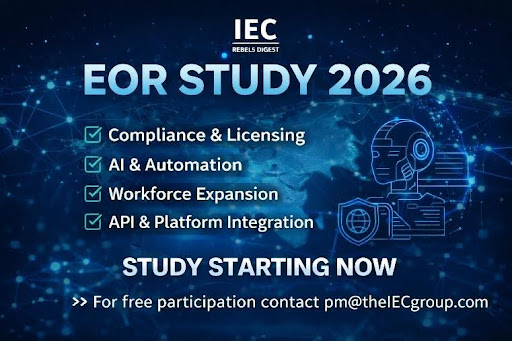 This is not just a market commentary. It’s the exact reason the IEC Global EOR Study 2026 is structured the way it is.
The study will assess providers across eight evaluation categories that reflect the compliance stack reality:
- Global Reach & Legal Infrastructure
- Compliance & Licensing Depth
- Tech Stack & Platform Maturity
- AI & Process Automation
- Client Experience (CX)
- Employee Experience (EX)
- Integration & API Coverage
- Innovation & Market Differentiation
And yes—there will be visibility into who ranks strongest across these categories, alongside insights into rising disruptors and the strategic direction of the market.
Because in 2026, “EOR provider” is not a uniform label. The gap between providers is widening—and the winners will be those who can prove compliance as infrastructure, not claim it as a feature.
A Final Reality Check
Global workforce management is no longer just about hiring talent abroad. It’s about building a defensible employment operating model across legal regimes—and doing it with speed, transparency, and integration.
That is a regulated product challenge.
And that’s why the EOR market is heading toward a compliance-led shakeout.
The platforms that win won’t simply help companies hire globally. They will help companies stand up to scrutiny globally.
Free participation: EOR Study 2026
Provider participation is free of charge for qualified companies. If you want to ensure your offering is correctly positioned and represented in the market, contact:
pm@theiecgroup.com See you in the study. —The IEC Rebels Digest Team
About the IEC Rebel’s Digest
We write for the ones breaking molds, building cross-border teams, and reshaping global work. No buzzwords. Just truths, tools, and tactics for the new era of employment.
IEC Rebel’s Digest— The IEC Group can help you audit your global employment setup by identifying labor leasing risks, verifying licensing requirements, and ensuring your EOR partners meet every compliance standard—before regulators come knocking.
Last but not Least: If you’re facing challenges and wondering how others are managing similar issues, why not join The Leadership Collective Community? It’s a peer group and webcast platform designed for leaders to exchange insights and experiences.
Introducing the IEC Knowledge Network Free Membership – Your Gateway to Seamless Access!
We are thrilled to present a new service that goes beyond the ordinary download experience. In addition to offering you the ability to download the things you love, we are delighted to introduce the IEC Knowledge Network Free Membership.
The Free Membership option grants you access to our library of articles and videos, without the need for tedious registrations for each piece of content.
The publication serves as a trusted resource to support executives in their pursuit of sustainable and successful global expansion. In addition the IEC Practitioners are available to discuss your specific challenge in more detail and to give you clear advise..
Take advantage of this valuable resource to accelerate your global expansion journey

